Beauty Price Monitoring on Notino and Douglas in 15+ Countries, in English
A cosmetics company got monthly prices and promotions from 40+ beauty stores in 15+ countries, translated to English and fed into its existing import.
Learn More
Empik lists books beside electronics, toys and fashion, and sells its own stock next to third-party offers. We collect both, keyed to ISBN where a book carries one.
Plans from €169/month · Free project assessment · Reply within 1 business day
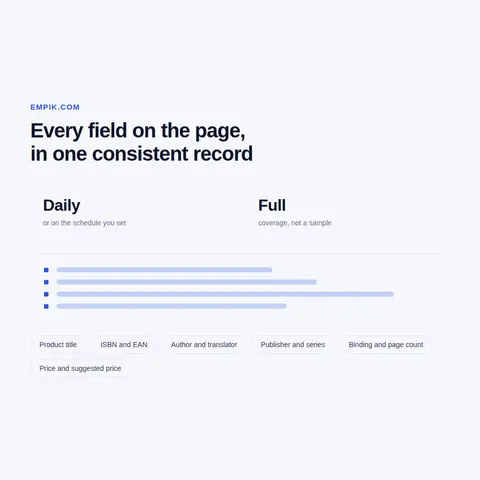
An Empik scraper we run is a scheduled job, not a one-off export. You set the scope - a publisher list, an ISBN list, a set of categories or the full book department - and the cadence. We run the crawl, normalise the fields, diff each run against the previous one and deliver CSV, JSON, XLSX, a Google Sheet, an S3 drop or a REST API your systems read on their own.
Change feeds are usually more useful than full snapshots. We can send only the rows where price, seller count, buy box holder or availability moved since the last run, which keeps daily files small enough for a spreadsheet or a BI tool with no pipeline in between.
Volume, cadence and field list are set per project. Empik price tracking across a few thousand ISBNs runs differently from a full catalogue sweep, and we size the job to the one you need.
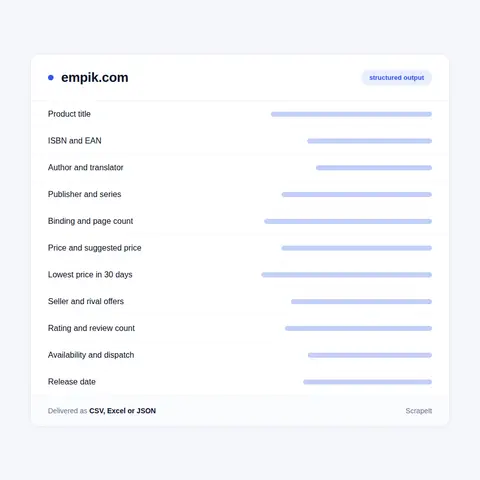
We extract the fields below from Empik by default and add more on request. Polish labels are quoted as they appear on the page, because those strings are what a crawler matches.
Collection covers public product and pricing data. No customer data is collected.
Empik publishes hub pages that most retailers do not. The sitemap index at empik.com/sitemap.xml points at separate files for author pages, publisher pages and publishing series pages, next to category and filter pages. Those hubs are a cheap way to enumerate a publisher's whole Empik presence, or to follow a series, without walking the entire catalogue.
Ranked bestseller lists are public. The books chart runs to a hundred positions with the rank printed beside each title, so a daily crawl builds a real time series of chart movement instead of a proxy assembled from sales estimates.
Pagination is worth stating plainly. Listing pages advance with a start parameter that steps in 60s, and a page parameter does not work. On 31 August 2026 a listing reporting 220745 "produktów" (products) offered a pager running to 3680 pages, which matches that total at 60 per page, so the result set is walkable rather than truncated. Sorting is set with "Trafność: największa" (best match), "Cena: od najniższej" (price, lowest first), "Cena: od najwyższej" and "Popularność: największa" (most popular). One limit is worth knowing up front: Empik Premium prices appear only after a shopper signs in, so a public crawl records the public price and nothing else.
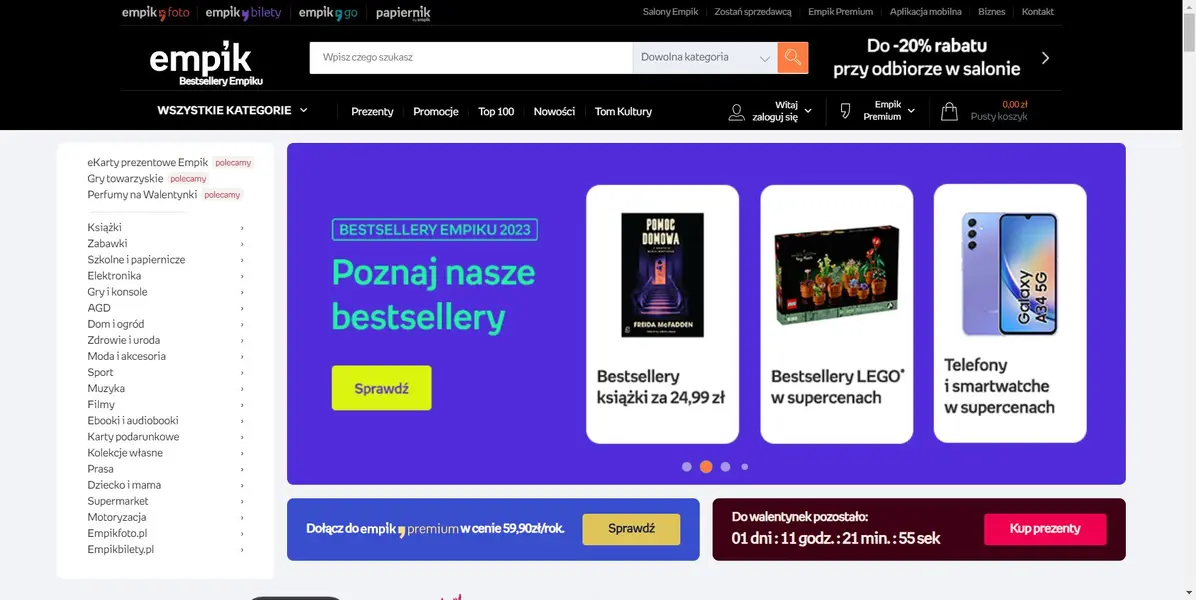
Empik is a Polish retailer built around books, music, film and press, with a salon network across the country and a large online catalogue at empik.com. That catalogue now reaches well past media into toys, electronics, fashion, stationery, home goods and beauty, but the book side still shapes the data. Empik reported 370 salons in Poland at the end of 2024 and set a target close to 400 for the year after.
Two kinds of offer share the same site. Empik sells its own stock, and EmpikPlace hosts third-party merchants who list against the same product records. A product page names its merchant outright, with a line reading "Sprzedaje firma Empik" (sold by the company Empik) when Empik itself is the seller. Where other merchants list the same item, the page carries a counter such as "Produkt sprzedają inni sprzedawcy (15)" (this product is sold by other sellers, 15 of them) together with the cheapest alternative offer. Listing pages expose a "Sprzedawca" (seller) facet that names Empik alongside individual marketplace shops.
Product URLs keep a fixed shape: a slug, a comma, the letter p with a numeric product id, then a category suffix. A book reads ,p1597338509,ksiazka-p and a toy reads ,p1431212244,zabawki-p. That id is stable and makes a clean join key for anything you store.
Get a Quote
Developers

Customers worldwide

Pages extracted

Hours saved for our clients
€199 / one-time
setup fee - included
€169 / mo
setup fee €499
€229 / mo
setup fee €499
€349 / mo
setup fee €499
€549 / mo
setup fee €799
Delivery: CSV, JSON or XLSX files, our API or a JSON feed. MCP server on request.
Full plan details →An ISBN is the reason to scrape Empik rather than treat it as one more Polish shop. The same 13 digits identify the same edition at a distributor, in a library catalogue, in a publisher's own list and at every competing bookseller. Match on it and Empik data joins cleanly to whatever else you hold, with no fuzzy title matching and no guessing about which of five reprints you are looking at. Very little of general retail hands you a key like that.
The publisher's suggested price carries the second argument. Empik prints "cena sugerowana przez wydawcę" next to the price it actually charges, so a book page holds the list price and the street price side by side. Discount depth per title, per publisher or per series falls straight out of that pair, and you never have to rebuild a reference price from history.
The third is the seller mix. Because the Empik offer and marketplace offers share one product record, a single crawl shows where Empik holds the buy box, how many merchants sit behind it and what the cheapest of them asks. For a publisher or a distributor that reads as a channel map: which titles resellers are undercutting, and where unexpected stock has surfaced.

A cosmetics company got monthly prices and promotions from 40+ beauty stores in 15+ countries, translated to English and fed into its existing import.
Learn More
A consultancy working for a fragrance brand owner got sellers, official-store flags and USD prices for 25 fragrances on about 30 marketplaces in 12 countries.
Learn More
Three Amazon US lighting categories collected in full for a lighting manufacturer, with description text and images from brand content blocks.
Learn MoreLearn how to use web scraping to solve data problems for your organization
If you sell online, run a marketplace, or advise e-commerce clients, you already know why eBay matters: it’s one of the few places where big retailers compete side by side with thousands of small merchants and private sellers.

E-commerce teams do not just need “some” competitor data anymore. They need a continuous stream of real prices, discounts, stock levels, reviews, and seller behavior from the platforms that actually shape their markets.
Amazon provides valuable information gathered in one place: products, reviews, ratings, exclusive offers, news, etc. So scraping data from Amazon will help solve the problems of the time-consuming process of extracting data from e-commerce.
ScrapeIt is a managed web scraping agency. We write the crawlers, host them, watch them and repair them when Empik changes its markup, so nobody on your side maintains scraping code. You receive data on a schedule, in the format your team already works with.
Scope, fields and delivery are agreed before we start and can be adjusted later without a rebuild. Tell us what you need from Empik and we will scope it.
Yes. The ScrapeIt Empik API returns ISBN, EAN, the price in zł, the publisher's suggested price, the seller and availability as JSON from an endpoint we host, refreshed on the schedule you set. The same data also comes as CSV or XLSX files or straight into your database. Public product and listing pages are what our crawlers read.
Yes, and it is the usual way these projects start. You send ISBNs, we resolve each one to its Empik product page, and we report back the ones with no match so your list stays honest. Formats are kept apart: a printed edition, an ebook and an audiobook of the same title sit on separate product pages with separate ids, so we flag which format each row belongs to rather than collapsing them into one line.
Product pages carry "Dostępny w salonie" (available in a salon) and, for qualifying items, "Odbierz za 2 godziny" (collect in 2 hours). That is a site-level signal about collection being offered, not a per-branch stock count. Choosing a specific salon happens inside checkout, which we do not enter. If per-store detail matters to you, say so at scoping and we will tell you plainly what the public pages support.
The product page states it. When Empik is the merchant the page reads "Sprzedaje firma Empik", and when third parties list the same item it shows a counter such as "Produkt sprzedają inni sprzedawcy" with the lowest alternative price. Listing pages carry a "Sprzedawca" (seller) facet naming Empik and individual marketplace shops. We store the seller name on every row, so you can filter to Empik's own assortment, to marketplace supply, or to both.
Cadence is a scoping decision: daily suits price and availability work, weekly or monthly suits catalogue and metadata work, and a narrow ISBN watchlist can run more often than a full department sweep. We agree it against your scope rather than quoting a fixed number. Delivery is CSV, JSON, XLSX, a Google Sheet, an S3 or SFTP drop, or a REST API, with a change feed if you would rather receive only the rows that moved.
Step 1 - Make a Request
You share your needs, expectations, and desired timeframe. We’ll suggest the best solution based on your request and budget.
Step 2 - Configuring Custom Web Crawlers
Our specialists configure the crawlers and extract a sample dataset for your review before proceeding with the full-scale extraction.
Step 3 - Collect and Deliver
Once you approve the sample, we launch the project and start full data collection. We gather, filter, and structure the data for easy use, delivering it on time in your preferred format.
Step 4 - Maintain and Support
Our team manages ongoing processes, monitors website changes, and supports all data extraction cycles. We can also help integrate data into your systems or create dashboards to simplify analysis.
Empik data from €169/month. Free project assessment, reply within 1 business day.

Scrapeit Sp. z o.o.
10/208 Legionowa str., 15-099, Bialystok, Poland
NIP: 5423457175
REGON: 523384582