The Entire Iherb Supplements Catalog, Captured End-to-End in 3 Days
Scraping supplement products from iHerb.com with full details, including descriptions and packaging variations.
Learn More
Every fnac.com product page carries a numeric prid after /a, an EAN-13, and a stack of competing marketplace offers sitting behind one displayed price.
Plans from €169/month · Free project assessment · Reply within 1 business day
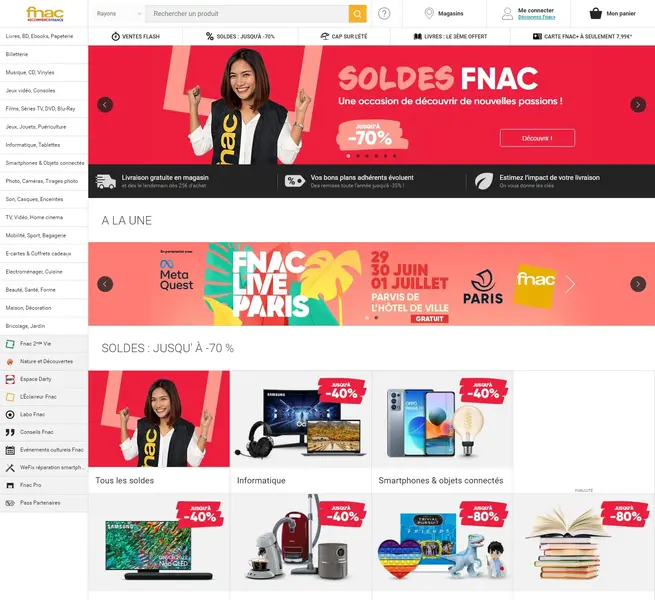
You give us a scope: a category, a list of shelf ids, a seller, a set of prids, or a list of EANs to resolve. We build the crawler, run it, and maintain it when Fnac changes the page.
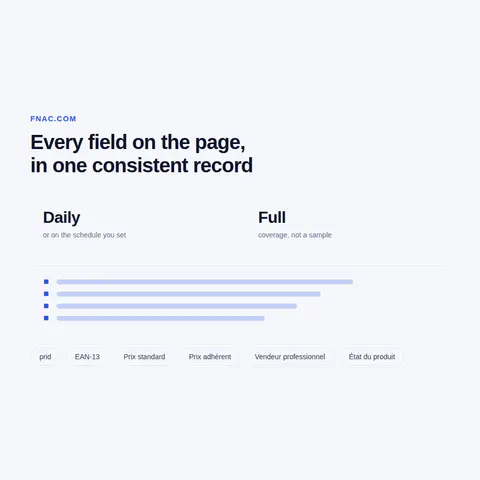
Output is CSV, JSON, XLSX or an API endpoint your systems poll. Schedules run hourly, daily or weekly depending on how fast the segment moves; marketplace offers justify a tighter cadence than book metadata.
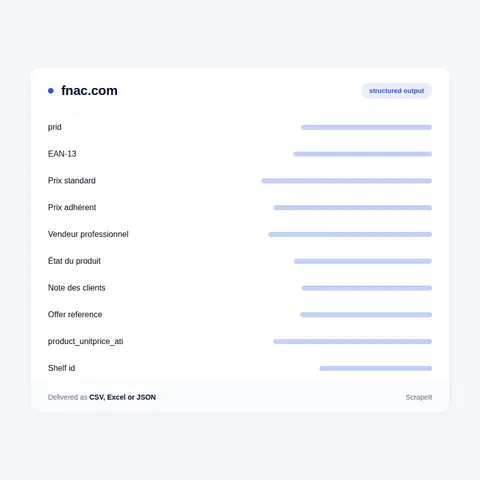
Every row carries the prid, the catalogue id and a capture timestamp, so runs join cleanly to each other and to your own catalogue. Where you already key on EANs, we deliver against gtin13 instead. Fields, delivery target and frequency are agreed before the first run and changed on request.
Fnac states its product data three times on one page: a JSON-LD Product block, the HTML buy box and an analytics layer. The three do not always agree, so we read all three and reconcile.
A one-off crawl of fnac.com has a known blind spot: the buy box names a single seller and says nothing about how long that seller has held it.
Run the same prid on a schedule and the marketplace layer becomes legible. The seller behind the default offer rotates. Across a sample of ordinary product pages taken at one point in time, the JSON-LD seller field read FNAC.COM on some and partner names such as PANAJOU, MICROMANIA and Super10Count on others, for comparable products. Which name occupies the slot on a given day is only knowable by measuring repeatedly.
Offer counts move as well. Sellers add and withdraw listings, refurbished units appear and clear, and the lowest new price and the lowest refurbished price drift apart at different speeds.
Prices carry a history the page hides. The crossed-out reference price and the selling price are separate fields, so repeated capture shows whether a discount is genuinely new or whether the reference was lifted first. Around "Ventes Flash" (flash sale) periods and Black Friday, Fnac spins up dedicated shelf ids that exist only while the event runs, and they disappear from the site afterwards.
Availability shifts with almost no visible change in the page copy, so trending the numeric product_availability code alongside product_stock is a sharper stock signal than reading the French label.
Fnac sells consumer electronics, books, music, film, board games and video games in France and several neighbouring markets. It belongs to the Fnac Darty group, formed by the 2016 merger, which also runs darty.com. The two are separate marketplaces with separate seller accounts and separate product sheets, so a Fnac dataset does not carry over to Darty.
A record on fnac.com is keyed by a numeric product reference Fnac calls the prid. It sits in the URL after the letter a, as in /Drone-DJI-Mavic-3-Gris/a16339895/w-4, and reappears in the markup as data-prid and in the page analytics layer as product_id. The trailing /w-4 segment is constant. The same grammar covers the rest of the site: category shelves use /shi352415/w-4, physical store pages use /cl88/w-4, customer reviews (avis) hang off the product path as /a16339895/avis, and products that entered through the marketplace take a second form, /mp13032608/slug/w-4, with the number ahead of the slug instead of behind it.
The prid is never a key on its own. Fnac pairs it with a catalogue id, exposed as product_ref, and publishes the joined value as product_ref_id in the form 1-16339895. Catalogue 1 is fnac.com itself.
One page is not one offer. Fnac sells first party and also hosts third-party sellers, so a single page can hold a Fnac offer, a set of partner offers, and separate new, refurbished and used tiers at the same time. Only the winning offer is rendered in the buy box; the rest sit behind a paginated offers list keyed on that same prid and catalogue pair.
Get a Quote
Developers

Customers worldwide

Pages extracted

Hours saved for our clients
€199 / one-time
setup fee - included
€169 / mo
setup fee €499
€229 / mo
setup fee €499
€349 / mo
setup fee €499
€549 / mo
setup fee €799
Delivery: CSV, JSON or XLSX files, our API or a JSON feed. MCP server on request.
Full plan details →Brands police price in France with it. Because a Fnac page carries the retailer's own offer and partner offers together, one crawl shows both the shelf price and the resale floor set underneath it. Breaches of recommended pricing usually surface on the marketplace side first, on the offers list rather than in the buy box.
Resellers use it to locate themselves. The offers list returns the whole competing set for a prid, not only the winner, so you can measure the gap to the leading offer, see which sellers hold position, and check how often a "TOP VENDEUR" (top seller) badge coincides with the default slot.
Publishers and distributors use it for catalogue coverage. Fnac search accepts an ISBN-13 directly in its Search parameter, so a title list resolves to live pages, prices and stock without manual lookup. Books, music and film are core Fnac territory, not a side category.
Category and buying teams use shelf pages for assortment. A shelf id such as /shi352415/w-4 is a stable, crawlable slice of the range, which is the practical way to answer what Fnac lists in a segment and in what price band.
Refurbishment businesses track the "reconditionné" (refurbished) and "occasion" (used) tiers, where Fnac reports a separate lowest price per condition.

Scraping supplement products from iHerb.com with full details, including descriptions and packaging variations.
Learn More
Daily scraping of lowest prices for 150K products on Allegro.pl to support marketplace pricing and margin optimization.
Learn More
Regular monitoring of Ralph Lauren clothing, footwear, and accessories sold across Amazon subdomains: AE, DE, ES, FR, IT, NL, PL, UK.
Learn MoreLearn how to use web scraping to solve data problems for your organization
If you sell online, run a marketplace, or advise e-commerce clients, you already know why eBay matters: it’s one of the few places where big retailers compete side by side with thousands of small merchants and private sellers.

E-commerce teams do not just need “some” competitor data anymore. They need a continuous stream of real prices, discounts, stock levels, reviews, and seller behavior from the platforms that actually shape their markets.
Amazon provides valuable information gathered in one place: products, reviews, ratings, exclusive offers, news, etc. So scraping data from Amazon will help solve the problems of the time-consuming process of extracting data from e-commerce.
ScrapeIt is a managed scraping team, not a library you have to operate yourself. We take on the parts that make Fnac awkward: a site with heavy bot protection, an offers list that is absent from the product HTML, French field labels that need mapping into your schema, and country sites that do not share product references.
You get maintained pipelines and clean files on a schedule. When the markup shifts, repairing it is our work rather than a ticket in your backlog.
It is the number immediately after the letter a. In https://www.fnac.com/Drone-DJI-Mavic-3-Gris/a16339895/w-4 the reference is 16339895. Fnac calls it the prid and repeats it as data-prid in the markup and product_id in the page analytics layer. It is always paired with a catalogue id, published together as product_ref_id in the form 1-16339895, where 1 is fnac.com. The slug in front of it is cosmetic and the trailing /w-4 is constant, so a URL can be rebuilt from the prid alone.
Yes. The competing offers are not present in the product page HTML. Fnac loads them from a separate paginated offers list keyed on the same prid and catalogue pair, with its own page, filter and sort parameters. We page through it and return every offer with its seller, price, shipping, condition and GUID offer reference. The all-zero GUID marks Fnac's own first-party offer, which is how you separate retailer pricing from marketplace pricing in the output.
No. Each country site runs its own reference sequence, so the same physical item has a different prid on fnac.com than on fnac.es. The two sites share no product reference. The EAN-13, exposed as gtin13, is the reliable cross-site key. The sites do share a platform: the same /a and /shi URL grammar, a per-locale sitemap index at /sitemapindex-master.xml, and language subdomains in Switzerland and Belgium such as fr.fnac.ch, de.fnac.ch and fr.fnac.be.
Yes. The ScrapeIt Fnac API returns the prid, gtin13, the standard and member prices, product_stock and every marketplace offer with its seller as JSON from an endpoint we host, refreshed on the schedule you set. The same data also comes as CSV or XLSX files or straight into your database. Fnac refuses automated clients across the board, so access is our side of the job: proxy rotation, browser rendering and adaptive pacing. Requests originating outside France and Spain are frequently refused as well. Fnac's own page configuration lists Akamai bot management cookies (_abck, bm_sz, ak_bmsc, bm_sv, bm_mi), and the site sits behind a Queue-it waiting room that can divert traffic into a queue carrying a queueittoken. Failed requests can also land on /_CustomError/500.fr-FR.htm, which returns page-shaped HTML rather than an obvious error. We treat this as an engineering and validation problem and run at conservative rates from the right region. We collect only publicly available data - everything a visitor can see on Fnac - and we collect it legally.
Yes. Fnac renders "Prix standard" (standard price) and "Prix adhérent" (member price) as two separately labelled fields for Fnac+ card holders, with "Offre adhérent" (member offer) used for promotions. An anonymous crawl always reports the page configuration flag isValidAdherent as false and the analytics segment as Non-Adherent, so what you capture is the publicly advertised member price rather than a price applied to a signed-in account. For competitive monitoring that is normally the figure you want, and both prices land in separate columns.
Step 1 - Make a Request
You share your needs, expectations, and desired timeframe. We’ll suggest the best solution based on your request and budget.
Step 2 - Configuring Custom Web Crawlers
Our specialists configure the crawlers and extract a sample dataset for your review before proceeding with the full-scale extraction.
Step 3 - Collect and Deliver
Once you approve the sample, we launch the project and start full data collection. We gather, filter, and structure the data for easy use, delivering it on time in your preferred format.
Step 4 - Maintain and Support
Our team manages ongoing processes, monitors website changes, and supports all data extraction cycles. We can also help integrate data into your systems or create dashboards to simplify analysis.
Fnac data from €169/month. Free project assessment, reply within 1 business day.

Scrapeit Sp. z o.o.
10/208 Legionowa str., 15-099, Bialystok, Poland
NIP: 5423457175
REGON: 523384582