The Entire Iherb Supplements Catalog, Captured End-to-End in 3 Days
Scraping supplement products from iHerb.com with full details, including descriptions and packaging variations.
Learn More
Snapdeal is a pure marketplace built around low price points, where every price belongs to a seller. We run the crawlers, resolve the variant and seller structure, and hand over clean rows.
Plans from €169/month · Free project assessment · Reply within 1 business day
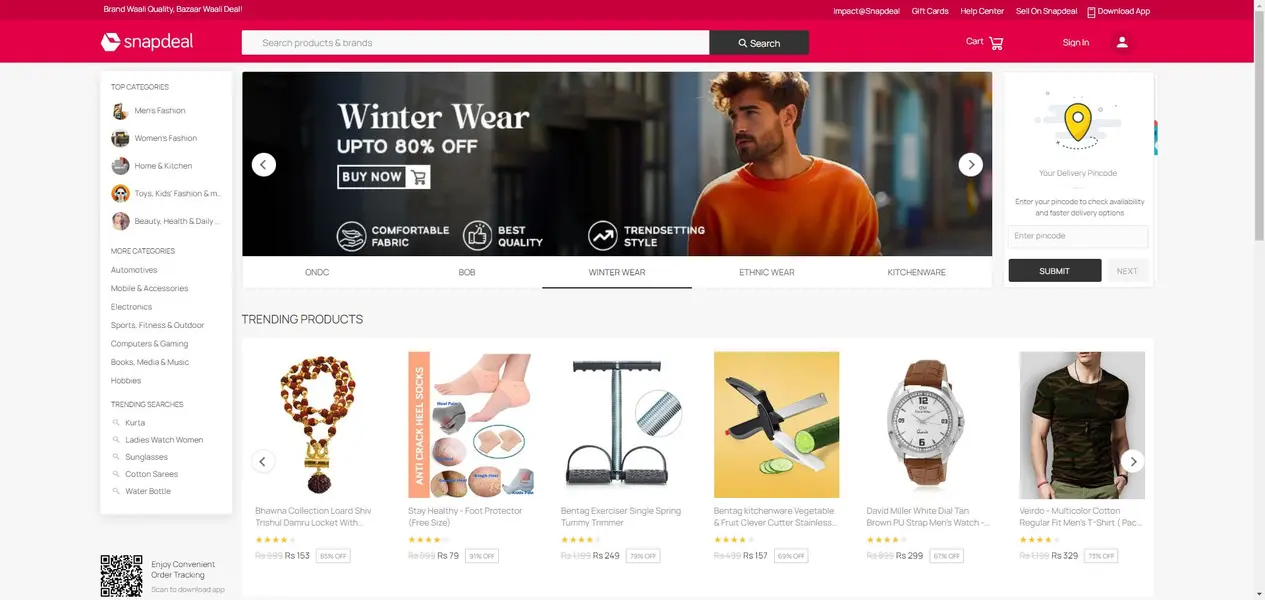
This runs as a managed service. You describe the categories, sellers or search terms that matter and the fields you need. We build the crawler, operate it on your schedule and deliver the rows.
Output is CSV, JSON, XLSX or an API endpoint your systems can poll. Daily, weekly or several times a day during sale windows, whichever the decision needs. We monitor the job, and when Snapdeal changes a template we repair the parser before it reaches your reports.
We collect only publicly available data - everything a visitor can see on Snapdeal - and we collect it legally.
A Snapdeal listing carries four identifiers at once, and they do not all agree. The page script sets them together as catalogId, supc, pogId and vendorCode. The number in the URL is the pogId, though on some listings the page configuration reports a different pogId for the same item. The SUPC is the per-variant stock code, printed on the page under Highlights as a string like SUPC: SDL206469256, and it is the key Snapdeal's own seller platform uses.
Fields we extract on a routine run:
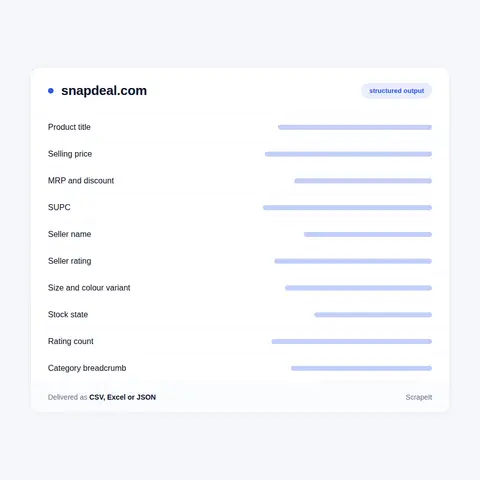
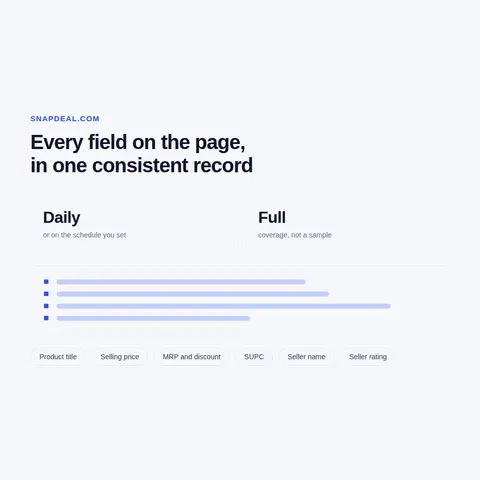
The site publishes a good deal of machine-readable structure, and it is cheaper to use than crawling blind.
One trap deserves naming. In a single category sitemap on 27 August 2026 there are 7,240 product URLs sharing only 514 distinct slugs, and a listing whose slug reads navy-blue can be a brown kurti. The slug is not an identity. Deduplicate on the numeric id and the SUPC, never on the slug or the title.
Snapdeal today is a value commerce marketplace. It holds no first-party inventory. Every listing belongs to a third-party seller, and the platform earns on the transaction rather than on stock it owns. Any price you collect is a seller's price, not Snapdeal's.
The commercial position is documented. Parent company AceVector Limited, which also holds Unicommerce and Stellaro Brands, disclosed during its 2025 listing process that more than 80 percent of Snapdeal orders were priced below Rs 599. Demand is concentrated in smaller cities rather than metros. Snapdeal's own 2022 listing attempt was withdrawn; AceVector filed again through the confidential route in July 2025 and had SEBI approval by November 2025. Describing this site as the horizontal player it was a decade ago will lead you to the wrong categories.
The catalogue shows the same shape. In August 2026, the sitemap index listed 1,433 child files and the curated collection sitemap held 1,600 landing pages. Fifty-four of those collections are explicit price bands, and the thresholds sit low: ten at under 500, seven at under 200, six at under 300. Slugs such as /collection/kurtis-below-200 and /collection/saree-under-500 are not campaign copy. They are the navigation.
Much of the assortment is unbranded or carries a seller's own label. That matters if you intend to match Snapdeal against another retailer, because there is frequently no GTIN, no manufacturer part number and no brand to join on.
Get a Quote
Developers

Customers worldwide

Pages extracted

Hours saved for our clients
€199 / one-time
setup fee - included
€169 / mo
setup fee €499
€229 / mo
setup fee €499
€349 / mo
setup fee €499
€549 / mo
setup fee €799
Delivery: CSV, JSON or XLSX files, our API or a JSON feed. MCP server on request.
Full plan details →The reason to scrape Snapdeal is that it prices differently from the rest of Indian e-commerce. Benchmark only against the large horizontal players and you never see the floor of the market. Snapdeal shows what the same category looks like at two hundred rupees, sold by a merchant nobody has heard of.
Common uses:
Snapdeal prices move for reasons that have nothing to do with the product. One seller drops off, another takes the buy position at a different price, and the listing looks unchanged apart from the number. Sampling once a month will not show you that happened.

Scraping supplement products from iHerb.com with full details, including descriptions and packaging variations.
Learn More
Daily scraping of lowest prices for 150K products on Allegro.pl to support marketplace pricing and margin optimization.
Learn More
Regular monitoring of Ralph Lauren clothing, footwear, and accessories sold across Amazon subdomains: AE, DE, ES, FR, IT, NL, PL, UK.
Learn MoreLearn how to use web scraping to solve data problems for your organization
If you sell online, run a marketplace, or advise e-commerce clients, you already know why eBay matters: it’s one of the few places where big retailers compete side by side with thousands of small merchants and private sellers.

E-commerce teams do not just need “some” competitor data anymore. They need a continuous stream of real prices, discounts, stock levels, reviews, and seller behavior from the platforms that actually shape their markets.
Amazon provides valuable information gathered in one place: products, reviews, ratings, exclusive offers, news, etc. So scraping data from Amazon will help solve the problems of the time-consuming process of extracting data from e-commerce.
ScrapeIt is a managed web scraping agency. We are not a library and not a self-service tool. We take the requirement, build and run the crawler, and hand over data that is ready to load.
Marketplaces break scrapers routinely. Templates change, fields move, identifiers get reused. Keeping a Snapdeal feed correct is continuous maintenance, and that maintenance is the service you are buying.
Yes. The ScrapeIt Snapdeal API returns the SUPC, selling price, struck MRP, discount, seller name and vendorscore as JSON from an endpoint we host, refreshed on the schedule you set. The same data also comes as CSV or XLSX files or straight into your database.
Yes. Ordinary automated requests to www.snapdeal.com are refused at the CloudFront edge, and cosmetic changes to the request do not change that. Anti-bot handling is part of the service: we render pages the way a browser does, pace requests, rotate proxies and handle CAPTCHAs. Where the site publishes machine-readable files we use those first: the sitemap index and its child files are rebuilt daily, which makes URL discovery cheap and stable.
Snapdeal is a pure marketplace, so every price on the site belongs to a merchant rather than to Snapdeal. A product page carries the seller name under the Sold by label, a seller URL in the form /seller/S76ee9, a numeric vendorscore and a field recording how many sellers offer the item. What we deliver is the seller holding the buy position at the moment of the run, with the score attached. Compare consecutive runs and seller rotation becomes visible, which is usually what people actually wanted to measure.
Use the SUPC. It is the per-variant stock code, it appears on the page under Highlights in the form SDL206469256, and it is the same key Snapdeal's seller platform uses for inventory and pricing, so it survives translation between public pages and merchant records. The number in the product URL is the pogId, which addresses a page reliably but is not always the pogId the page's own configuration reports. Do not join on the slug or the product title: in one category sitemap on 27 August 2026 there are 7,240 product URLs across only 514 distinct slugs.
Prices and stock move daily, and faster during festive periods. Sellers rotate, which changes the displayed price while the product itself stays put, so a monthly sample will read as noise. The sitemaps are rebuilt every day. For price and stock work most clients run daily and step up to several times a day inside sale windows. For assortment or catalogue mapping, weekly is normally enough. We set the schedule with you and change it when the season calls for it.
Step 1 - Make a Request
You share your needs, expectations, and desired timeframe. We’ll suggest the best solution based on your request and budget.
Step 2 - Configuring Custom Web Crawlers
Our specialists configure the crawlers and extract a sample dataset for your review before proceeding with the full-scale extraction.
Step 3 - Collect and Deliver
Once you approve the sample, we launch the project and start full data collection. We gather, filter, and structure the data for easy use, delivering it on time in your preferred format.
Step 4 - Maintain and Support
Our team manages ongoing processes, monitors website changes, and supports all data extraction cycles. We can also help integrate data into your systems or create dashboards to simplify analysis.
Snapdeal data from €169/month. Free project assessment, reply within 1 business day.

Scrapeit Sp. z o.o.
10/208 Legionowa str., 15-099, Bialystok, Poland
NIP: 5423457175
REGON: 523384582