Beauty Price Monitoring on Notino and Douglas in 15+ Countries, in English
A cosmetics company got monthly prices and promotions from 40+ beauty stores in 15+ countries, translated to English and fed into its existing import.
Learn More
A Tata CLiQ listing prices an item twice: the MRP, inclusive of all taxes, and a selling price that is often lower. Our Tata CLiQ scraper keeps both, with sizes, ratings and seller.
Plans from €169/month · Free project assessment · Reply within 1 business day
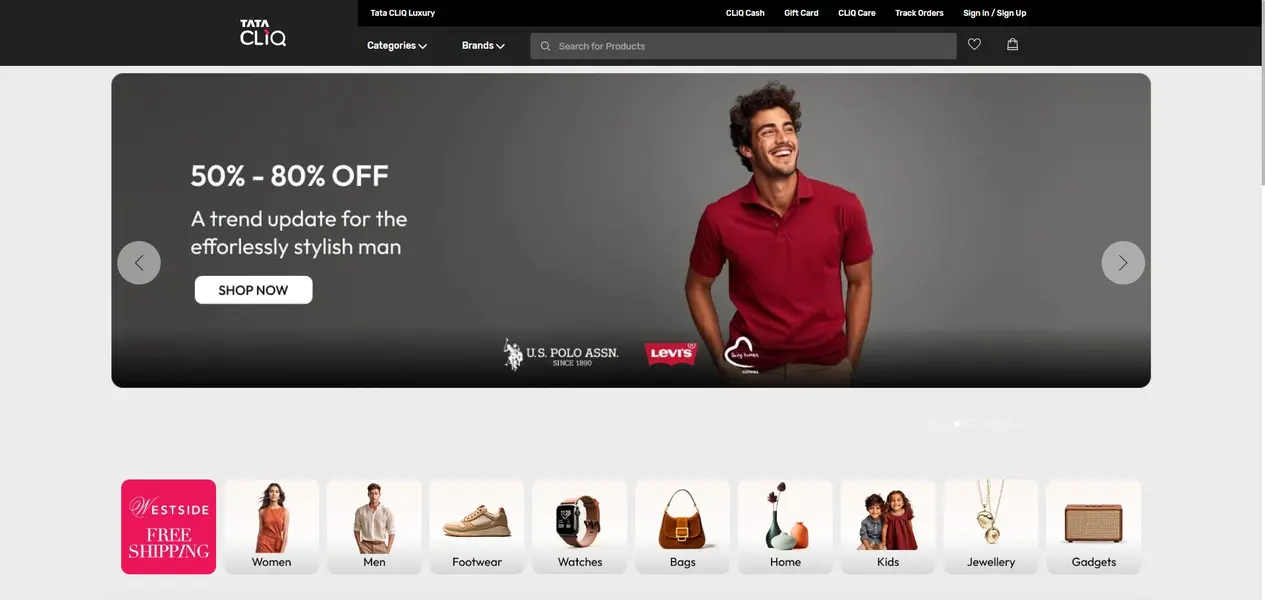
You tell us which part of Tata CLiQ matters - a brand store such as Westside, a category like women's footwear or watches, a list of product codes, or the luxury.tatacliq.com catalogue - and how often it should be read. We build the crawlers, run them and repair them whenever the storefront changes. The site answers unfamiliar traffic with a block page, so rendering, pacing, proxy rotation and CAPTCHA handling are part of the service, not something you arrange.
Runs are one-off or scheduled daily, weekly or on demand. Files arrive as CSV, Excel or JSON, or the same rows come through our API, a JSON feed or a load into your database, with field documentation and a run date on every row. The project assessment is free, and a sample can be ordered before you commit.
A Tata CLiQ product page is built around its price block: the MRP marked "Inclusive of all taxes" and, when the item is discounted, a lower selling price in rupees with a "% Off" badge for the gap. Each listing has its own product code, visible at the end of the address as p-mp followed by a long zero-padded number, and that code keeps a row stable from one run to the next.
Search results and category grids carry the core fields on every card, so a catalogue can be built from a keyword list, a category or a brand store. One block stays out on purpose: CLiQ Perks asks shoppers to log in to view their benefits, and since we never sign in, personalised offers are not part of the dataset.
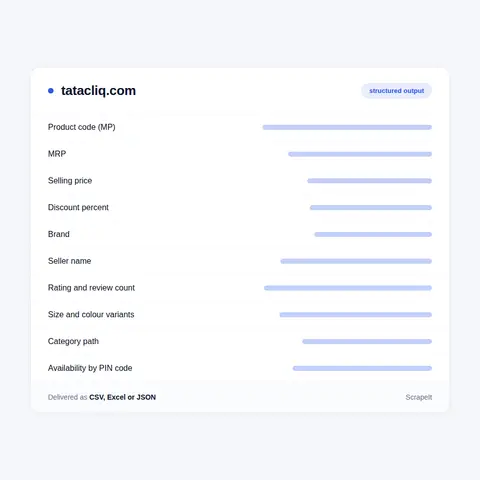
One extract shows what Tata CLiQ charges today; a schedule shows how it got there. Repeat runs keyed on the product code turn selling price, MRP and discount into a Tata CLiQ price history for every listing, so a price drop becomes a dated row, and an MRP revision shows up as a change in the reference price rather than as a new discount.
Coverage reaches past single pages. Keyword searches, category grids and brand stores such as the Westside store give the assortment view: which products a brand lists, which appear for the first time and which drop out. A colourway can sit under its own product code with its own price, so we deliver each as a row and keep colour as a field you can group on.
The same schedule runs on luxury.tatacliq.com, where a product page adds a Why It's Special note, a Selected Colour switch and a Sold By line naming the seller. Ratings and review counts can be captured on every pass too, which shows how a product's score moves after a sale event.
Tata CLiQ is the Tata group's online fashion and lifestyle store, owned by Tata UniStore Limited, registered in Mumbai. The main storefront calls itself Tata CLiQ Fashion and sells clothing, footwear, watches, jewellery, bags, beauty and home goods for women, men and kids across India. Inside it sit themed stores - CliQ Drip, the Sneaker Store, the Indie Finds Store, the Lingerie Store - and Tata CLiQ Palette for skincare, makeup and wellness.
Many sellers list on the site, so the Sold By line matters: a Westside kurta is sold by Trent Limited, a Fossil watch is sold directly by Fossil India, and a smaller label can come from an independent seller. Westside has its own brand store, and its labels - WES Casuals, Soleplay, Utsa, Vark, Zuba - list products under "by Westside" names. Product cards carry badges such as New Arrivals, Online Only and Limited stock, and search pages sort by Popularity, Price Low to High, Price High to Low, New Arrivals and Discounts.
Tata CLiQ Luxury lives on a separate host, luxury.tatacliq.com, with designer clothing, handbags, beauty and fragrances, watches and home goods from global brands and homegrown Indian labels. Both hosts use the same p-mp product code format, so rows from the two storefronts join on one key while staying labelled by source.
Get a Quote
Developers

Customers worldwide

Pages extracted

Hours saved for our clients
€199 / one-time
setup fee - included
€169 / mo
setup fee €499
€229 / mo
setup fee €499
€349 / mo
setup fee €499
€549 / mo
setup fee €799
Delivery: CSV, JSON or XLSX files, our API or a JSON feed. MCP server on request.
Full plan details →The MRP column is what makes Tata CLiQ data worth having. Every discount on the site is shown against it, so a feed with the selling price alone cannot tell a genuine cut from a quiet MRP revision. With both columns, a brand can see how deep each listing is discounted and whether that depth fits its own pricing policy.
Tata CLiQ's own Discounts and Price Low to High sorts, captured on every run, are also the quickest way to find the lowest price on Tata CLiQ for a product type and to see which seller offers it.

A cosmetics company got monthly prices and promotions from 40+ beauty stores in 15+ countries, translated to English and fed into its existing import.
Learn More
A consultancy working for a fragrance brand owner got sellers, official-store flags and USD prices for 25 fragrances on about 30 marketplaces in 12 countries.
Learn More
Three Amazon US lighting categories collected in full for a lighting manufacturer, with description text and images from brand content blocks.
Learn MoreLearn how to use web scraping to solve data problems for your organization
If you sell online, run a marketplace, or advise e-commerce clients, you already know why eBay matters: it’s one of the few places where big retailers compete side by side with thousands of small merchants and private sellers.

E-commerce teams do not just need “some” competitor data anymore. They need a continuous stream of real prices, discounts, stock levels, reviews, and seller behavior from the platforms that actually shape their markets.
Amazon provides valuable information gathered in one place: products, reviews, ratings, exclusive offers, news, etc. So scraping data from Amazon will help solve the problems of the time-consuming process of extracting data from e-commerce.
ScrapeIt runs web scraping as a managed service: our team builds, operates and maintains the crawlers, and you receive the data. Indian fashion and lifestyle stores bring their own brief - two prices on every card, size runs that thin out one size at a time, and sale events that reprice whole categories. Reviewers' names are left out by default, personal data is handled under GDPR, and we do not sell contact lists or profiles of people. Plans start from EUR 169 a month, or EUR 199 for a one-time extract.
Yes. The ScrapeIt Tata CLiQ API returns the product code, title, brand, selling price, MRP, discount and average rating as JSON from an endpoint we host, refreshed on the schedule you set. The same rows also come as CSV or Excel files, a JSON feed or a direct load into your database.
Yes. Titles, selling prices, MRP, sizes, ratings and seller names are shown to every visitor without an account. We collect only publicly available data - everything a visitor can see on Tata CLiQ - and we collect it legally. Logged-in content such as CLiQ Perks stays out, and reviewers' names are left out by default.
We revisit the same product codes on a schedule and compare selling price and MRP with the previous run. A drop is flagged when the selling price falls; an MRP revision is recorded in its own column, so a bigger "% Off" badge caused by a higher MRP is not mistaken for a cut. Daily runs suit most watch lists, and sale periods can be read more often.
Yes. The luxury storefront, luxury.tatacliq.com, is a separate host with its own catalogue of designer fashion, fragrances and watches, but its product pages use the same p-mp code format as the main site. We crawl both inside one project and deliver one table with a storefront column, so a brand sold on both can be compared side by side.
Yes. The size selector lists the sizes of a style, and we store them in a sizes field next to the colour. Where a colourway has its own product code, it becomes its own row linked to the style, so price and rating stay attached to the right colour.
Step 1 - Make a Request
You share your needs, expectations, and desired timeframe. We’ll suggest the best solution based on your request and budget.
Step 2 - Configuring Custom Web Crawlers
Our specialists configure the crawlers and extract a sample dataset for your review before proceeding with the full-scale extraction.
Step 3 - Collect and Deliver
Once you approve the sample, we launch the project and start full data collection. We gather, filter, and structure the data for easy use, delivering it on time in your preferred format.
Step 4 - Maintain and Support
Our team manages ongoing processes, monitors website changes, and supports all data extraction cycles. We can also help integrate data into your systems or create dashboards to simplify analysis.
Tata CLiQ data from €169/month. Free project assessment, reply within 1 business day.

Scrapeit Sp. z o.o.
10/208 Legionowa str., 15-099, Bialystok, Poland
NIP: 5423457175
REGON: 523384582