eBay Data: 1.9M Auto Parts Listings from eBay.de, Specs Translated
About 1.9 million auto parts listings from eBay.de with brand, OEM, EAN and fitment, plus titles and specs machine-translated for the client's team.
Learn More
Vivino is a ratings database with a shop attached, and the same label in two vintage years is two products here: its own score, its own rating count, its own price and its own sellers.
Plans from €169/month · Free project assessment · Reply within 1 business day
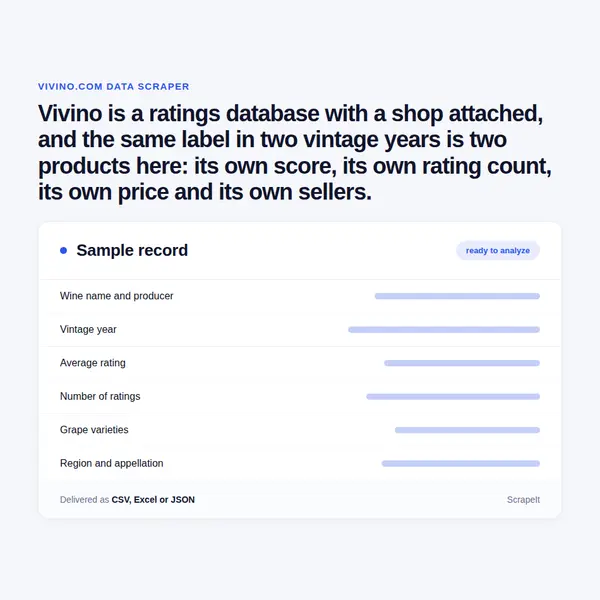
You set the scope: which countries and regions, which grapes, styles or appellations, which price bands, and whether you want one row per wine or one row per wine per vintage per market. We build the crawler, run it on your schedule and deliver CSV, JSON, XLSX, a database drop or an API endpoint. Field names, the vintage key and the currency handling are agreed before the first run.
The engineering is ours. Coverage is assembled from the published address sets and sliced by country, region, grape and style rather than by paging a results grid that stops at a fixed depth. Anti-bot handling, proxy rotation and CAPTCHA solving are part of the managed service, along with adaptive pacing. We work only on pages a signed-out visitor can reach, and we do not log in.
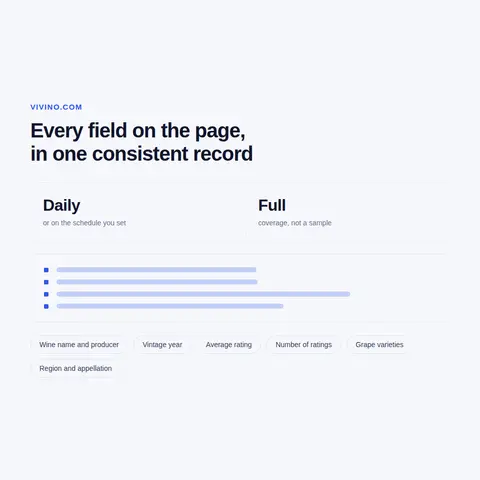
A wine page stacks three layers on one address: wine, vintage and offer. What we extract from Vivino wine pages:
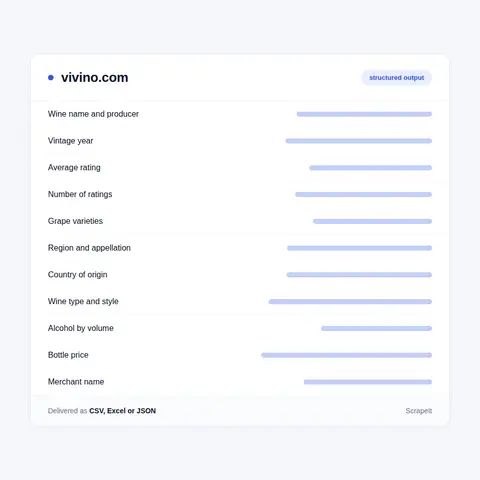
Vivino does not publish one price, it collects them. Under each wine sits a merchants-with-prices block: a list of sellers, each with its own amount for a named vintage. One Tuscan red carried 33 named merchants and 45 price rows on a single storefront, from 39.99 to 52.95 euro for the same year. Beside them sits a market median per vintage, the benchmark most pricing work needs.
Each offer is a record rather than a number: an offer id, also carried in the address, the vintage id it belongs to, the amount and its currency, a dollar equivalent, an offer type, a was-price where one is shown, the seller link, and a bottle type object with the format name and the volume in milliliters, 750 for a standard bottle, so magnums and halves never quietly join the same average.
Sellers are records too: id, trading name, slug, legal entity, home country and currency, logo and shipping estimate, each with its own page on the site. Because the storefront decides who is shown, one wine can carry dozens of offers in one market and a single offer in another, quoted in dollars, euros, pounds or francs.
The taste layer is worth taking too. Past the four structure axes, the page lists flavor groups with a mention count: on that Tuscan red, oak, vanilla and chocolate drew 838 mentions, plum and blackberry 665, cherry and raspberry 333, leather and smoke 255. That is a descriptor profile weighted by how many drinkers said it. Reviews are written by named people with public profiles; we do not collect reviewers or their profiles, and take the aggregate only - the average, the counts and the star distribution.
Vivino sells wine, but the asset underneath the shop is a ratings database. The company has been at it since 2010, and its own numbers page counts about 77.4 million users, 3.49 billion scanned labels and 20.4 million wines. Every scan is a person holding a bottle, which is why a Vivino scraper returns something no retailer catalog holds: a consumer verdict on a named wine, in a named year, with the sample size printed beside it.
The catalog is global and the storefront is local. A language prefix sits in the path and a delivery country sits next to it, and that pair decides the currency, the merchant list and the price on screen while the wine record itself stays the same. Sitemaps are published per language for Danish, German, English, Spanish, French, Italian, Japanese, Dutch, Portuguese for both Brazil and Portugal, Swedish, Ukrainian and Chinese.
Addressing is stable, which is what makes systematic Vivino scraping possible. A wine page ends in /w/ and a numeric wine id, behind a slug built from the winery and the wine name. A vintage is chosen with a year parameter on that same address, and a single seller offer with a price id. One id names the wine, one parameter names the year, one parameter names the offer.
The rest is taxonomy, and it is deeper than any shop needs: grape pages, region pages down to sub-appellation level, wine style pages combining country, region, grape and color, winery pages, merchant pages, country pages and editorial top lists. In September 2026 the English sitemaps alone listed about 719,000 wine pages and 255,000 winery pages, plus roughly 4,175 regions, 2,229 grape varieties, 887 wine styles, 915 merchants and 4,774 top lists.
Get a Quote
Developers

Customers worldwide

Pages extracted

Hours saved for our clients
€199 / one-time
setup fee - included
€169 / mo
setup fee €499
€229 / mo
setup fee €499
€349 / mo
setup fee €499
€549 / mo
setup fee €799
Delivery: CSV, JSON or XLSX files, our API or a JSON feed. MCP server on request.
Full plan details →The expensive mistake in wine data is treating a wine as one product. It is not. A wine is a label; the vintage is the thing that gets bought, scored and priced, and the gap between two years of the same label is not a rounding error.
Take one Bolgheri red from a single Tuscan producer. The site holds 54 vintages of it under one wine id. Its recent years cluster at roughly 47 to 50 euro, the 2020 sits at 62.30, the 2015 at 69.90 and the 2011 at 149.90 - one label, one producer, one address, a threefold spread driven by nothing but the year. Scores move separately: a 2024 with 56 ratings averages 4.1, while the 2021 with a thousand ratings averages 4.3.
A naive crawler flattens that into one row and one number. The result looks like a catalog and behaves like noise: an average price for a bottle nobody sells, and a score blended from vintages that taste nothing alike. Because every year has its own id and its own year parameter, a Vivino price panel can be built the way the trade actually works, one row per wine per vintage per market.
That is what buyers pay for. Importers and retailers benchmark shelf prices against the market median for the exact year. Producers watch how their vintages score against neighbors in the same appellation. Collectible and investment desks track how older years drift. And anyone building a wine product needs the taxonomy - grape, region, appellation, style, food pairing - published here as structured fields instead of prose.
About 1.9 million auto parts listings from eBay.de with brand, OEM, EAN and fitment, plus titles and specs machine-translated for the client's team.
Learn More
A one-off Takealot product list for an entrepreneur choosing niches: only products rated 4 stars or higher with at least 50 reviews.
Learn More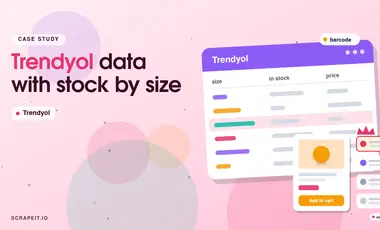
Trendyol product data for an e-commerce startup reselling Turkish fashion: 27 categories in JSON on FTP, with in-stock status for every size.
Learn MoreLearn how to use web scraping to solve data problems for your organization
If you sell online, run a marketplace, or advise e-commerce clients, you already know why eBay matters: it’s one of the few places where big retailers compete side by side with thousands of small merchants and private sellers.

E-commerce teams do not just need “some” competitor data anymore. They need a continuous stream of real prices, discounts, stock levels, reviews, and seller behavior from the platforms that actually shape their markets.
Amazon provides valuable information gathered in one place: products, reviews, ratings, exclusive offers, news, etc. So scraping data from Amazon will help solve the problems of the time-consuming process of extracting data from e-commerce.
ScrapeIt is a managed web scraping team. We have no affiliation with Vivino, and we do not resell a stored wine dataset. You get a crawler built to your brief, watched when the site changes, and clean files or an API on the schedule you set. Layout changes on vivino.com are handled as maintenance, not as a new project. Start with a sample - one region, one grape, or a single producer's back catalog with every vintage - check the fields against your model, then scale to the coverage you need.
Yes. The ScrapeIt Vivino API returns wine id, vintage id, average rating, rating count, merchant offers and the market median price per vintage as JSON from an endpoint we host, refreshed on the schedule you set. The same data also comes as CSV or XLSX files or straight into your database.
Every vintage, and that is usually the point of the project. One wine id can hold dozens of years - we have seen 54 on a single Tuscan red - and each year has its own numeric vintage id, its own average score, its own rating count, its own label count and its own market median price. We deliver one row per wine per vintage, with the wine id and the vintage id both kept as keys, so your side can roll up to the label when it wants to and stay at the year when it matters. Vintage-level highlight flags, such as the best-rated year of a wine, come across as fields.
Yes, that is the strongest part of a Vivino price data feed. A wine page lists sellers with their own amounts for a named vintage, and we take the whole block: seller id, trading and legal name, home country, the amount, the currency, the dollar equivalent, the was-price where one is shown, and the bottle format with its volume so a magnum is never averaged against a standard bottle. The site's own market median per vintage comes across as a separate column. Which sellers appear depends on the delivery country, so we run the storefronts you care about and label each row with its market.
Scope is set by geography and taxonomy, not by a result cap: we build the address list from the published sitemaps and slice by country, region, grape, style, wine type and price band. The English sitemaps list about 719,000 wine pages and 255,000 winery pages, so most briefs start with a slice - one country, one appellation, one grape - rather than the whole catalog. Daily runs are normal for prices and offers, weekly or monthly for ratings and the taxonomy, which move slowly. Output is CSV, JSON, XLSX, a database drop or an API endpoint.
Yes. Wine and vintage records, average ratings and rating counts, taste profiles and merchant prices are shown to every visitor on vivino.com, and those are the fields we deliver. We collect only publicly available data - everything a visitor can see on Vivino - and we collect it legally. We work only on public pages, we do not log in and we do not touch reviewer profiles.
Step 1 - Make a Request
You share your needs, expectations, and desired timeframe. We’ll suggest the best solution based on your request and budget.
Step 2 - Configuring Custom Web Crawlers
Our specialists configure the crawlers and extract a sample dataset for your review before proceeding with the full-scale extraction.
Step 3 - Collect and Deliver
Once you approve the sample, we launch the project and start full data collection. We gather, filter, and structure the data for easy use, delivering it on time in your preferred format.
Step 4 - Maintain and Support
Our team manages ongoing processes, monitors website changes, and supports all data extraction cycles. We can also help integrate data into your systems or create dashboards to simplify analysis.
Vivino data from €169/month. Free project assessment, reply within 1 business day.

Scrapeit Sp. z o.o.
10/208 Legionowa str., 15-099, Bialystok, Poland
KRS: 0000996672
NIP: 5423457175
REGON: 523384582