Grainger Data: 3 MRO Catalogs with UNSPSC, 250K Products from Cromwell
Full MRO catalogs from Grainger, Fastenal and Cromwell for a product content company: UNSPSC, EAN, every attribute and a taxonomy sheet.
Pandora runs one catalogue behind many country storefronts. We key every row on the style code, so prices, sizes, stock and retirements line up across markets.
Plans from €169 a month · Free project assessment · Reply within 1 business day
CSV · Excel · JSON · XML · FTP · SFTP · Amazon S3 · Google Cloud

API, JSON feed or CSV, XLSX and JSON files
ScheduleOne-time, monthly, weekly, daily or 3 times a day
Pandora pages, filters, fields and a schedule
Built, monitored and repaired by our team
API, JSON feed or CSV, XLSX and JSON files
The default set describes a style and its price in one market, keyed so the same style joins across markets and across runs.
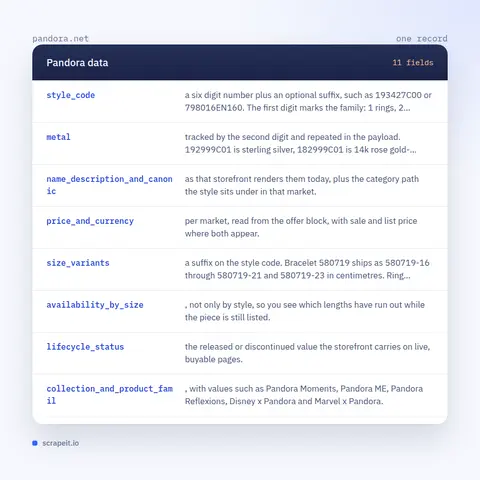
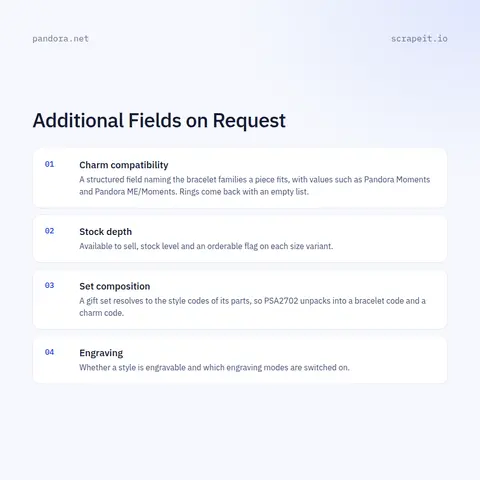
The storefront payload carries a good deal beyond the core fields, and most of it matters in this category.
Pandora is a Danish jewellery company that sells through country storefronts on pandora.net. The country is the subdomain and the language is the first path segment, so the United Kingdom sits at uk.pandora.net/en and Germany at de.pandora.net/de. Several markets carry more than one language on the same host: Canada runs /en and /fr, Belgium runs /fr and /nl, Switzerland runs /de, /fr and /it, and the United Arab Emirates runs /ar and /en. A few markets sit outside the pattern, such as China on cn.pandora.net.cn and Brazil on pandorajoias.com.br.
The storefronts run on Salesforce Commerce Cloud behind a React front end. A product page ends in a style code, as in /en/rings/stackable-rings/row-of-hearts-ring/193427C00.html. Only the trailing code resolves. Put a wrong slug or a wrong category segment in front of a live code and the page still loads, then names the current address in its own canonical tag. The style code is the stable key here, and the slug is a label Pandora rewrites when a piece is renamed.
Each storefront publishes a sitemap index at /sitemap_index.xml, split into product, image, category and content files. Category pages paginate with a page parameter and refine through the prefn and prefv pairs that Salesforce Commerce Cloud uses. Each product page in the product sitemap carries the style code, price and currency, size variants, availability by size and lifecycle status for that market.
Delivery: CSV, JSON or XLSX files, our API or a JSON feed. MCP server on request.
Full plan detailsPandora sets its own price in every market, and the spread is not a currency conversion. Style 580719 is one catalogue entry, and each storefront attaches its own price, its own name and its own category path to it. Resellers, grey market monitors and brand protection teams need the code to line those rows up, because the product name will not do it: the same bracelet is listed as Heart Clasp Snake Chain Bracelet on the UK site and Heart & Snake Chain Bracelet on the Canadian English site.
Assortment differs too. A style on sale in the United Kingdom, Canada and France may be absent from the German and Australian sitemaps entirely. Reading one storefront tells you nothing about the others.
Then there is retirement, which drives the whole secondary market in this category. Retired charms routinely resell above their original shelf price. The storefront gives two warnings and then goes quiet. First, a live page carries a status value that turns to discontinued while the piece is still buyable. Second, when the style finally leaves, the URL stops resolving and the entry drops out of the sitemap. There is no redirect and no archived page. If nobody recorded the style while it was live, the price, the name, the materials and the images are gone.
Full MRO catalogs from Grainger, Fastenal and Cromwell for a product content company: UNSPSC, EAN, every attribute and a taxonomy sheet.

Every seller shop on bol.com with its trade name, business address, KvK and VAT number, collected once: 72,961 shops in 18 days.
A one-time B2B lead file from Amazon seller profiles: 51,216 sellers with business name and address, 13,366 of them in the US and Canada.
Learn how to use web scraping to solve data problems for your organization

If you sell online, run a marketplace, or advise e-commerce clients, you already know why eBay matters: it’s one of the few places where big retailers compete side by side with thousands of small merchants and private sellers.

E-commerce teams do not just need “some” competitor data anymore. They need a continuous stream of real prices, discounts, stock levels, reviews, and seller behavior from the platforms that actually shape their markets.
Amazon provides valuable information gathered in one place: products, reviews, ratings, exclusive offers, news, etc. So scraping data from Amazon will help solve the problems of the time-consuming process of extracting data from e-commerce.

ScrapeIt is a managed scraping agency. We build the crawler, run it on your schedule, watch it when the site changes, and deliver CSV, JSON, XLSX or an API endpoint. You maintain no selectors and no proxies. Anti-bot handling - pacing, proxy rotation and rendering - is part of the service, so this is steady engineering rather than a script someone runs once. Tell us the markets, the categories and the fields you need, and we will scope the run.
Still unsure? Write to info@scrapeit.io
By style code. The six digit code and its suffix identify the same catalogue entry in every market, while the URL slug, the category path and even the English product name change from storefront to storefront. We key every row on the style code and treat the market as a separate column, so a price panel joins cleanly. Where a style is missing from a market we record the absence rather than leaving a hole in the table.
Yes, provided the crawl starts before the style goes. A live page carries a status value that turns to discontinued while the piece is still on sale, which is the early signal. When the style finally leaves the assortment the URL stops resolving and the entry drops out of the sitemap, with no redirect and no archived page. We run a daily sitemap and status diff, so each retirement is recorded with the last known price, name, materials and images.
Yes. A size is a variant with its own code, formed by appending the size to the style code. Bracelet 580719 exists as 580719-16 through 580719-21 and 580719-23 in centimetres, and ring 193427C00 as -48 through -60 on the even European sizes. Availability is reported per size, so a style can stay listed while several lengths are out of stock. We deliver either one row per size or one row per style with a nested size array, whichever suits your load.
Any storefront on the pandora.net pattern, where the country is the subdomain and the language is the first path segment, plus the markets that sit on their own domains. Canada, Belgium, Switzerland, Hong Kong and the United Arab Emirates each run more than one language on a single host, and we treat every language as its own crawl so the localised names, category paths and material descriptions are captured properly.
Yes. The ScrapeIt Pandora API returns style code, market, price and currency, availability by size and lifecycle status as JSON from an endpoint we host, refreshed on the schedule you set. The same Pandora data also comes as CSV or XLSX files or straight into your database. Price and stock work usually runs daily, because that is the cadence at which promotions and sold out sizes move. Full catalogue snapshots with images and long descriptions are more often weekly. We own the scheduling, the monitoring and the repairs when the site changes.
You share your needs, expectations, and desired timeframe. We'll suggest the best solution based on your request and budget.
Our specialists configure the crawlers and extract a sample dataset for your review before proceeding with the full-scale extraction.
Once you approve the sample, we launch the project and start full data collection. We gather, filter, and structure the data for easy use, delivering it on time in your preferred format.
Our team manages ongoing processes, monitors website changes, and supports all data extraction cycles. We can also help integrate data into your systems or create dashboards to simplify analysis.
Tell us which sites, which fields and how often. A couple of lines is enough to start.
Pandora data from €169/month. Free project assessment, reply within 1 business day.