Booking.com Data: 12 Cities, 6 Airports, a Screenshot for Every Price
Since 2022, weekly car rental and, from 2025, hotel prices from Booking.com for a tourism organization comparing its destination with rivals.
Learn More
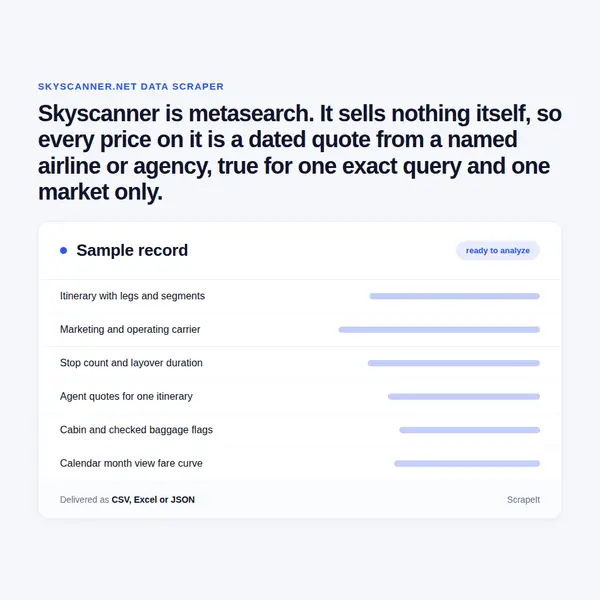
Skyscanner is metasearch. It sells nothing itself, so every price on it is a dated quote from a named airline or agency, true for one exact query and one market only.
Plans from €169/month · Free project assessment · Reply within 1 business day
Skyscanner defends its live search pages against automated clients, and it builds results through a create-and-poll flow rather than serving them whole, so a plain fetch returns a shell with no fares in it. That is exactly what our managed service covers: anti-bot handling, proxy rotation and CAPTCHA solving, session and poll handling until a search reports complete, and one run per market so each row carries the market, locale and currency it was really quoted in. We build the crawler, run it on your cadence, watch it and repair it when the site shifts. Delivery is CSV, JSON, XLSX or an API endpoint, with a documented schema and one row per agent quote per observation. A paid sample comes before any bigger commitment.
A quote is meaningless without the question that produced it, so the query key sits beside every row we store: origin, destination, outbound date, inbound date on a return trip, cabin class, adult count and child ages, market, locale, currency and the moment of observation. Change one of them and the number changes; hold them fixed and successive passes stack into a readable series.
Fields the platform never returns stay empty. We infer no baggage allowance, operating carrier or fare brand that no seller published, and collect no traveller accounts, saved searches or personal data.

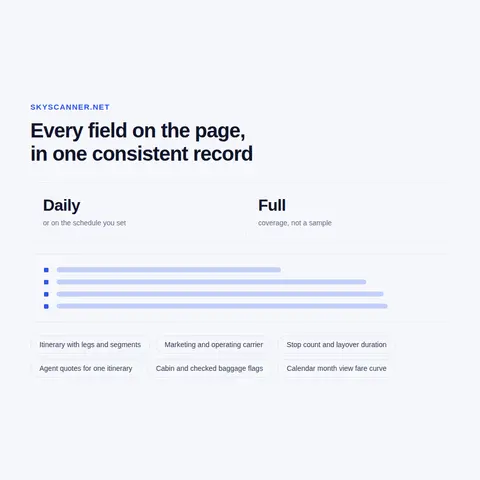
Past the single results page there are layers worth collecting in their own right. The calendar-month-view prices an entire month of departure dates for one route in a single pass, which is the cheap way to build a fare curve. The browse-view answers a country search or an Everywhere search with indicative prices for many destinations at once, and those figures are cached estimates recycled from earlier live searches, not live quotes: they must never share a column with live pricing. Flexible dates widen the outbound and inbound day either side of the one chosen. Flights and car hire accept dates up to twelve months out, hotels up to eighteen.
Geography is a hierarchy rather than a list: continent, country, city and airport for flights, plus district, island, train station and hotel elsewhere. Every place carries an internal entity id as well as an IATA code, and the entity id is the safer join key because a city and one of its airports can share the same three letters.
Storefronts then multiply all of it. As of September 2026 Skyscanner currently runs country sites on more than thirty of its own domains, from skyscanner.de and skyscanner.fr through skyscanner.co.kr to skyscanner.com.br, with a few markets served off subdomains and a few folded back into skyscanner.net. Market, locale and currency travel as a set, and one itinerary can be quoted differently on two of them because the agent list and the conversion differ. Point of sale is part of the question, not a display preference.
Skyscanner is a travel metasearch marketplace operated by Skyscanner Ltd, trading since the early 2000s and covering three separate verticals: Flights, Hotels and Car Hire. It carries no inventory. A traveller enters a route and dates, Skyscanner fans that query out to airlines and online travel agencies, waits for them to answer, and lays the answers side by side. Picking a result hands the traveller to the seller through a deeplink, and the booking, the payment and the ticket all belong to that seller.
That one structural fact reshapes what Skyscanner data actually is. A row here is not a shop price. It is a single agent's quote for a single itinerary, in one market, in one currency, at one instant. The same itinerary routinely carries several quotes from several sellers, and each seller is typed as either an airline or a travel agent. Quotes come from supply partners and can change or vanish without notice, and unpriced itineraries turn up too.
The platform also speaks its own dialect, which is worth learning before you write a collection brief. A results page is a day-view. A whole month of departure prices for one route is a calendar-month-view. A country origin, a country destination or an Everywhere search returns a browse-view of cities and countries priced indicatively rather than live. Hotels have a home-view, a day-view and a hotel-details page; car hire has a home and a day-view. The rest of this page uses those words.
Get a Quote
Developers

Customers worldwide

Pages extracted

Hours saved for our clients
€199 / one-time
setup fee - included
€169 / mo
setup fee €499
€229 / mo
setup fee €499
€349 / mo
setup fee €499
€549 / mo
setup fee €799
Delivery: CSV, JSON or XLSX files, our API or a JSON feed. MCP server on request.
Full plan details →Skyscanner is the spot where many sellers answer the same question in the same second, which is the reason buyers scrape Skyscanner instead of one airline site. An airline page tells you what that airline charges. A metasearch page tells you what the market answered and who answered it, including the agencies reselling the same seat under or over the carrier's own fare.
Airline revenue teams follow a competitor route against departure date, because that is the shape air pricing really has: a curve that bends as seats sell and the departure date closes in. Distribution teams check whether their own inventory shows up at all in a given market, at what number, and through which reseller. Airports and tourist boards read carrier presence and frequency on a city pair before any schedule commentary reaches print. Online agencies use the agent spread to see where they are undercut and by how much. Hotel groups and car hire suppliers run the identical method on their own verticals, where the comparable field is the board basis or the vehicle class rather than the cabin.
None of it survives a single snapshot. A Skyscanner price is a quote with a timestamp on it, and the worth sits in a repeated series against an unchanged query key, so a movement in the number is a movement in the market and not a change in the question you asked.

Since 2022, weekly car rental and, from 2025, hotel prices from Booking.com for a tourism organization comparing its destination with rivals.
Learn More
Four datasets for a studio that builds directory websites: Hawaii stays from Booking.com, UK schools and tattoo studios from Google Maps, GetInked profiles.
Learn More
Daily scraping of Booking.com services - hotels, flights, car rentals, and attractions - with best-price selection across global destinations.
Learn MoreLearn how to use web scraping to solve data problems for your organization

If you work in travel tech, an OTA, a hotel chain, or at an airport, you are in a price-and-availability arms race. Fares change by the hour, room inventory disappears in minutes, and competitors test new bundles and ancillaries constantly.

Leveraging advances in technology, the AI-powered web scraper has skyrocketed in demand and is helping to expand capabilities by automating tedious daily tasks and speeding up data collection from thousands of websites several times over.

Web scraping is a method of obtaining web data by extracting it from pages of web resources with the help of a program, that is, in automatic mode. It is used to syntactically convert web pages into more usable forms.
ScrapeIt is a managed web scraping agency. You name the routes, dates, cabins and markets you care about; we write the crawler, run it on schedule, monitor it and fix it when the target moves, which on a metasearch platform is often. Nothing to install on your side and nothing to maintain. You get documented output in the format you asked for and a named contact who knows your project, and we tell you what is collectable and what is not before you commit to anything.
Yes. The ScrapeIt Skyscanner API returns itineraries with their legs and carriers, flight numbers, departure and arrival times, the quoting agent with its price and currency, and fare detail such as baggage, as JSON from an endpoint we host, refreshed on the schedule you set. The same data also comes as CSV or XLSX files or straight into your database.
Everything a public result shows: itinerary and leg structure, carriers, flight numbers, stop count, layover length, departure and arrival times in airport local time, total duration, the quoting agent with its price and outbound link, and fare detail such as baggage, brand name and change or cancellation flags where the seller publishes them. Hotels add room, board, policy, star rating and amenity fields; car hire adds the SIPP vehicle code, supplier, fuel policy and mileage. What the site does not display we do not invent, and nothing behind a traveller login is touched.
Each search fires real calls to airlines and agencies, so results are assembled fresh and the same query twenty minutes later can come back with a different set and a different cheapest agent. Cadence is therefore a business decision rather than a technical one: hourly for a tight pricing window, daily for a fare curve, weekly for a market survey. We agree a fixed grid of routes, dates, cabins and markets first, then hold it steady, spread the load across the day and keep the rate low so collection stays quiet and repeatable.
Yes, and it is usually the more interesting question. Market, locale and currency are part of the query, and the country storefronts do not always answer alike: the set of agencies quoting differs by market, and so does the converted amount. We run each market as its own pass and stamp every row with the market, locale and currency it was quoted in, so a cross-market comparison compares like with like instead of an artefact of conversion.
Delivery is CSV, JSON, XLSX or a REST endpoint, on your schedule, with a documented schema and stable column names. On legality, yes: we take only publicly visible pages, we do not log in, we do not defeat access controls, and we gather no personal data about travellers. We collect only publicly available data - everything a visitor can see on Skyscanner - and we collect it legally.
Step 1 - Make a Request
You share your needs, expectations, and desired timeframe. We’ll suggest the best solution based on your request and budget.
Step 2 - Configuring Custom Web Crawlers
Our specialists configure the crawlers and extract a sample dataset for your review before proceeding with the full-scale extraction.
Step 3 - Collect and Deliver
Once you approve the sample, we launch the project and start full data collection. We gather, filter, and structure the data for easy use, delivering it on time in your preferred format.
Step 4 - Maintain and Support
Our team manages ongoing processes, monitors website changes, and supports all data extraction cycles. We can also help integrate data into your systems or create dashboards to simplify analysis.
Skyscanner data from €169/month. Free project assessment, reply within 1 business day.

Scrapeit Sp. z o.o.
10/208 Legionowa str., 15-099, Bialystok, Poland
KRS: 0000996672
NIP: 5423457175
REGON: 523384582