Charter Flight Data from 12 Danish Tour Operators: a Pilot in 2 Weeks
A paid pilot for a regional airport in Scandinavia: direct charter departures from 12 Danish tour operator sites, sampled in two weeks.
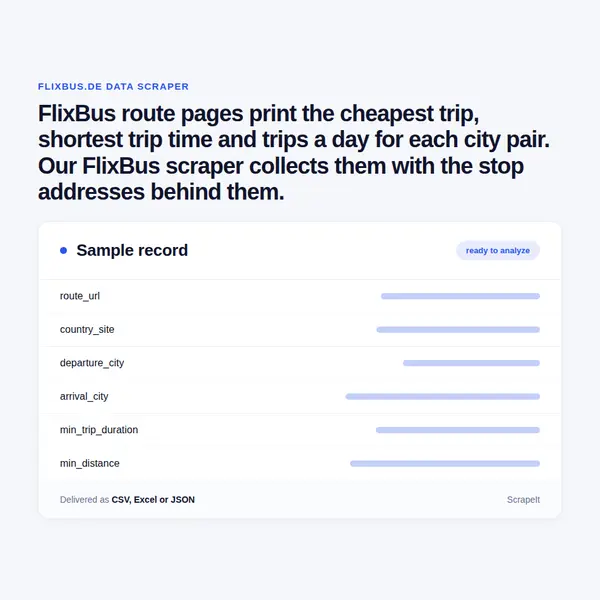
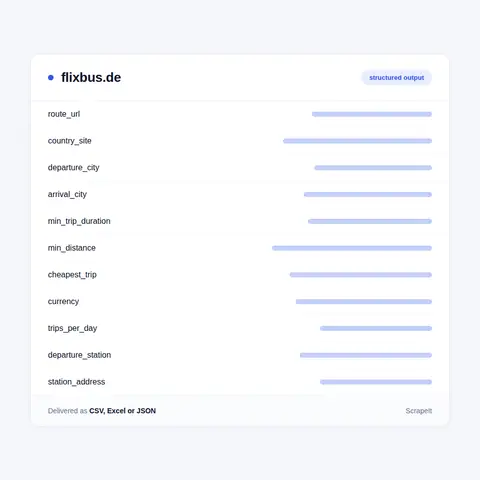
FlixBus route pages print the cheapest trip, shortest trip time and trips a day for each city pair. Our FlixBus scraper collects them with the stop addresses behind them.
Plans from €169 a month · Free project assessment · Reply within 1 business day
CSV · Excel · JSON · XML · FTP · SFTP · Amazon S3 · Google Cloud
API, JSON feed or CSV, XLSX and JSON files
ScheduleOne-time, monthly, weekly, daily or 3 times a day
FlixBus pages, filters, fields and a schedule
Built, monitored and repaired by our team
API, JSON feed or CSV, XLSX and JSON files
You give us the city pairs, the whole network of a country site or a list of stations, plus the ride dates and how often to look. We build the crawler around the FlixBus pages themselves: the route and city pages that describe each connection, and for date-specific fares the booking search, whose address carries the departure city, arrival city and ride date. We run it on your schedule and repair it when FlixBus changes its layout. Pacing, proxy rotation, CAPTCHA handling and rendering are part of the service.
No ticket is bought and no passenger details are entered. Every row keeps the country site and language it came from, because flixbus.de, flixbus.com and flixbus.fr describe the same connection in different words.
FlixBus publishes a page for every city it serves and for city pairs across its network, on each country site. Those pages are the stable layer of the network, and they share one format: a facts block, the stations at both ends, the service on board and a long FAQ. We turn them into rows keyed on the route address, such as /bus-routes/bus-berlin-munich on flixbus.com or /voyages-car/berlin-munich on flixbus.fr.
German, French and English pages label the same field differently - Günstigste Fahrt is Cheapest trip - so we map each to one column and keep the original label beside it.
FlixBus prices change, and FlixBus says why on its own route pages: fares move with demand, time of day and how far ahead you book. That makes a single price meaningless without the date it was seen and the date of travel. A FlixBus price history is built by asking for the same city pairs and ride dates on a schedule - daily, or several times a day in the last week before departure - and storing each fare with both dates. The price changes then read as a curve per departure, showing how close early fares sit to the Cheapest trip figure, when they climb, and which departures stay cheap.
The network layer changes too, more slowly. Run monthly, the route and city pages record new city pairs, routes that disappear, a rising or falling number of trips a day, stops that move, and changes to the first and last bus. Across country sites the same crawl compares how one connection is advertised on each of them.
FlixBus is the long-distance bus brand of Flix SE, which by its own account was launched in Munich in 2013 and also runs FlixTrain, Greyhound in the United States and Kâmil Koç in Turkey. Flix describes an asset-light model: local bus partners provide the transport, while Flix plans the network, sets prices, sells the tickets and does the marketing. For a data buyer that means one consistent catalogue of routes and fares across operators that would otherwise each publish their own.
The network is sold through country sites and languages. flixbus.de is the home market, flixbus.com and global.flixbus.com carry English editions, and the language selector lists English versions for the US, UK, Canada, India, Ireland and Australia, Spanish ones for Spain, the US, Chile, Mexico and Peru, Portuguese for Portugal and Brazil, and single-language sites from Bulgarian to Ukrainian. The German site groups its menu under Plane Deine Reise - all connections, timetables and stops, travel deals - and its footer links to separate pages for airports, night buses (Nachtbusse) and FlixTrain.
The German home page advertises coach and FlixTrain rail trips side by side under one search, so one crawl can cover both.
Delivery: CSV, JSON or XLSX files, our API or a JSON feed. MCP server on request.
Full plan detailsRail operators, other coach companies and ride-sharing services price against FlixBus on the same corridors. Daily FlixBus ticket prices by ride date show where the green buses undercut a train and by how much, how quickly cheap fares go on popular weekends, and whether FlixBus prices go up on a route after a competitor leaves it.
The route pages answer network questions without a single fare: how many trips a day connect two cities, the shortest trip time, which stations in a city FlixBus uses and whether a corridor has a night bus. Transport planners, city tourism offices and investors read those fields as a measure of intercity coach supply. Travel platforms and aggregators use station addresses and route facts to check their own coach listings against the operator's. Station operators and airports see which of their stops appear on which city pairs.
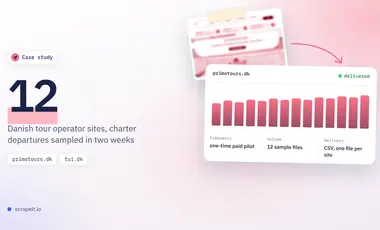
A paid pilot for a regional airport in Scandinavia: direct charter departures from 12 Danish tour operator sites, sampled in two weeks.
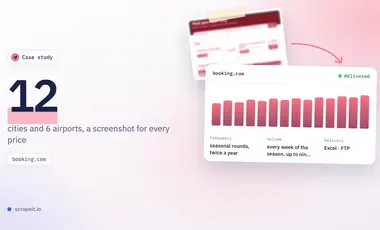
For several years, weekly car rental and, more recently, hotel prices from Booking.com for a tourism organization comparing its destination with rivals.
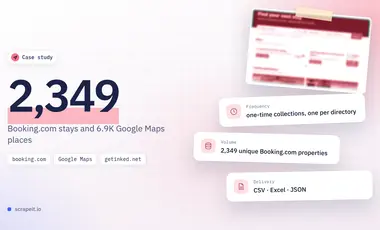
Four datasets for a studio that builds directory websites: Hawaii stays from Booking.com, UK schools and tattoo studios from Google Maps, GetInked profiles.
Learn how to use web scraping to solve data problems for your organization
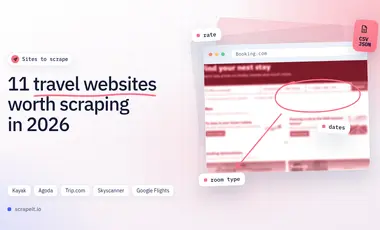
If you work in travel tech, an OTA, a hotel chain, or at an airport, you are in a price-and-availability arms race. Fares change by the hour, room inventory disappears in minutes, and competitors test new bundles and ancillaries constantly.
Data scraping is the wide term that includes documents, scans and old screens; web scraping is the part that works on websites. We compare sources, daily work, output and cost drivers, give a briefing checklist and walk through two of our projects.
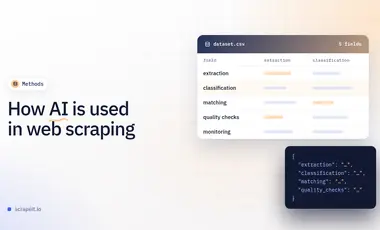
Leveraging advances in technology, the AI-powered web scraper has skyrocketed in demand and is helping to expand capabilities by automating tedious daily tasks and speeding up data collection from thousands of websites several times over.

ScrapeIt is a managed scraping service for companies that need website data on a schedule without running crawlers themselves. Transport networks suit us: large sets of near-identical pages per country, labels that change language from site to site, and prices that only make sense with two dates attached. For FlixBus we hand over route, station and fare tables with field documentation, as CSV, Excel or JSON files, through our API, to Amazon S3 or into your database.
Still unsure? Write to info@scrapeit.io
Yes. The ScrapeIt FlixBus API returns city pair, stations with addresses, trip duration, trips a day and the cheapest fare as JSON from an endpoint we host, refreshed on the schedule you set. The same data also comes as CSV or XLSX files, a JSON feed or straight into your database.
Yes. Route pages, city pages, station addresses and fares are shown to every visitor of the FlixBus country sites. We collect only publicly available data - everything a visitor can see on FlixBus - and we collect it legally.
FlixBus states that fares change with demand, time of day and how far ahead you book, so the answer differs by route and date. Our scheduled runs record the fare for each ride date on every collection day, so you see where prices rise, how fast, and when they fall back.
Any public one. flixbus.de, flixbus.com, flixbus.co.uk, flixbus.fr and the other country sites each publish route and city pages in the local language, and we collect one, several or all of them, mapping their labels to a single set of columns.
Yes. Route and city pages list every bus station and stop FlixBus uses in a city with its name and street address - in Berlin they run from the central bus station on Masurenallee to Südkreuz and Alexanderplatz. We deliver them as a station table that links to every route row.
You share your needs, expectations, and desired timeframe. We'll suggest the best solution based on your request and budget.
Our specialists configure the crawlers and extract a sample dataset for your review before proceeding with the full-scale extraction.
Once you approve the sample, we launch the project and start full data collection. We gather, filter, and structure the data for easy use, delivering it on time in your preferred format.
Our team manages ongoing processes, monitors website changes, and supports all data extraction cycles. We can also help integrate data into your systems or create dashboards to simplify analysis.
Tell us which sites, which fields and how often. A couple of lines is enough to start.
FlixBus data from €169/month. Free project assessment, reply within 1 business day.