Charter Flight Data from 12 Danish Tour Operators: a Pilot in 2 Weeks
A paid pilot for a regional airport in Scandinavia: direct charter departures from 12 Danish tour operator sites, sampled in two weeks.
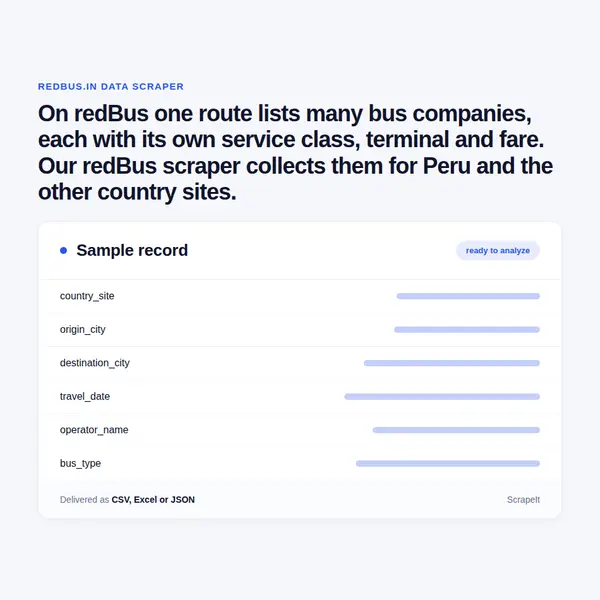
On redBus one route lists many bus companies, each with its own service class, terminal and fare. Our redBus scraper collects them for Peru and the other country sites.
Plans from €169 a month · Free project assessment · Reply within 1 business day
CSV · Excel · JSON · XML · FTP · SFTP · Amazon S3 · Google Cloud
API, JSON feed or CSV, XLSX and JSON files
ScheduleOne-time, monthly, weekly, daily or 3 times a day
redBus pages, filters, fields and a schedule
Built, monitored and repaired by our team
API, JSON feed or CSV, XLSX and JSON files
Tell us the country sites, the routes or cities, the travel dates and how often - Lima to Cusco and Lima to Arequipa every morning for the coming month, or every route out of Kuala Lumpur once a week - and we build the redBus scraper, run it and keep it working when the site changes. Prices per departure exist only after a search for a route and a date, so every run is a planned set of searches; no seat is held, nothing is bought and no passenger data is entered. Proxy rotation, pacing, CAPTCHA handling and rendering are included.
Each row carries the country site, the currency and the redBus city ids of origin and destination, so Peru in soles and Malaysia in ringgit sit in one table. Delivery is CSV, Excel, JSON or our API, one-off or scheduled daily or weekly.
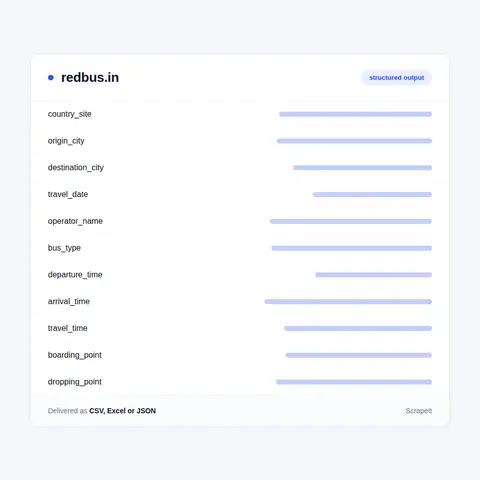
redBus publishes each route in two layers. The route guide page - /pasajes-de-bus/lima-a-cusco in Peru, /bus-tickets/kuala-lumpur-to-singapore in Malaysia - summarises the route, and the dated search behind it lists every departure with its price. Operator pages add the company view. What we collect:
Bus operators are businesses, so their names, ratings and published contacts are delivered as shown; reviewer names stay out of the dataset, and personal data is handled under GDPR.
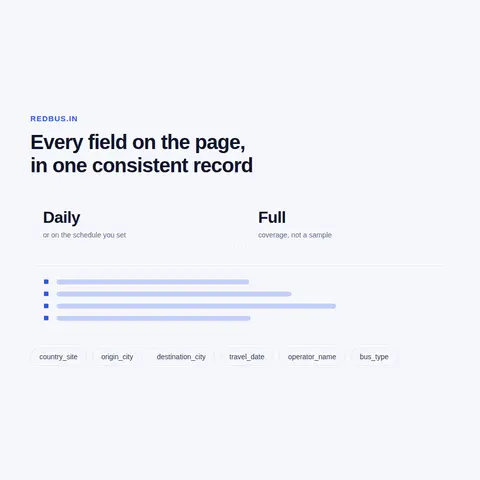
A dated search shows one day on one route. The useful picture builds up across days, routes and operators.
redBus is an online bus ticketing platform founded in 2006. Its footer lists the country sites under Sitio Global - India, Singapore, Malaysia, Indonesia, Peru, Colombia, Cambodia and Vietnam - each on its own domain, such as redbus.in, redbus.my or redbus.pe, and credits ibibo group, with Goibibo and MakeMyTrip linked as partners.
Each country site is a separate catalogue in its own language and currency. redbus.pe opens in Spanish, has an English version and quotes fares in soles or US dollars; it sells interprovincial routes from Lima to Cusco, Arequipa, Huaraz or Piura through companies such as Wari Palomino, America Express, Allinbus, Megabus, PeruBus and Transzela. The Malaysian site sells cross-border routes into Singapore and adds ferry tickets and things to do.
The layout repeats across countries: a route guide page with a summary and an operator table, a dated search that sorts by relevance, price, rating or departure time and filters by bus type, departure time band, boarding point, dropping point, operator and amenities, and an operator page with ratings, photos and schedules. Peru adds terminal-specific details, such as the terminal use ticket for Gran Terminal Terrestre Plaza Norte that redBus sells together with the fare.
Delivery: CSV, JSON or XLSX files, our API or a JSON feed. MCP server on request.
Full plan detailsIntercity buses in Peru, Colombia, India and Southeast Asia are run by many private companies on the same roads, and redBus is where their fares, classes and departure times appear side by side. That makes it a practical source for:
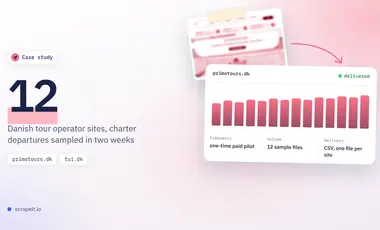
A paid pilot for a regional airport in Scandinavia: direct charter departures from 12 Danish tour operator sites, sampled in two weeks.
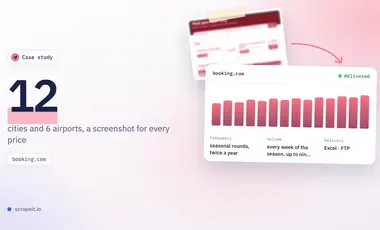
For several years, weekly car rental and, more recently, hotel prices from Booking.com for a tourism organization comparing its destination with rivals.
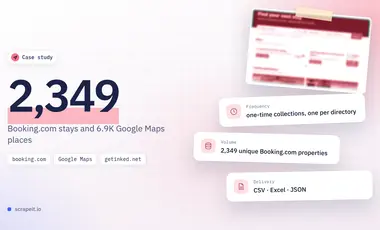
Four datasets for a studio that builds directory websites: Hawaii stays from Booking.com, UK schools and tattoo studios from Google Maps, GetInked profiles.
Learn how to use web scraping to solve data problems for your organization
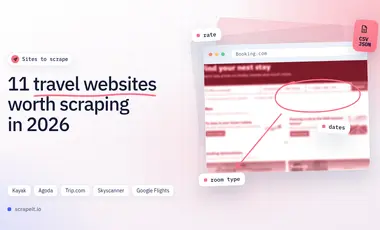
If you work in travel tech, an OTA, a hotel chain, or at an airport, you are in a price-and-availability arms race. Fares change by the hour, room inventory disappears in minutes, and competitors test new bundles and ancillaries constantly.

Data scraping is the wide term that includes documents, scans and old screens; web scraping is the part that works on websites. We compare sources, daily work, output and cost drivers, give a briefing checklist and walk through two of our projects.
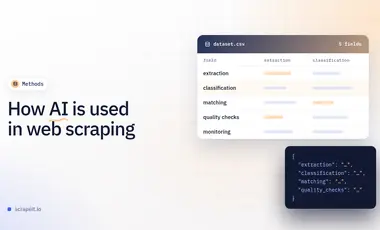
Leveraging advances in technology, the AI-powered web scraper has skyrocketed in demand and is helping to expand capabilities by automating tedious daily tasks and speeding up data collection from thousands of websites several times over.

ScrapeIt is a managed data extraction service. We build the crawlers, run them on your schedule and hand over the dataset with field documentation. Booking platforms like redBus are a regular part of the work: a fare that appears only once a route and date are searched, seats that sell out before departure, and one brand running separate catalogues in different currencies. Plans start from EUR 169 a month, or EUR 199 for a one-time extract.
Still unsure? Write to info@scrapeit.io
Yes. The ScrapeIt redBus API returns operator, bus type, departure and arrival times, boarding point, seats available and fare as JSON from an endpoint we host and refresh on your schedule. You can also take the same data as CSV or Excel files, through a JSON feed or loaded into your database.
Yes. Route pages, operator pages and dated search results can be opened by anyone browsing redBus, no sign-in needed, and the companies listed are businesses. We collect only publicly available data - everything a visitor can see on redBus - and we collect it legally. Reviewer names and passenger details are left out.
Each country site is crawled on its own domain, starting from its route, city and operator directories and then searching the routes and dates you choose. Rows keep the country, the currency and the redBus city ids, so Peru, Colombia, India or Malaysia can be compared in one file.
Each operator sets its own fare on redBus, and some departures carry a redDeal on top, so the answer differs by operator and route. The way to know for a route is to search the same travel date every day and record each operator's from fare, which is what a daily run does.
Yes. We repeat the dated search on the schedule you set and keep every result, so each departure gets a fare series from the first day we see it on sale to the day it leaves or sells out. History starts with the first run, so it is worth starting before the season you want to study.
You share your needs, expectations, and desired timeframe. We'll suggest the best solution based on your request and budget.
Our specialists configure the crawlers and extract a sample dataset for your review before proceeding with the full-scale extraction.
Once you approve the sample, we launch the project and start full data collection. We gather, filter, and structure the data for easy use, delivering it on time in your preferred format.
Our team manages ongoing processes, monitors website changes, and supports all data extraction cycles. We can also help integrate data into your systems or create dashboards to simplify analysis.
Tell us which sites, which fields and how often. A couple of lines is enough to start.
redBus data from €169/month. Free project assessment, reply within 1 business day.