Flight Pricing at Scale: Opodo Scraped with Full Filter Logic
Automated scraping of filtered flight ticket data from Opodo.com, including complex on-page interactions for airline and pricing selection.
Learn More
Nearly every travel site closes its search results to crawlers. A deal published as editorial content is the price data you are actually allowed to collect.
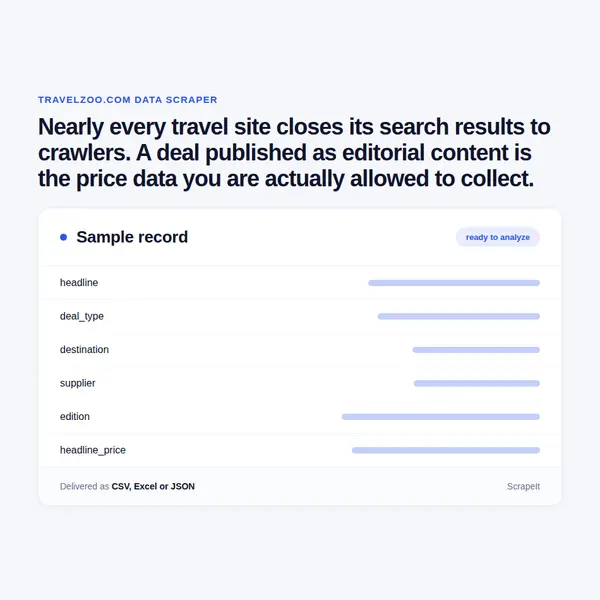
ScrapeIt runs the collection as a managed service. You name the editions, destinations or deal types; we build the pipeline with the price basis kept separate, expiry and travel window as distinct dates and editions as separate markets, and hand back CSV, JSON, Excel or a push into your warehouse.
Deals appear and expire weekly, so collection runs on a cycle that catches an offer while it is live and records when it stopped appearing.
We collect published deal content only, honour the crawl rules and pace requests. We do not collect booking-site search results that are closed to crawlers, and we say so at scoping rather than implying otherwise. Content is copyrighted, so the dataset is for analysis rather than republication.
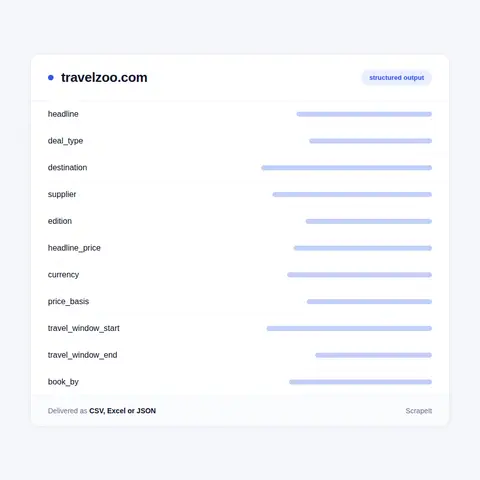
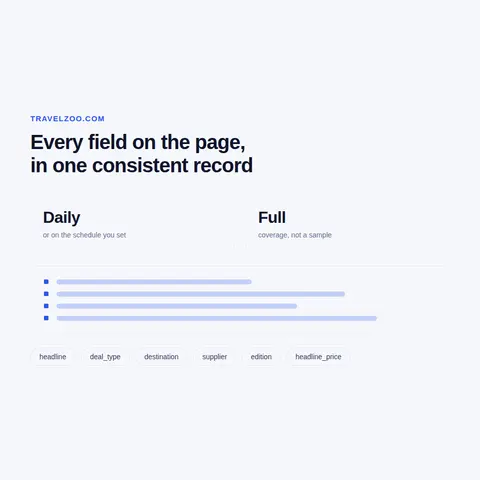
Deal records carry the headline, deal type - flight, hotel, package, cruise or experience - the headline price, currency, what the price covers, the travel window, the booking deadline or expiry, the destination and the supplier where named.
What the price covers is kept as its own field rather than folded into the headline. A price per person sharing, per room per night and per package are different quantities, and deal copy states them in different ways. A comparison that ignores the basis compares nothing.
Expiry and travel window are separate dates. A deal bookable until Friday for travel next spring has two time dimensions, and conflating them breaks any analysis of seasonal pricing.
Edition is a first class field, because the same supplier appears in different country editions with different offers, and the editions are separate markets.
Every row carries the collection timestamp and the date the deal was first seen, so the lifecycle of an offer - published, still live, expired - becomes a record.
Discount depth tracking by destination and supplier is the main output: how far offers go below usual prices, where the claim is stated, and how that shifts across the year.
Seasonal demand signals come from volume rather than price. A surge of offers for a destination and window usually means the supply is not selling, which is useful to anyone planning capacity or marketing spend.
Supplier discounting patterns show which brands use a deals channel, how often, and with what kind of offer - a view of promotional strategy the booking platforms keep to themselves.
The limits are stated plainly. Published deals are a curated slice of the market, not the full fare or rate distribution. Headline prices come with conditions, which we collect rather than strip. And a deal is an offer, not a transaction: it tells you what was advertised, not what was booked.
Travelzoo is a travel deals publisher operating editions across North America, Europe and Asia-Pacific. Its editors negotiate and select offers from airlines, hotels, tour operators and cruise lines, then publish them as articles with a price, a description and the conditions attached. Its weekly Top 20 is the best known of those lists.
That publishing model is why this source matters more than its size suggests. Across the travel sector, the pages where prices appear - search results, price calendars, cheapest-fare listings - are routinely closed to automated collection in the sites' own crawl rules. We checked the major booking platforms and found the same pattern almost everywhere.
A deals publisher is the exception. Here the price is the editorial content itself, published to be read and shared, and the deal and top-list pages sit outside anything the crawl rules restrict. The rules disallow only the tracking redirects used in email campaigns.
Country editions and the Top 20 list respond directly with substantial content.
Get a Quote
Developers

Customers worldwide

Pages extracted

Hours saved for our clients
€199 / one-time
setup fee - included
€169 / mo
setup fee €499
€229 / mo
setup fee €499
€349 / mo
setup fee €499
€549 / mo
setup fee €799
Travel price monitoring is one of the most requested things in this whole category, and it runs into a wall that most providers do not mention.
The pages where travel prices appear are closed. Hotel search results, flight search listings, fare calendars, cheapest-flight pages - on the major booking sites these paths are disallowed in the sites' own crawl rules. Collecting them anyway is a choice we do not make, and a monitoring product built that way is built on something the source has said no to.
That leaves a smaller set of legitimate routes, and published deals are one of the best. A deal is a price the supplier chose to advertise, curated by an editor and published as content. It is not the full price distribution for a route, and we say so. It is a genuine, lawfully collectable signal about where suppliers are discounting, how deep, and for which travel windows.
The second reason is that deals lead. Suppliers discount when demand is soft, so the volume and depth of published offers by destination and season is an early read on where travel demand is weak - before it shows up anywhere else.
The third is supplier behaviour. Which airlines, hotel groups and tour operators discount through a publisher, how often and how deeply, is competitive intelligence that the booking platforms do not expose.

Automated scraping of filtered flight ticket data from Opodo.com, including complex on-page interactions for airline and pricing selection.
Learn More
Daily scraping of Booking.com services - hotels, flights, car rentals, and attractions - with best-price selection across global destinations.
Learn MoreLearn how to use web scraping to solve data problems for your organization

If you work in travel tech, an OTA, a hotel chain, or at an airport, you are in a price-and-availability arms race. Fares change by the hour, room inventory disappears in minutes, and competitors test new bundles and ancillaries constantly.

Leveraging advances in technology, the AI-powered web scraper has skyrocketed in demand and is helping to expand capabilities by automating tedious daily tasks and speeding up data collection from thousands of websites several times over.

Web scraping is a method of obtaining web data by extracting it from pages of web resources with the help of a program, that is, in automatic mode. It is used to syntactically convert web pages into more usable forms.
ScrapeIt is a managed extraction company, not a tool you have to learn. Our team builds the pipeline, keeps up with how deal copy phrases prices and conditions, and repairs the collector before a week of offers goes unrecorded.
You see a sample first, in your format, over the editions and destinations you actually track, with price basis and dates separated so you can judge the parsing on real deals.
Because their price pages are closed in their own crawl rules - hotel search, flight listings, fare calendars, cheapest-flight pages. We checked the major platforms and found the pattern almost everywhere. We do not build on something the source has said no to, and we tell you that before quoting.
Where suppliers chose to discount, how deeply, for which travel windows, and how often. That is a curated slice rather than the full price distribution, and we describe it that way - but it is a lawful, genuine signal, and discount volume leads demand.
Because per person sharing, per room per night and per package are different quantities, and deal copy states them in different ways. A price comparison that ignores the basis compares numbers that do not measure the same thing.
Yes - every row carries the date it was first seen and the collection time, so an offer's lifecycle from publication to expiry becomes a record. That is only possible if collection runs while the deal is live.
No. A deal is an advertised offer with conditions, not a booking. It tells you what suppliers put in front of the market, which is exactly what makes it useful for promotional analysis, and not what the market cleared at.
Step 1 - Make a Request
You share your needs, expectations, and desired timeframe. We’ll suggest the best solution based on your request and budget.
Step 2 - Configuring Custom Web Crawlers
Our specialists configure the crawlers and extract a sample dataset for your review before proceeding with the full-scale extraction.
Step 3 - Collect and Deliver
Once you approve the sample, we launch the project and start full data collection. We gather, filter, and structure the data for easy use, delivering it on time in your preferred format.
Step 4 - Maintain and Support
Our team manages ongoing processes, monitors website changes, and supports all data extraction cycles. We can also help integrate data into your systems or create dashboards to simplify analysis.

Scrapeit Sp. z o.o.
10/208 Legionowa str., 15-099, Bialystok, Poland
NIP: 5423457175
REGON: 523384582