Booking.com Data: 12 Cities, 6 Airports, a Screenshot for Every Price
Since 2022, weekly car rental and, from 2025, hotel prices from Booking.com for a tourism organization comparing its destination with rivals.
Learn More
On Google Flights a fare belongs to one route, date, cabin and market, and the booking usually moves to an airline or agency. Our Google Flights scraper keeps each quote with its search.
Plans from €169/month · Free project assessment · Reply within 1 business day
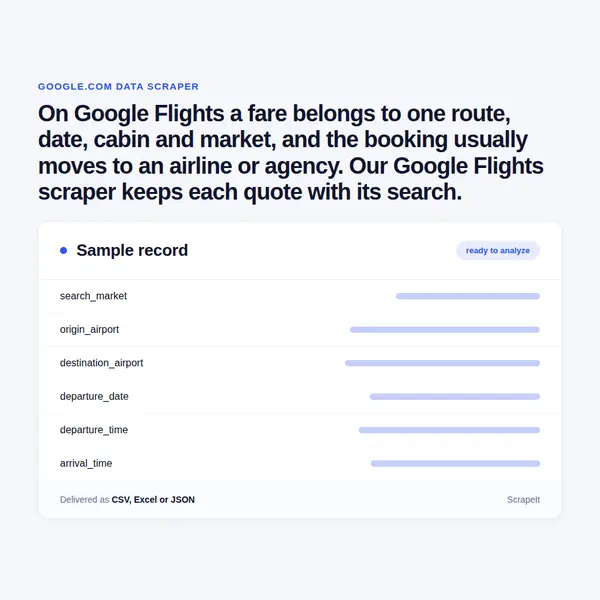
You give us the searches: origin and destination airports or cities, departure dates or a rolling window such as every Friday for the next eight weeks, trip type, cabin, passenger mix and the market whose fares you need. We build the crawlers, run them daily, weekly or on demand, and repair them when Google Flights changes its layout. Pacing, proxy rotation in the countries you price from, CAPTCHA handling and page rendering are part of the service.
Every capture is stamped with the exact search behind it and the time it ran, and field documentation arrives with the first file. The project assessment costs nothing, and a sample built on your own routes can be ordered before any schedule starts.
A Google Flights scraper starts from a search, not from a product page. A flight has no fixed price there, only a quote for a route, dates, cabin, party size and the market the search comes from, so every row carries the search that produced it next to the flight options listed for it.
Segments stay linked to their itinerary, so a two-leg connection becomes two rows under one itinerary id, and a codeshare is not counted twice under two airline names.
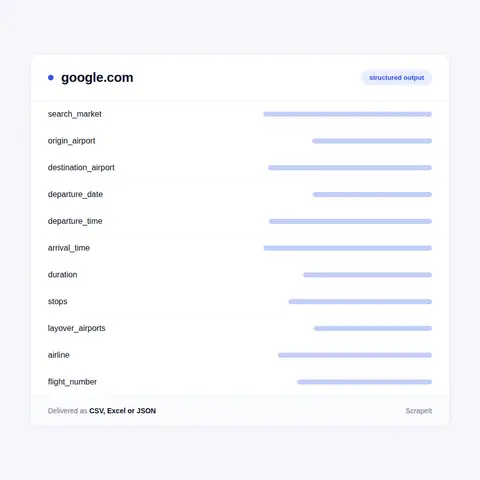
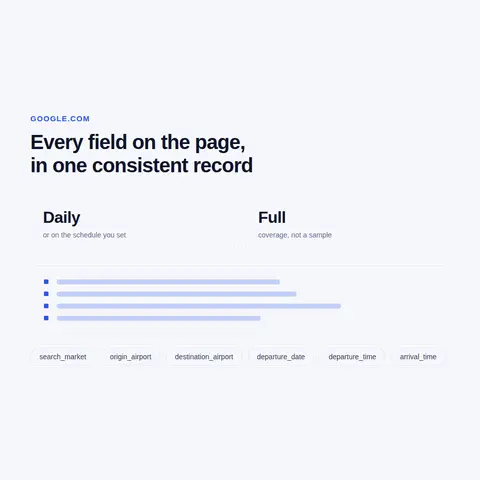
Google keeps Tracked flight prices for signed-in visitors. We build the history another way: the same searches repeated on a schedule, each capture saved with its timestamp, so the price tracker becomes a table you own - fare by route, by departure date and by days left before departure.
Several public views go beyond a single search:
Run on a schedule, route pages add historical data on typical fares and airline frequency to the fare snapshots.
Google Flights is the flight search of Google's travel pages, alongside Hotels, Vacation rentals and Explore. It compares fares from airlines and online travel agencies; picking a flight usually opens the airline's or the agency's own site to finish the purchase. For a buyer of data that makes it a reading of the market at the moment of search rather than one seller's price list.
The search form takes a trip type, passengers split into adults, children aged 2 to 11 and infants in a seat or on a lap, four cabin classes and one or several airports at each end. Results can be filtered by stops, airlines, bags, price, times, emissions, connecting airports and duration, and Top flights, the default order, weighs price against duration, the number of stops and airport changes during a layover.
Language, location and currency are three separate settings, and the footer links to country versions such as Google Flights Canada, United Kingdom, India and Australia, Google Vuelos for Spain and Google Voos for Brazil. Static route pages and the Explore map sit beside the search form and need no travel dates, so a project can cover many city pairs without choosing any.
Get a Quote
Developers

Customers worldwide

Pages extracted

Hours saved for our clients
€199 / one-time
setup fee - included
€169 / mo
setup fee €499
€229 / mo
setup fee €499
€349 / mo
setup fee €499
€549 / mo
setup fee €799
Delivery: CSV, JSON or XLSX files, our API or a JSON feed. MCP server on request.
Full plan details →Airline pricing teams scrape Google Flights to see their own fares the way a traveller does: next to every rival on the route, in the traveller's currency, with the stops and duration that decide the click. A daily pull of the same city pairs shows who undercuts whom, on which departure days, and how close to departure the gap opens.

Since 2022, weekly car rental and, from 2025, hotel prices from Booking.com for a tourism organization comparing its destination with rivals.
Learn More
Four datasets for a studio that builds directory websites: Hawaii stays from Booking.com, UK schools and tattoo studios from Google Maps, GetInked profiles.
Learn More
Daily scraping of Booking.com services - hotels, flights, car rentals, and attractions - with best-price selection across global destinations.
Learn MoreLearn how to use web scraping to solve data problems for your organization

If you work in travel tech, an OTA, a hotel chain, or at an airport, you are in a price-and-availability arms race. Fares change by the hour, room inventory disappears in minutes, and competitors test new bundles and ancillaries constantly.

Leveraging advances in technology, the AI-powered web scraper has skyrocketed in demand and is helping to expand capabilities by automating tedious daily tasks and speeding up data collection from thousands of websites several times over.

Web scraping is a method of obtaining web data by extracting it from pages of web resources with the help of a program, that is, in automatic mode. It is used to syntactically convert web pages into more usable forms.
ScrapeIt is a managed web scraping service: we build, run and repair the crawlers and deliver the dataset, so your analysts work with fares instead of browser sessions. Flight search engines are familiar ground - results that exist only for one date, market and passenger count and change between two runs. Plans start from EUR 169 a month, or EUR 199 for a one-time extract. Personal data is handled under GDPR, and our searches never enter a traveller's name or payment details.
Yes. The ScrapeIt Google Flights API returns the route, departure and arrival times, airline and flight number, stops, cabin class and fare as JSON from an endpoint we host, refreshed on the schedule you set. Rows can also be delivered as CSV or XLSX files, through a JSON feed or loaded straight into your database.
Yes. Fares, schedules, airlines, emissions estimates and route pages are shown to any visitor without an account. We collect only publicly available data - everything a visitor can see on Google Flights - and we collect it legally. Tracked prices and anything else tied to a Google account stay out of the dataset.
Yes. The same route can be searched with different location and currency settings - the United States in dollars, the United Kingdom in pounds, Canada in Canadian dollars, a euro country in euros - and each row keeps its market, currency and capture time. Google notes that the displayed currency can differ from the one used to buy the ticket, so we never convert one market's fare into another's.
We track prices in Google Flights by repeating the same searches - route, dates, cabin, passengers, market - on a fixed schedule and storing every capture. Daily runs suit departures in the next few weeks, weekly runs later dates. The result is a fare history per flight and departure date that shows how prices move as departure approaches.
Yes. Each flight option arrives as one row with the search parameters, times, stops, layover airports, airlines, emissions and fare, in an Excel (XLSX) file or as CSV, JSON, JSONLines or XML. After every run the files can land in Google Drive, Dropbox, Amazon S3 or an SFTP folder.
Step 1 - Make a Request
You share your needs, expectations, and desired timeframe. We’ll suggest the best solution based on your request and budget.
Step 2 - Configuring Custom Web Crawlers
Our specialists configure the crawlers and extract a sample dataset for your review before proceeding with the full-scale extraction.
Step 3 - Collect and Deliver
Once you approve the sample, we launch the project and start full data collection. We gather, filter, and structure the data for easy use, delivering it on time in your preferred format.
Step 4 - Maintain and Support
Our team manages ongoing processes, monitors website changes, and supports all data extraction cycles. We can also help integrate data into your systems or create dashboards to simplify analysis.
Google Flights data from €169/month. Free project assessment, reply within 1 business day.

Scrapeit Sp. z o.o.
10/208 Legionowa str., 15-099, Bialystok, Poland
KRS: 0000996672
NIP: 5423457175
REGON: 523384582