Flight Pricing at Scale: Opodo Scraped with Full Filter Logic
Automated scraping of filtered flight ticket data from Opodo.com, including complex on-page interactions for airline and pricing selection.
Learn More
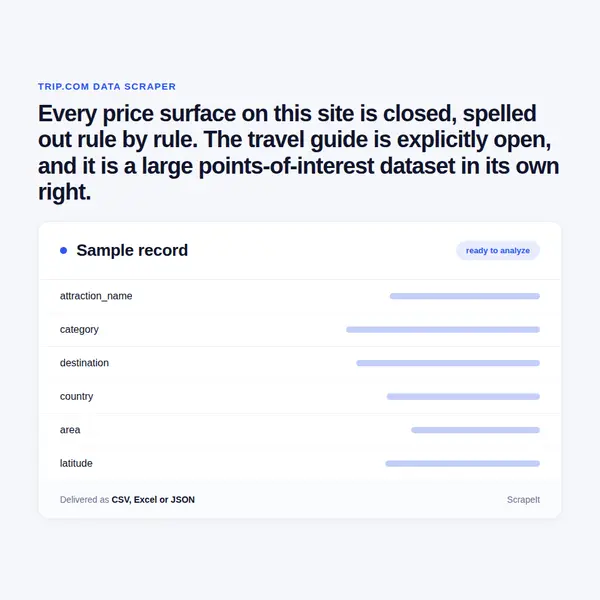
Every price surface on this site is closed, spelled out rule by rule. The travel guide is explicitly open, and it is a large points-of-interest dataset in its own right.
ScrapeIt runs the collection as a managed service. You name the destinations and categories; we collect the open travel guide sections, type attractions, food and shopping separately, and hand back CSV, JSON, Excel or a push into your warehouse.
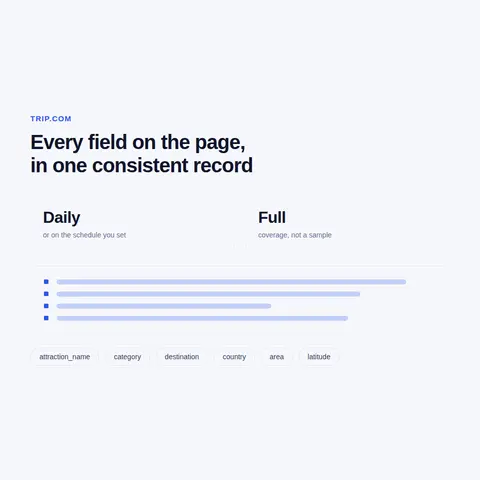
Guide content changes slowly, so periodic collection with change records fits better than a daily crawl and is what we quote.
We collect only the sections the crawl rules open and pace requests. Prices, reviews and bookings are closed and out of scope. Content is copyrighted, so the dataset is for analysis rather than republication, and your counsel should see the use case before the project starts.
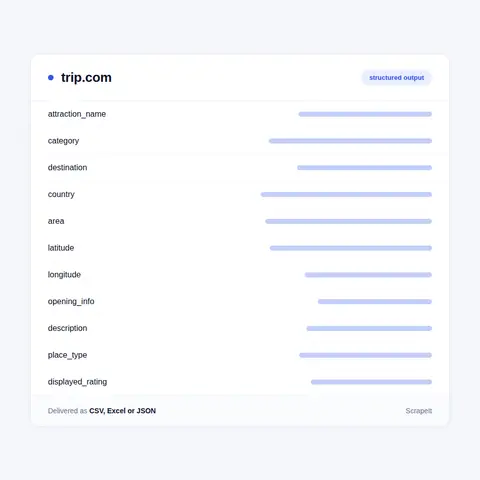
Attraction records carry the attraction name, category, destination city, country, address or area as published, coordinates where published, opening information, the description and the attraction page address.
Destination records carry the destination name, country, the guide sections published for it and the attractions, shops and food listings linked from it.
Local food and shopping records are their own types, since a restaurant recommendation and a museum are different kinds of place and a points-of-interest dataset that merges them is harder to use.
Review text, comment counts drawn from comment pages and ticket prices are not collected, because the crawl rules close those surfaces. Where an attraction page itself shows a headline rating, it is recorded as displayed and labelled as such.
Every row carries the collection timestamp and the guide section it came from, so coverage can be audited against the open sections.
Points-of-interest assembly is the main use: attractions, food and shopping by destination, with category and location, ready to join to a client's own map or recommendation data.
Destination coverage comparison shows how deeply the guide covers each city and which categories dominate, which is useful to destinations measuring how they are presented to international travellers.
Category mix analysis across cities answers what kinds of attractions a global platform features where, a question tourism marketers ask and rarely get structured data for.
Limits, stated once and held: no hotel lists or hotel detail pages, no flight fares, no car hire, no reviews, no comments, no ticket booking - all closed in the crawl rules. The travel guide sections that the rules explicitly open are the scope.
Trip.com is the international brand of Trip.com Group, one of the largest online travel companies, selling flights, hotels, trains, car hire and attraction tickets across many markets, with a large destination and attraction guide alongside.
Its crawl rules draw the same line we found across the travel sector, but with unusual precision. Hotel lists and hotel detail pages by identifier are closed. Flight fare pages, route ticket pages and the flight query interface are closed. Car hire lists and bookings are closed. Reviews are closed. Attraction comments and ticket booking are closed.
The travel guide is handled carefully rather than wholesale: the guide root is closed, and then specific sections are explicitly opened - destinations, attractions, shops, local food and guidebooks. The attraction pages we checked responded with substantial content.
So the collectable part of Trip.com is not its prices and not its reviews. It is a very large, structured catalogue of places.
Get a Quote
Developers

Customers worldwide

Pages extracted

Hours saved for our clients
€199 / one-time
setup fee - included
€169 / mo
setup fee €499
€229 / mo
setup fee €499
€349 / mo
setup fee €499
€549 / mo
setup fee €799
Travel data briefs usually start with prices, and on this site, as on most of the sector, prices are closed in the crawl rules. We do not collect them and we say so first.
What the site opens instead is a structured guide to a great many destinations worldwide: attractions with categories and locations, local food, shopping and guidebooks. For tourism boards, travel app builders, mapping products and anyone assembling a points-of-interest database, that is directly useful data, and it is data the platform has chosen to make crawlable.
The second reason is coverage. A global travel platform maintains guides for destinations that local sources cover in different languages and formats. One consistent schema across many cities is much easier to work with than stitching together regional sources.
The third is that the boundaries are unusually explicit. The rules name the exact subsections that are open, so the scope of a project is a reading of the file rather than a judgement call. That makes compliance easy to demonstrate, which matters when the data feeds a commercial product.

Automated scraping of filtered flight ticket data from Opodo.com, including complex on-page interactions for airline and pricing selection.
Learn More
Daily scraping of Booking.com services - hotels, flights, car rentals, and attractions - with best-price selection across global destinations.
Learn MoreLearn how to use web scraping to solve data problems for your organization
If you work in travel tech, an OTA, a hotel chain, or at an airport, you are in a price-and-availability arms race. Fares change by the hour, room inventory disappears in minutes, and competitors test new bundles and ancillaries constantly.

Leveraging advances in technology, the AI-powered web scraper has skyrocketed in demand and is helping to expand capabilities by automating tedious daily tasks and speeding up data collection from thousands of websites several times over.
Web scraping is a method of obtaining web data by extracting it from pages of web resources with the help of a program, that is, in automatic mode. It is used to syntactically convert web pages into more usable forms.
ScrapeIt is a managed extraction company, not a tool you have to learn. Our team follows the open guide sections as the site restructures them, keeps each place typed correctly, and repairs collection when page templates change.
You see a sample first, in your format, over the destinations you actually cover, so you can judge the attraction data on real cities.
No. The crawl rules close hotel lists, hotel detail pages, flight fare and ticket pages, and car hire. We do not collect them. This is the same line the whole travel sector draws, and Trip.com draws it very precisely.
The travel guide sections the rules explicitly allow: destinations, attractions, shops, local food and guidebooks. The attraction pages we checked are substantial, and together they form a large catalogue of places worldwide.
No. Reviews and attraction comments are closed in the crawl rules. Where an attraction page shows a headline rating itself, we record it as displayed and label it - but review text is out of scope.
Tourism boards, travel app builders, mapping products and anyone assembling a points-of-interest database. A consistent schema across many destinations is much easier to use than stitching together regional sources.
The rules name the open subsections exactly, so scope is a reading of the file rather than a judgement call. We record the guide section on every row, which makes the boundary auditable after delivery.
Step 1 - Make a Request
You share your needs, expectations, and desired timeframe. We’ll suggest the best solution based on your request and budget.
Step 2 - Configuring Custom Web Crawlers
Our specialists configure the crawlers and extract a sample dataset for your review before proceeding with the full-scale extraction.
Step 3 - Collect and Deliver
Once you approve the sample, we launch the project and start full data collection. We gather, filter, and structure the data for easy use, delivering it on time in your preferred format.
Step 4 - Maintain and Support
Our team manages ongoing processes, monitors website changes, and supports all data extraction cycles. We can also help integrate data into your systems or create dashboards to simplify analysis.

Scrapeit Sp. z o.o.
10/208 Legionowa str., 15-099, Bialystok, Poland
NIP: 5423457175
REGON: 523384582