Flight Pricing at Scale: Opodo Scraped with Full Filter Logic
Automated scraping of filtered flight ticket data from Opodo.com, including complex on-page interactions for airline and pricing selection.
Learn More
Alaska sells the same seat twice: once in dollars, once in points. We extract both, keep the fare family attached to every price, and deliver Alaska Airlines data on your schedule.
Plans from €169/month · Free project assessment · Reply within 1 business day
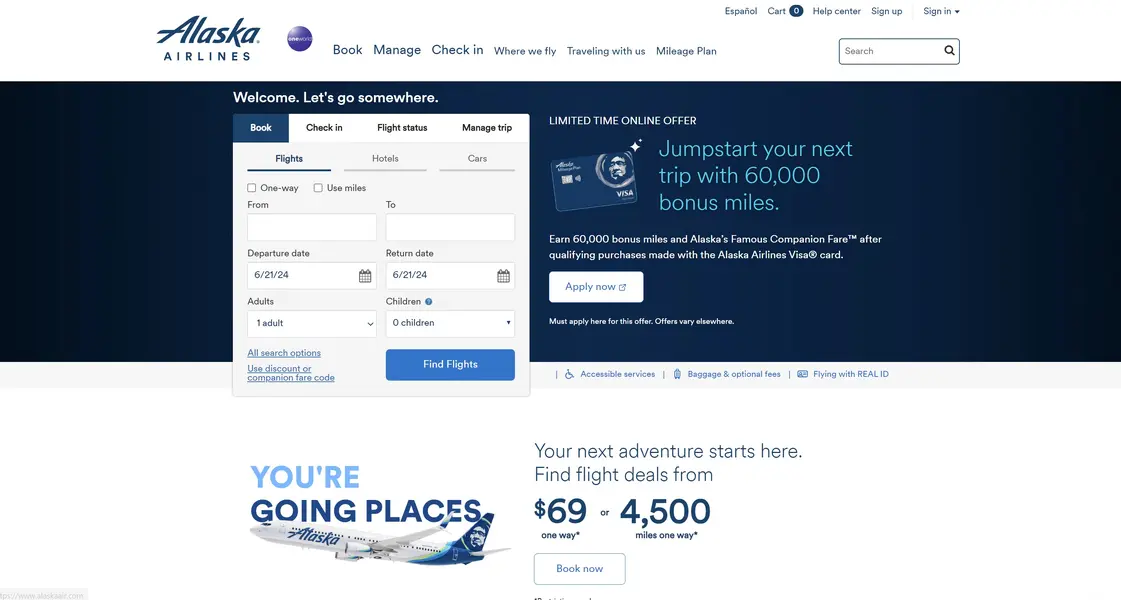
We build and run the Alaska Airlines scraper and hand over the result. You pick the routes, cabins, departure date window and refresh rate; the output arrives as CSV, JSON, XLSX or an API endpoint your systems call.
Anti-bot handling is part of the service. Proxy rotation, CAPTCHA solving and adaptive crawling sit on our side, and you never build or maintain that layer. We also pace collection rather than hammering a booking engine, because each search costs the operator real work. Nothing behind a login or a member account is in scope.
Schema design, deduplication, currency handling and monitoring come with it. When the site changes we repair the crawler, and the delivery keeps its shape so nothing downstream breaks.
A stored airfare record is only useful if it carries everything that makes it comparable later. We capture the whole row, not the headline number.
Collection covers public fare and schedule data only. No passenger data and no booking data is gathered at any point.
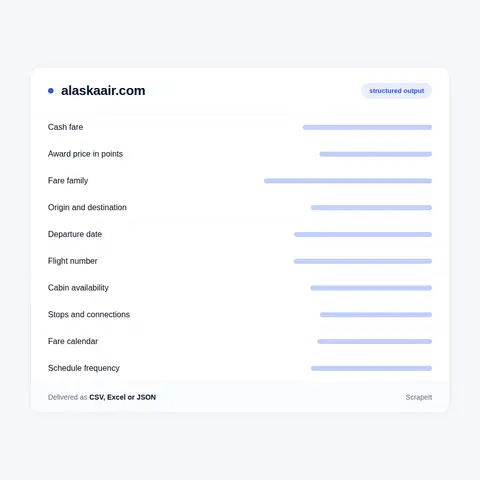
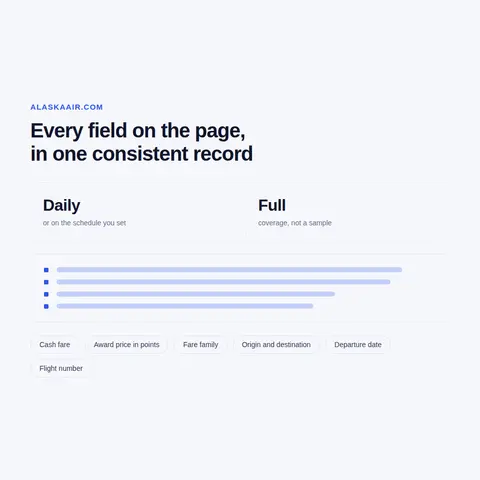
The two currency problem is what catches teams out. Switching a search to price in points does not relabel the same result set. Award space is inventory of its own: a date can carry a cash fare in every cabin and no award seat at all, or an award seat up front when the cash cabin has priced itself out of reach. Award levels move by route, by cabin and by whether the flight is operated by Alaska, by Hawaiian or by a partner airline in the Atmos Rewards network, which spans more than thirty carriers including oneworld members. None of it can be derived from the cash fare, so we run the route in both currencies and store the two records against the same flight key.
Fare families are the second trap. A price without its brand compares to nothing. Saver is the restricted end of the ladder, with seats assigned at check-in and only limited changes, and Alaska has published that Saver fares stop earning Atmos Rewards points for travel from 1 August 2026. Main, Premium Class, First Class and the 787 Business Class cabin each carry a different bag, seat, change and upgrade profile. We attach the brand and its inclusions to every price we extract.
The Hawaiian side now lives inside the same storefront rather than beside it. Treating alaskaair.com as one network instead of two gets you the merged picture, including the Hawaii and Pacific flying, in a single pass.
Alaska Airlines sells direct. Every price on alaskaair.com comes from the carrier that operates the flight, so there is no aggregator layer, no supplier margin and no third party inventory sitting in between. That changes what a collection has to do. On a metasearch site a route carries one comparable number. On an airline site the same seat carries two prices in two currencies: a cash fare in dollars, and an award price in points through Atmos Rewards, the loyalty program that replaced Mileage Plan. The booking engine returns one or the other depending on whether the search is set to price in miles, and the two move on separate logic.
The storefront is also a merged one. Alaska Air Group combined with Hawaiian Airlines in September 2024, the two carriers received a single operating certificate on 29 October 2025, and the single passenger service system cut over in April 2026. Since then every flight carries the AS code, Hawaiian services are displayed and sold on alaskaair.com under their own brand and tail, and the combined group publishes service to more than 140 destinations across North America, Latin America, Asia and the Pacific.
Around the booking engine sits a large public layer built for search: destination pages per city, city pair route pages carrying a day by day fare calendar, a route map, a new routes page and a schedule tool that answers by route or by flight number. That layer is a dataset in its own right, and it is usually the first slice of Alaska Airlines data a buyer asks for.
Get a Quote
Developers

Customers worldwide

Pages extracted

Hours saved for our clients
€199 / one-time
setup fee - included
€169 / mo
setup fee €499
€229 / mo
setup fee €499
€349 / mo
setup fee €499
€549 / mo
setup fee €799
Delivery: CSV, JSON or XLSX files, our API or a JSON feed. MCP server on request.
Full plan details →Airfare data from a direct seller answers questions a metasearch feed cannot. The price is the airline's own, the fare brand is stated rather than inferred, and the award side exists at all.
Revenue management teams at competing carriers watch the same city pairs and need the fare as it was offered on the day, not a reconstruction. Competitive fare tracking only works when the price, the fare family and the advance purchase distance sit in the same row, because a low number attached to Saver and a similar number attached to Main are different market signals.
Corporate travel managers and travel management companies test negotiated rates against the public fare on the same route and date, with Main and Premium Class separated out, since policy usually permits one and not the other.
Loyalty teams, card issuers and award search products need the second currency. A point can only be valued if the cash fare and the award price for the same flight on the same day are captured together, which is why award availability and mileage pricing belong in the same run.
Route planners and market analysts use the network layer: which city pairs Alaska publishes, which are new, which quietly vanish, and how Hawaii and transpacific flying settled after two carriers became one selling system. Deal sites and airline pricing intelligence products lean on the fare calendar, because a month of daily low fares per route is the plainest way to show where prices sit.

Automated scraping of filtered flight ticket data from Opodo.com, including complex on-page interactions for airline and pricing selection.
Learn More
Daily scraping of Booking.com services - hotels, flights, car rentals, and attractions - with best-price selection across global destinations.
Learn MoreLearn how to use web scraping to solve data problems for your organization

If you work in travel tech, an OTA, a hotel chain, or at an airport, you are in a price-and-availability arms race. Fares change by the hour, room inventory disappears in minutes, and competitors test new bundles and ancillaries constantly.

Leveraging advances in technology, the AI-powered web scraper has skyrocketed in demand and is helping to expand capabilities by automating tedious daily tasks and speeding up data collection from thousands of websites several times over.

Web scraping is a method of obtaining web data by extracting it from pages of web resources with the help of a program, that is, in automatic mode. It is used to syntactically convert web pages into more usable forms.
ScrapeIt is a managed web scraping agency. We have built travel pipelines against airlines, metasearch engines and booking platforms, and we run them as a service instead of shipping you a tool to babysit. You describe the routes and the fields, we handle collection, maintenance and delivery, and clean Alaska Airlines data lands on the schedule you set. Pricing follows volume and refresh rate, and most teams start with a small paid pilot on a handful of routes.
Yes. The ScrapeIt Alaska Airlines API returns cash fares, Atmos Rewards points prices with their cash taxes, fare families with bag and change inclusions, flight numbers and the day by day fare calendar as JSON from an endpoint we host, refreshed on the schedule you set. The same data also comes as CSV or XLSX files or straight into your database.
Yes. The route is searched in both currencies and the two records are stored against the same flight, so you get the cash fare, the Atmos Rewards points price, the cash taxes charged with the points, and the cabin each one applies to. Award availability is separate inventory, so a date with a cash fare in every cabin can still show no award seat, and that absence is recorded rather than dropped.
Cadence is yours to choose: hourly on a short list of priority city pairs, daily across a wider route set, or weekly for network and schedule tracking. Volume is a question of pacing rather than a hard ceiling, since we deliberately spread searches over time instead of bursting them. Tell us the routes, the departure date horizon and how fresh the numbers need to be, and we size the run to match.
The brand travels with the price. Every row is labelled Saver, Main, Premium Class, First Class or Business Class, and the inclusions that define it are captured too: bags, seat selection before check-in, change and cancellation treatment, standby, upgrade eligibility and points earning. Without that label a stored fare is not comparable across dates, routes or carriers.
Delivery is CSV, JSON, XLSX or an API endpoint, pushed to cloud storage, an FTP target or a webhook on the schedule you set, with a fixed schema so downstream jobs stay stable. Scope is public fare, schedule and route network information. Nothing behind a member account, no personal data and no booking records.
Step 1 - Make a Request
You share your needs, expectations, and desired timeframe. We’ll suggest the best solution based on your request and budget.
Step 2 - Configuring Custom Web Crawlers
Our specialists configure the crawlers and extract a sample dataset for your review before proceeding with the full-scale extraction.
Step 3 - Collect and Deliver
Once you approve the sample, we launch the project and start full data collection. We gather, filter, and structure the data for easy use, delivering it on time in your preferred format.
Step 4 - Maintain and Support
Our team manages ongoing processes, monitors website changes, and supports all data extraction cycles. We can also help integrate data into your systems or create dashboards to simplify analysis.
Alaska Airlines data from €169/month. Free project assessment, reply within 1 business day.

Scrapeit Sp. z o.o.
10/208 Legionowa str., 15-099, Bialystok, Poland
NIP: 5423457175
REGON: 523384582