Flight Pricing at Scale: Opodo Scraped with Full Filter Logic
Automated scraping of filtered flight ticket data from Opodo.com, including complex on-page interactions for airline and pricing selection.
Learn More
A travel insurance comparison is only as good as its coverage terms. The published product pages are where those terms are stated, before any quote is asked for.
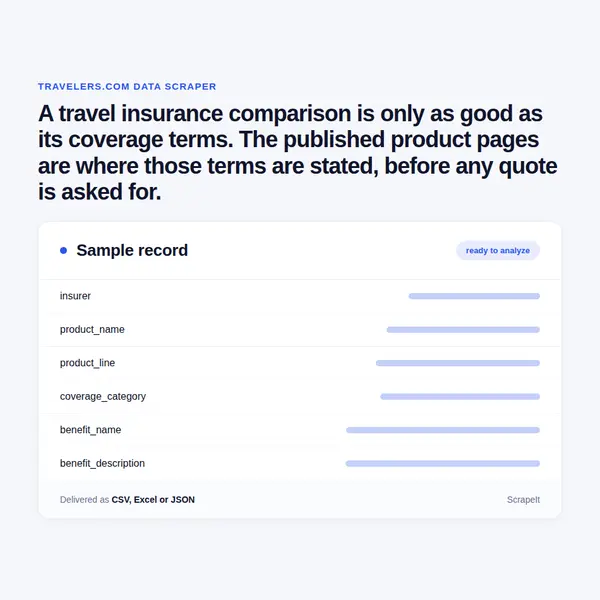
ScrapeIt runs the collection as a managed service. You name the insurers and product lines; we collect the published product pages, break coverage into categories, keep conditions and exclusions verbatim, and hand back CSV, JSON, Excel or a push into your warehouse.
Product pages change occasionally rather than daily, so periodic collection with change records is what fits and what we quote.
We collect published product information only and honour the crawl rules. Quote flows involve personal data and are out of scope. Nothing we deliver is insurance advice. Content is copyrighted, so the dataset is for analysis rather than republication, and your counsel should see the use case before the project starts.
Product records carry the product name, the coverage categories described, the benefits named, the conditions and exclusions stated on the page, and the page address.
Coverage category is a first class field, because comparison work is category by category: cancellation against cancellation, medical against medical. A block of product text is not comparable to anything until it is broken down.
Stated conditions and exclusions are kept as their own records rather than summarised. In insurance the exclusion is often the finding, and paraphrasing it risks changing what it says.
Jurisdiction notes are recorded where the page gives them, since insurance in the United States is regulated state by state and product availability and terms can vary accordingly.
Every row carries the collection timestamp, so a change to product wording becomes a dated record.
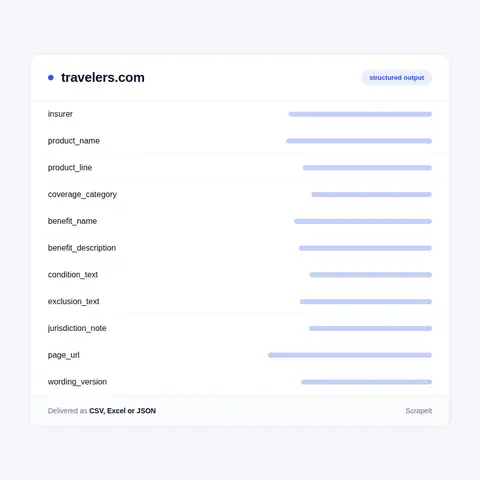
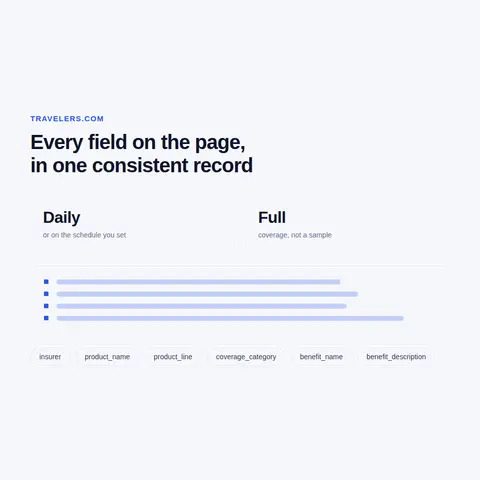
Coverage comparison across insurers is the main use: which benefit categories each product describes, with the stated conditions side by side, broken down so that like is compared with like.
Wording change tracking records when product pages are revised and what changed, which matters to anyone whose own materials describe an insurer's cover.
Travel seller content support - making sure a booking platform's description of optional insurance matches the insurer's own published terms - is a practical, compliance-flavoured use of the same data.
Limits: no quote flows, no personal details, no account areas, and nothing that could be read as insurance advice. We collect what the insurer publishes; interpreting it for a customer is a regulated activity that belongs to licensed people.
Travelers is one of the largest property and casualty insurers in the United States, selling home, auto, business and specialty cover. Travel insurance is one of its personal lines, published on its own product page.
That page is substantial. It explains what travel insurance covers and why travellers buy it, naming the kinds of benefit a policy can include - trip cancellation, medical expenses, and cover for baggage and personal effects among them.
For travel businesses and comparison products, that published material is the valuable part. It is where an insurer states its coverage categories and conditions in plain language, before any quote is requested.
The quote process is different. It asks for personal details - who is travelling, where from, the cost of the trip - and it is not something we collect. The crawl rules close the site search and preview variants; the product pages are open.
Get a Quote
Developers

Customers worldwide

Pages extracted

Hours saved for our clients
€199 / one-time
setup fee - included
€169 / mo
setup fee €499
€229 / mo
setup fee €499
€349 / mo
setup fee €499
€549 / mo
setup fee €799
Travel insurance comparison has two layers, and only one of them is suitable for collection.
The published layer is product information: what the cover is for, which kinds of benefit exist, what conditions apply. It is written for the public, it is stable, and it is exactly what a comparison or a travel seller needs to explain the product accurately.
The quote layer is personal. A price depends on the traveller's age, residence, destination and trip cost, and obtaining one means submitting those details. Automating that would mean fabricating personal information or collecting it, and neither belongs in a data project. We do not touch quote flows.
The second reason the published layer matters is change over time. Product wording is revised, and for a comparison product the date a condition changed is as important as the condition itself. Collected regularly, the product pages become a dated record of what the insurer said and when.
The third is scope. Travelers is one insurer. A useful travel insurance dataset compares several, and we scope it that way rather than letting one product page stand in for the market.

Automated scraping of filtered flight ticket data from Opodo.com, including complex on-page interactions for airline and pricing selection.
Learn More
Daily scraping of Booking.com services - hotels, flights, car rentals, and attractions - with best-price selection across global destinations.
Learn MoreLearn how to use web scraping to solve data problems for your organization
If you work in travel tech, an OTA, a hotel chain, or at an airport, you are in a price-and-availability arms race. Fares change by the hour, room inventory disappears in minutes, and competitors test new bundles and ancillaries constantly.

Leveraging advances in technology, the AI-powered web scraper has skyrocketed in demand and is helping to expand capabilities by automating tedious daily tasks and speeding up data collection from thousands of websites several times over.
Web scraping is a method of obtaining web data by extracting it from pages of web resources with the help of a program, that is, in automatic mode. It is used to syntactically convert web pages into more usable forms.
ScrapeIt is a managed extraction company, not a tool you have to learn. Our team keeps coverage categories consistent across insurers, preserves conditions verbatim, and records when product wording changes.
You see a sample first, in your format, over the insurers you actually compare, so you can check the category breakdown against the published pages yourself.
Yes. Alongside its home, auto and business lines, Travelers publishes a travel insurance product page describing cover such as trip cancellation, medical expenses, and baggage and personal effects.
No. A quote requires personal details - who is travelling, where from, the trip cost. Automating that would mean fabricating or collecting personal information, and neither belongs in a data project. We collect the published product terms instead.
Because in insurance the exclusion is often the point, and paraphrasing risks changing its meaning. A comparison built on summarised exclusions can mislead the very customers it is meant to help.
They can - insurance in the United States is regulated state by state. Where the product page gives jurisdiction notes, we record them, so a comparison does not present one state's terms as universal.
No. We collect what the insurer publishes. Interpreting cover for a particular customer is a regulated activity that belongs to licensed professionals, not to a dataset.
Step 1 - Make a Request
You share your needs, expectations, and desired timeframe. We’ll suggest the best solution based on your request and budget.
Step 2 - Configuring Custom Web Crawlers
Our specialists configure the crawlers and extract a sample dataset for your review before proceeding with the full-scale extraction.
Step 3 - Collect and Deliver
Once you approve the sample, we launch the project and start full data collection. We gather, filter, and structure the data for easy use, delivering it on time in your preferred format.
Step 4 - Maintain and Support
Our team manages ongoing processes, monitors website changes, and supports all data extraction cycles. We can also help integrate data into your systems or create dashboards to simplify analysis.

Scrapeit Sp. z o.o.
10/208 Legionowa str., 15-099, Bialystok, Poland
NIP: 5423457175
REGON: 523384582