RVUSA Data for 2 Model Years Plus RV Model Tags Rebuilt from Filters
RVUSA catalogs by model year and a full feature-tag list per RV model on RVing Planet, rebuilt from its filters, for a returning client.
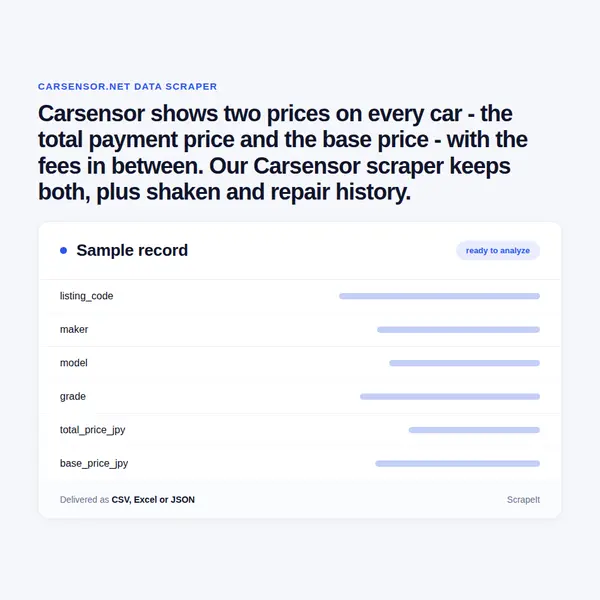
Carsensor shows two prices on every car - the total payment price and the base price - with the fees in between. Our Carsensor scraper keeps both, plus shaken and repair history.
Plans from €169 a month · Free project assessment · Reply within 1 business day
CSV · Excel · JSON · XML · FTP · SFTP · Amazon S3 · Google Cloud
API, JSON feed or CSV, XLSX and JSON files
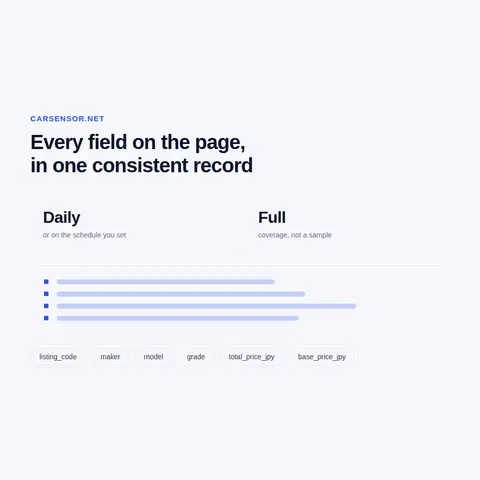
ScheduleOne-time, monthly, weekly, daily or 3 times a day
Carsensor pages, filters, fields and a schedule
Built, monitored and repaired by our team
API, JSON feed or CSV, XLSX and JSON files
You choose the scope - 国産車 or 輸入車, certain makers and models, regions or single prefectures, price and year bands, or a list of dealers - and how often to repeat. We build the Carsensor crawler, run it and repair it when the site changes, with rendering, proxy rotation, pacing and CAPTCHA handling included. Japanese labels and coded values are mapped to English column names, with the original text kept alongside, so an analyst in Tokyo and one in Rotterdam read the same file.
Prices shown in 万円 (units of ten thousand yen) are converted to whole yen. A sample comes first, and the field documentation travels with the dataset.
Each car has its own page at /usedcar/detail/ plus a listing code such as AU7339096046 - the code that also rides along as BKKN in every link on the page, and the key we use between runs. The site is entirely in Japanese; below, the site's label comes first, then its meaning.
A field the dealer leaves empty stays empty in the file; we never infer a repair history from photos.
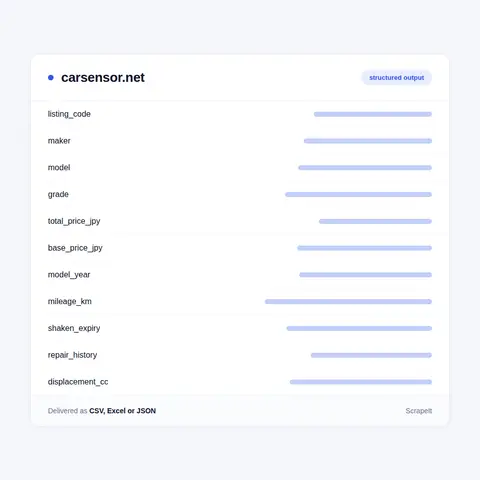
The nationwide list sorts by 新着順 (newest), total payment price, base price, year, mileage, displacement, shaken and repair history, and filters by maker, model and grade, region and city, colour, equipment and checkboxes such as 修復歴なし or 支払総額あり. Every maker, model and region carries a stock count, so we size a slice before crawling it and cut the large ones by prefecture and price band until every car is reached.
Each dealer has a shop page under /shop/ with its prefecture and a numeric shop ID, a stock list of every car it advertises and a クチコミ review page. A dealer review page gives the 総合評価 overall score, category scores for 接客 (service), 雰囲気 (atmosphere), アフター (aftercare) and 品質 (quality), and per review a title, score, posting date, the car bought and the purchase month, followed by the dealer's reply. Reviewer nicknames are left out by default.
For model-level work the 中古車相場表 market price table cross-tabulates base price against year, base price against mileage and year against mileage, with a listing count in each cell. Daily runs keyed on the listing code add what no single page shows: the price history of each car and the day it left the market.
Carsensor (カーセンサー) is Japan's used car search site run by Recruit. It runs in Japanese only, with prices in yen, and every listing card names the shop selling the car - franchised メーカー系販売店 and independent dealers alike - so each car is tied to an address, opening hours and a review record.
Search starts from maker and model, region or body type, with separate entry points for 国産車 (domestic cars), 輸入車 (imported cars, also served by the カーセンサーエッジ site) and 軽自動車 (kei cars). Navigation follows Japanese geography: the breadcrumb runs from maker to model to prefecture to city, and stock counts are shown for regions such as 関東, 東海 and 関西.
Two things shape the data. Prices appear both as the all-in 支払総額 and as the 車両本体価格, so any comparison has to say which one it uses. And shaken, Japan's periodic road-worthiness inspection, gives every car an expiry that buyers weigh. Around the listings sit 車買取 (selling your car), loans and insurance, 中古車リース (used car leasing) and the カーセンサーアフター保証, a paid aftercare warranty.
Delivery: CSV, JSON or XLSX files, our API or a JSON feed. MCP server on request.
Full plan detailsThe Japanese used car market prices cars in its own way, and Carsensor's fields make that visible.
RVUSA catalogs by model year and a full feature-tag list per RV model on RVing Planet, rebuilt from its filters, for a returning client.
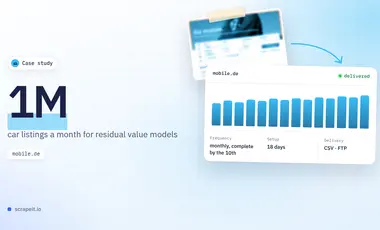
A monthly snapshot of mobile.de for an automotive data company: cars and vans up to 12 years old, delivered in the client's own CSV template.
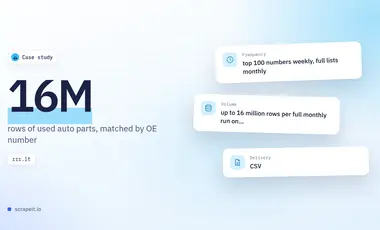
Weekly and monthly prices of used parts by OE number from rrr.lt and a Scandinavian marketplace, for a car dismantling business.
Learn how to use web scraping to solve data problems for your organization
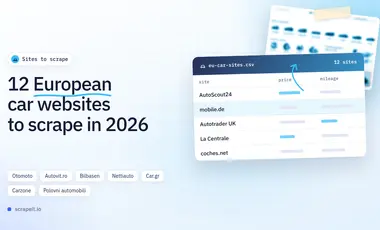
Twelve car marketplaces across Europe compared as data sources, from AutoScout24 and mobile.de to Otomoto, Bilbasen and Car.gr: what each shows, how VAT, mileage, inspection and seller fields differ by market, and how to merge them into one schema.
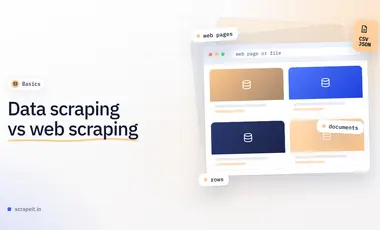
Data scraping is the wide term that includes documents, scans and old screens; web scraping is the part that works on websites. We compare sources, daily work, output and cost drivers, give a briefing checklist and walk through two of our projects.
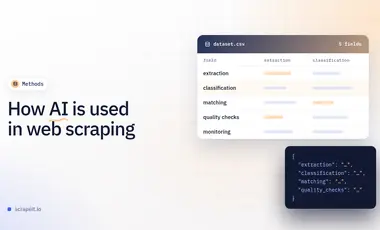
Leveraging advances in technology, the AI-powered web scraper has skyrocketed in demand and is helping to expand capabilities by automating tedious daily tasks and speeding up data collection from thousands of websites several times over.

ScrapeIt runs web scraping as a managed service: we build the crawlers, keep them running and deliver the data in the format and on the schedule you choose. Japanese dealer marketplaces like Carsensor suit that model - every row needs label mapping, yen unit conversion and a stable listing key before it is usable outside Japan. We assess each project free of charge. Plans start from EUR 169 a month, or EUR 199 for a one-time extract.
Still unsure? Write to info@scrapeit.io
Yes. Our ScrapeIt Carsensor API serves the listing code, 支払総額, 車両本体価格, 年式, 走行距離 and 修復歴 in JSON through an endpoint hosted by us, updated as often as you need. Files work too - CSV, XLSX or a Google Cloud Storage bucket - or we write the rows straight into your database.
Yes. Prices, specifications, shaken dates, quality assessments and dealer pages are open to every visitor. We collect only publicly available data - everything a visitor can see on Carsensor - and we collect it legally. Reviewer nicknames on dealer review pages stay out of the file unless a project needs them.
Yes. Both sit on the car page, labelled 支払総額 and 車両本体価格, with the fees between them. We deliver both in whole yen and add the difference as its own column; where a dealer shows only one, the other stays empty.
Yes. 修復歴 (repair history) appears on the card and the car page, and the 車検 field gives the shaken expiry. Both are also filters and sort keys, so a dataset can be limited to cars without repair history from the start.
Yes. Column names come in English, coded values such as AT/CVT or a repair-history flag are mapped to English, and the original Japanese stays in a parallel column. Free-text dealer notes stay in Japanese unless you ask for a translation.
You share your needs, expectations, and desired timeframe. We'll suggest the best solution based on your request and budget.
Our specialists configure the crawlers and extract a sample dataset for your review before proceeding with the full-scale extraction.
Once you approve the sample, we launch the project and start full data collection. We gather, filter, and structure the data for easy use, delivering it on time in your preferred format.
Our team manages ongoing processes, monitors website changes, and supports all data extraction cycles. We can also help integrate data into your systems or create dashboards to simplify analysis.
Tell us which sites, which fields and how often. A couple of lines is enough to start.
Carsensor data from €169/month. Free project assessment, reply within 1 business day.