RVUSA Data for 2 Model Years Plus RV Model Tags Rebuilt from Filters
RVUSA catalogs by model year and a full feature-tag list per RV model on RVing Planet, rebuilt from its filters, for a returning client.
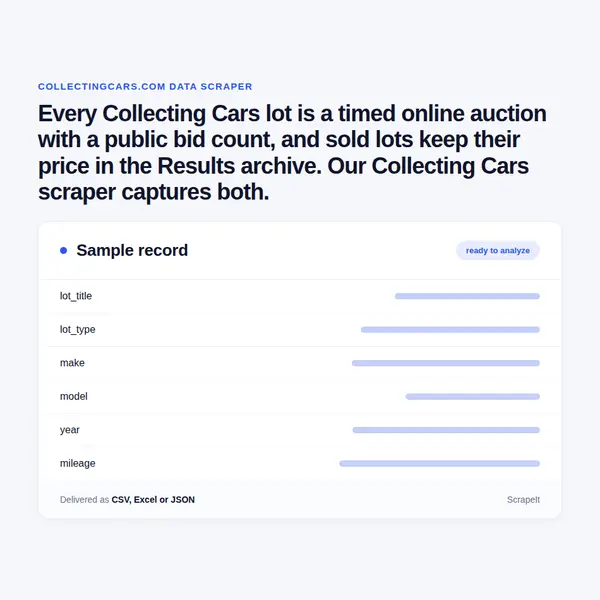
Every Collecting Cars lot is a timed online auction with a public bid count, and sold lots keep their price in the Results archive. Our Collecting Cars scraper captures both.
Plans from €169 a month · Free project assessment · Reply within 1 business day
CSV · Excel · JSON · XML · FTP · SFTP · Amazon S3 · Google Cloud
API, JSON feed or CSV, XLSX and JSON files
ScheduleOne-time, monthly, weekly, daily or 3 times a day
Collecting Cars pages, filters, fields and a schedule
Built, monitored and repaired by our team
API, JSON feed or CSV, XLSX and JSON files
To scrape Collecting Cars properly you follow each lot through three stages - Coming Soon, live and sold - and the live stage changes by the minute as the end time approaches. We build that crawler, run it and repair it when the site changes, so you receive rows, not code.
You choose the lot types, makes, regions or collections and the cadence; a common set-up is a tight pass over lots in their final hours plus a daily sweep of the Results archive. Anti-bot handling, pacing and proxy rotation come with the service. We start with a free assessment of your project, then a sample, and field documentation ships with every delivery.
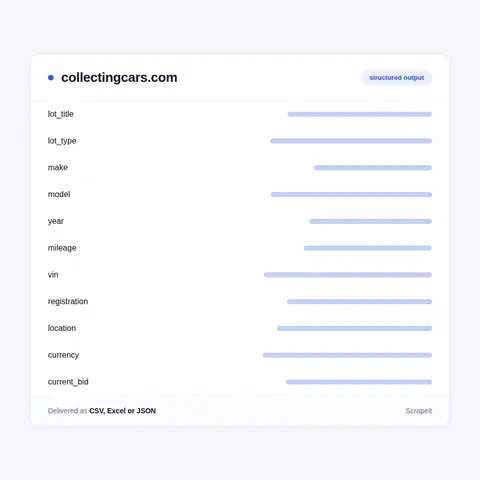
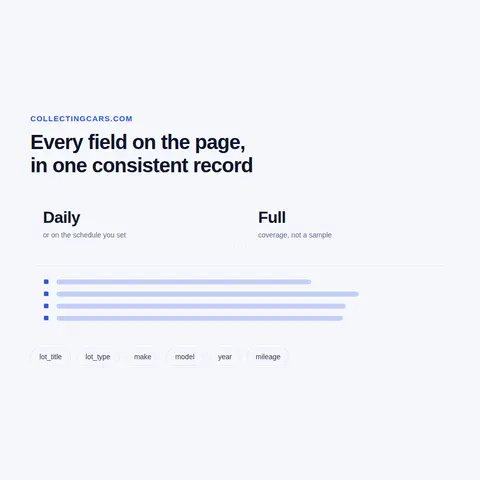
A Collecting Cars lot lives under /for-sale/ with a slug built from year, make and model, and the page splits into a specification panel, the seller's description and the bidding block. The slug is the row key we keep between runs. Fields we return:
Seller usernames, bidder names in the Bid History and the names of Collecting Cars staff attached to a lot are personal data, so we leave them out by default and keep the counts.
One lot page is a single moment in an auction. The useful dataset comes from the views around it and from repeating the pass.
Collecting Cars is an online auction platform for enthusiast and collector vehicles that started in the UK, sold its first car in 2019 and describes itself as a 24/7 online auction. A seller submits the car, a market specialist gets in touch, the platform sends a photographer and writes the listing, and the seller sets a reserve before the lot goes live. A lot page names the consignment specialist handling it and states whether the seller is private or trade.
The brand is British, the stock is not. Live grids mix lots in Britain, continental Europe, Australia, New Zealand, Japan and the Gulf, and each lot bids in its region's currency: a Porsche in Knoxfield, Victoria runs in Australian dollars, one in Bielefeld in euros, and lots in Tokyo, Hong Kong or Dubai in US dollars. The site is available in English, French, German, Italian, Spanish, Swedish, Dutch, Chinese and Japanese.
Beyond cars it auctions motorcycles, cherished number plates and parts, and the home feed also carries watch auctions. Sellers who want no publicity can choose Sealed Bids or an off-market sale; those deals never reach the public grid, so a dataset covers the open auctions only.
Delivery: CSV, JSON or XLSX files, our API or a JSON feed. MCP server on request.
Full plan detailsAn auction result is a price somebody paid, not an asking price, and on Collecting Cars it comes with the specification, mileage and bidding behind it.
For dealers the Coming Soon tab doubles as a sourcing list: a car can be spotted, researched and budgeted before the first bid is placed.
RVUSA catalogs by model year and a full feature-tag list per RV model on RVing Planet, rebuilt from its filters, for a returning client.
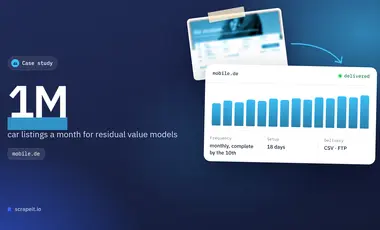
A monthly snapshot of mobile.de for an automotive data company: cars and vans up to 12 years old, delivered in the client's own CSV template.
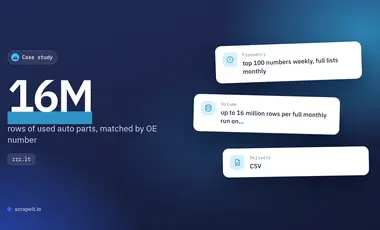
Weekly and monthly prices of used parts by OE number from rrr.lt and a Scandinavian marketplace, for a car dismantling business.
Learn how to use web scraping to solve data problems for your organization
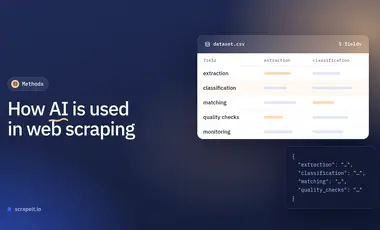
Leveraging advances in technology, the AI-powered web scraper has skyrocketed in demand and is helping to expand capabilities by automating tedious daily tasks and speeding up data collection from thousands of websites several times over.
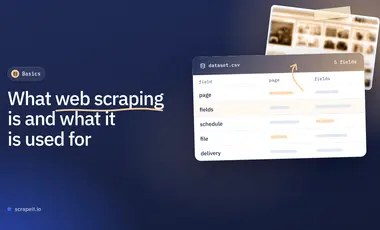
Web scraping is a method of obtaining web data by extracting it from pages of web resources with the help of a program, that is, in automatic mode. It is used to syntactically convert web pages into more usable forms.
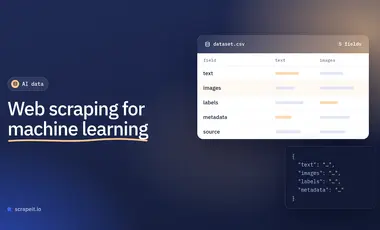
If you specialize in machine learning, you need to feed large amounts of data to the algorithms. Web scraping is the easiest and the most efficient method of collecting the data from all over the Internet.

ScrapeIt is a managed web scraping service: we build, run and maintain the crawlers and deliver the dataset, one-off or on the schedule you set. Timed auctions shape how we work - the decisive data appears in the last hours of a lot and then moves to a results page - so runs are planned around end times rather than the calendar. Field documentation comes with every dataset, and a sample can be ordered first. Plans start from EUR 169 a month, or EUR 199 for a one-time extract.
Still unsure? Write to info@scrapeit.io
Yes. The ScrapeIt Collecting Cars API returns the lot title, current bid, bid count, end time, the No Reserve and Reserve Lowered flags and the sold figure as JSON from an endpoint we host, refreshed on the schedule you set. You can also take the same rows as CSV or XLSX files, through a JSON feed or loaded straight into your database.
Yes, from the Results archive, which lists sold lots with year, make, location, the sold figure in the auction currency and the sale date. Each result links back to its lot page, so specification, mileage and bid count join to the price. Where a result is not shown publicly, the price column stays empty rather than estimated.
No. The seller sets the reserve before the auction and the figure stays private. A visitor sees the No Reserve badge on lots without one and Reserve Lowered when the seller has reduced it; we record both flags with the time they appeared, so you can set them against the final price.
Yes. Lot pages, bid counts, badges and the Results archive are open to any visitor without signing in. We collect only publicly available data - everything a visitor can see on Collecting Cars - and we collect it legally. Seller usernames and bidder names are personal data under GDPR and stay out of the dataset by default.
Every region the site lists. UK listings share the grid with lots in Europe, Australia, New Zealand, Japan and the Middle East, each in its region's currency, so rows carry a country and a currency column and, if you want it, a price converted at the sale-date rate. A feed can also be limited to one country, one make or the plate auctions.
You share your needs, expectations, and desired timeframe. We'll suggest the best solution based on your request and budget.
Our specialists configure the crawlers and extract a sample dataset for your review before proceeding with the full-scale extraction.
Once you approve the sample, we launch the project and start full data collection. We gather, filter, and structure the data for easy use, delivering it on time in your preferred format.
Our team manages ongoing processes, monitors website changes, and supports all data extraction cycles. We can also help integrate data into your systems or create dashboards to simplify analysis.
Tell us which sites, which fields and how often. A couple of lines is enough to start.
Collecting Cars data from €169/month. Free project assessment, reply within 1 business day.