Dealer-Ready Datasets with Every Parameter That Matters
Daily monitoring of car listings on car.gr and autoscout24.com, collecting full technical specifications to support a European auto dealer.
Learn More
A managed Carzone scraper for carzone.ie: every advert, dealer storefront and monthly finance quote turned into clean rows, refreshed as often as your pricing desk needs it.
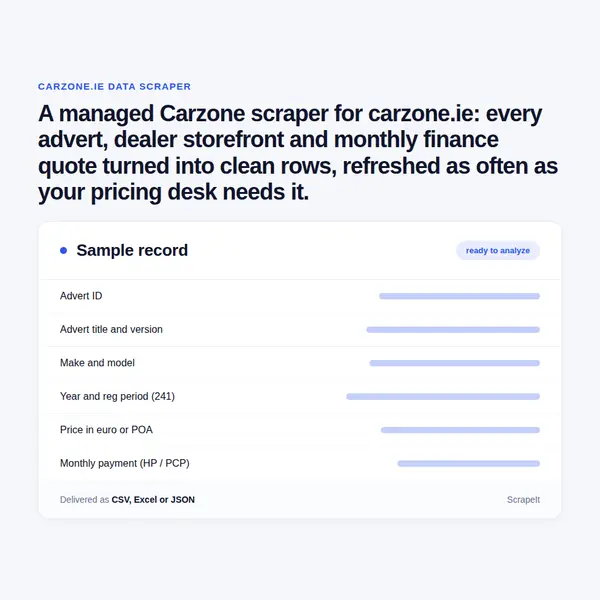
ScrapeIt runs Carzone scraping as a managed service. You name the channels, counties, makes and price bands; we build the crawler, keep it alive and hand over the rows. Carzone sits behind an edge filter that turns away plain automated clients, so anti-bot handling, proxy rotation and CAPTCHA solving are part of the work rather than an extra line on the invoice. Coverage comes from slicing the catalogue by county, make, model and price band instead of paging one endless list. Delivery is CSV, Excel, JSON or a direct database load, one-off or on a daily, weekly or monthly schedule. We stay on public pages: nothing behind a login, no seller portal, and no personal data - phone numbers, private seller identities and review authors are left where they are.
Each Carzone advert lives at a Full Page Advert address built from channel, make, model and a numeric advert id, so a car reads /used-cars/bmw/x5/fpa/ plus its id and a van uses /commercials/used/ with the same tail. That id is the stable key our Carzone scraper writes into every row, so the same vehicle stays trackable across runs.
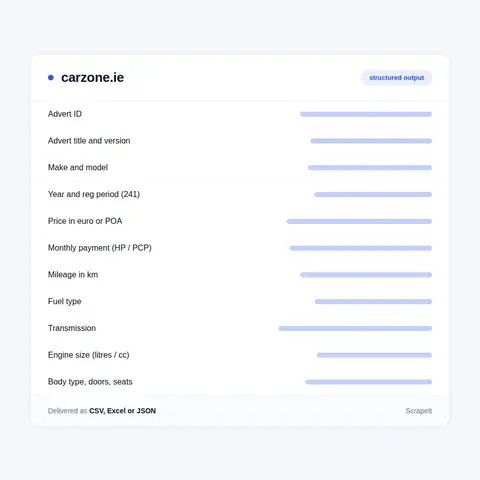
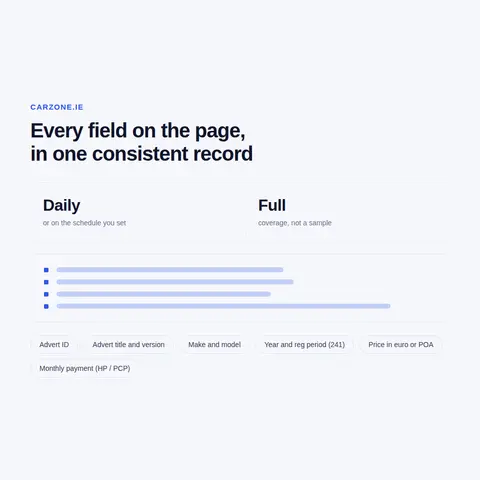
What we extract from Carzone on each advert:
Search cards carry a thinner copy of the same record - price, monthly payment, year, mileage, engine and fuel, seller type and county - so we walk result pages for coverage and open every advert for depth. Registration numbers and VINs are held by Carzone but never printed on a public advert.
The advert is not the only object worth taking. Carzone paginates a dealer directory across dozens of pages, and every garage in it owns a storefront under /stores/ keyed by dealer id: stock count, address with Eircode, telephone revealed on click, website, day-by-day opening hours, franchise brands, a video call or tour flag and a review feed with author name, relative date and free text. Collect the directory first and the storefronts second and you have a dealer census that joins to the adverts on dealer id, which is how inventory share by county or by franchise actually gets measured.
Two further surfaces repay attention. The finance search is a filter in its own right: you pick a monthly budget band and a deposit instead of a purchase price, and the result set contains only the cars a lender has quoted, with make-level counts of its own. The new car showroom is a separate catalogue, listing model and body variants with a price range across trims and the number of trims behind each range - useful when list prices need to sit beside the used curve.
Around the classifieds sit curated entry points worth their own runs: classic and vintage cars over twenty years old, cars under five thousand euro, electric and hybrid hubs, and the recently added feed. Editorial adds car reviews, motoring advice, driver tips and the Ask Carzone expert column. All of it is ordinary public HTML, and we scrape Carzone across these sections on the same schedule as the listings.
Carzone has been selling cars online in Ireland since 1998. It is run from Independent House on Talbot Street in Dublin by Webzone Limited, trading as Carzone, a subsidiary of Motion Group inside Mediahuis Ireland, and it calls itself Ireland's Ultimate Motoring Marketplace. The site is single-country and single-currency: euro prices, English only, and a geography of the twenty-six counties of the Republic, from Dublin and Cork down to Leitrim and Longford.
Stock is split into channels that each own a URL branch and a separate search: used cars, used commercials, used bikes, classic and vintage cars over twenty years old, and a new car showroom built from manufacturer trim lists rather than live adverts. A dealer directory sits beside all of it, and every garage gets a storefront page carrying its stock count, opening hours, franchise brands and customer reviews.
Supply is overwhelmingly trade. Most adverts come from motor dealers, many of them flagged as SIMI registered, while private sellers buy a timed package - Basic for forty-five days, Premium for ninety, Ultimate until the car is sold - with up to twenty photos on each advert. Carzone also screens insurer records and refuses to publish Category A and B write-offs, blocking republication on its own pages and on the white-label dealer sites it hosts, so the inventory you collect has already been filtered by a rule most classifieds never apply.
Get a Quote
Developers

Customers worldwide

Pages extracted

Hours saved for our clients
€199 / one-time
setup fee - included
€169 / mo
setup fee €499
€229 / mo
setup fee €499
€349 / mo
setup fee €499
€549 / mo
setup fee €799
Irish used-car pricing does not transfer from Britain or Germany. The market is small, dealer-led, quoted in euro and run on a registration calendar of its own, so anyone selling, funding or insuring cars here works from Carzone price data rather than a European average.
Repeat collection turns a snapshot into a series: how long a car stays live, when the asking price is cut, which adverts are relisted, and how supply shifts between Dublin, Cork, Galway and smaller counties.

Daily monitoring of car listings on car.gr and autoscout24.com, collecting full technical specifications to support a European auto dealer.
Learn MoreLearn how to use web scraping to solve data problems for your organization

Leveraging advances in technology, the AI-powered web scraper has skyrocketed in demand and is helping to expand capabilities by automating tedious daily tasks and speeding up data collection from thousands of websites several times over.

Web scraping is a method of obtaining web data by extracting it from pages of web resources with the help of a program, that is, in automatic mode. It is used to syntactically convert web pages into more usable forms.

If you specialize in machine learning, you need to feed large amounts of data to the algorithms. Web scraping is the easiest and the most efficient method of collecting the data from all over the Internet.
ScrapeIt is a managed web scraping agency, not a toolkit you have to operate yourself. A Carzone API-style feed is one of hundreds of sources we build and maintain for pricing teams, marketplaces and research desks. You get a named engineer, a schema agreed before the first run, monitoring with automatic reruns on failed pages, and a paid sample to test against your own pipeline before anything is scheduled. When Carzone changes its markup or its pagination, repairing the scraper is our job, not yours.
No. Carzone publishes no developer portal, no documented endpoints and no open data feed, and there is no partner programme offering listing data to outside builders. The public site is a single-page application talking to a private backend, while dealer stock arrives through commercial upload agreements covered by the dealer terms rather than anything you can call yourself. What we deliver instead is a scheduled Carzone API substitute: the same records, normalised into your own columns, dropped into CSV, JSON or your database on the cadence you choose.
Used cars, used commercials, used bikes, classic and vintage cars, the new car showroom, the dealer directory and every dealer storefront, plus the curated hubs for electric, hybrid, budget and recently added stock. Searches can be narrowed exactly as the site allows: by make, model, county, year and registration period, price or monthly payment band, fuel, transmission, body type, engine size, seller type and mileage. Tell us the slice you want and we collect only that.
Anything from a one-off snapshot to several runs a day. Daily is the usual choice for pricing work, because the interesting movement on Carzone is short-lived: dealers cut asking prices, adverts vanish when a car sells, and private adverts expire on their package clock after forty-five or ninety days unless the seller has bought the advertise-until-sold option. Daily runs let us stamp first seen, last seen, every price change and the days a vehicle stayed live, which a single snapshot can never show.
CSV, Excel, JSON or JSONL, a direct load into your PostgreSQL, MySQL or BigQuery, or a drop into S3 or Google Cloud Storage. The schema is agreed before the first run and then held stable, so downstream jobs do not break: prices stay numeric with a separate POA flag, mileage stays in kilometres, the Irish year and half-year code is split into two columns, and NCT or CVRT expiry is normalised to a date. Images can be delivered as URLs or downloaded in bulk.
We collect only pages that Carzone serves publicly, with no login, no seller portal and no circumvention of access controls. The site terms restrict automated access without written permission, which is normal for classifieds and is a commercial question between you and Carzone rather than a criminal one, so we ask clients to confirm their own lawful basis and intended use. We do not collect personal data by default: private seller phone numbers, named review authors and any personal detail a dealer types into a description are excluded from the output.
Step 1 - Make a Request
You share your needs, expectations, and desired timeframe. We’ll suggest the best solution based on your request and budget.
Step 2 - Configuring Custom Web Crawlers
Our specialists configure the crawlers and extract a sample dataset for your review before proceeding with the full-scale extraction.
Step 3 - Collect and Deliver
Once you approve the sample, we launch the project and start full data collection. We gather, filter, and structure the data for easy use, delivering it on time in your preferred format.
Step 4 - Maintain and Support
Our team manages ongoing processes, monitors website changes, and supports all data extraction cycles. We can also help integrate data into your systems or create dashboards to simplify analysis.

Scrapeit Sp. z o.o.
10/208 Legionowa str., 15-099, Bialystok, Poland
NIP: 5423457175
REGON: 523384582