Dealer-Ready Datasets with Every Parameter That Matters
Daily monitoring of car listings on car.gr and autoscout24.com, collecting full technical specifications to support a European auto dealer.
Learn More
The other automotive sites in this section sell a car once. InstaCar rents its own fleet by the month, so an InstaCar price is never one number - it is a grid of term, prepayment and inclusions.
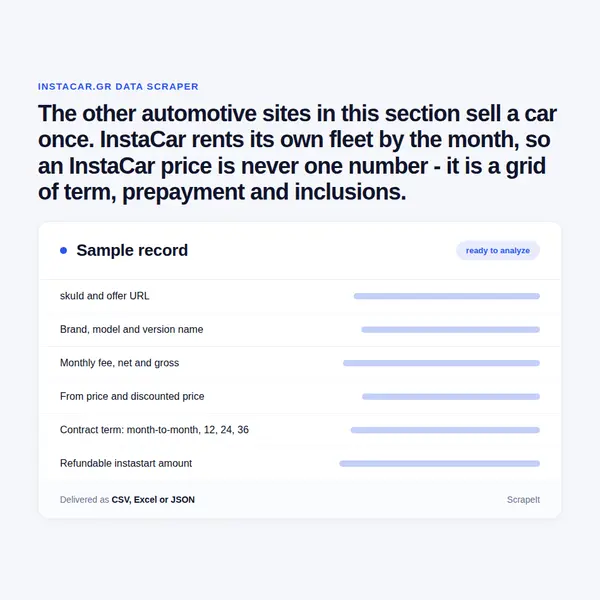
ScrapeIt builds and runs the InstaCar scraper as a managed service. You name the trees - leasing, buy, micromobility - the facets and the refresh rate; we write the collector, pace it against the site, and deliver CSV, Excel, JSON or a direct load into your warehouse. Offers, specifications, equipment lists and facet counts arrive as related tables joined on the skuId, with contract length and VAT state kept as their own columns instead of being flattened into a single price.
Access is our side of the deal: anti-bot handling, proxy rotation and CAPTCHA solving are part of the service, and we hold the exit region in Greece so fees and availability read the way a local customer sees them. We never sign in, so nothing inside the customer portal or the driver app is touched, and we leave personal data out - reviewer names and partner contact numbers printed on public pages do not enter the export.
The unit of this catalogue is an offer, not a model. The same BMW 1-Series 116d shows up more than once with different monthly figures and states, so an InstaCar price feed keys on the skuId rather than on make and model, and a specific used unit appends a dated suffix to that id.
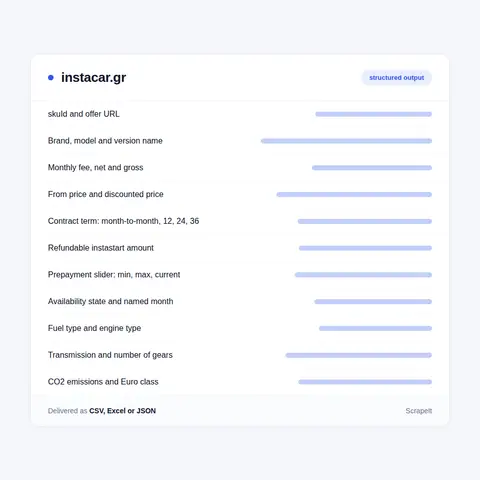
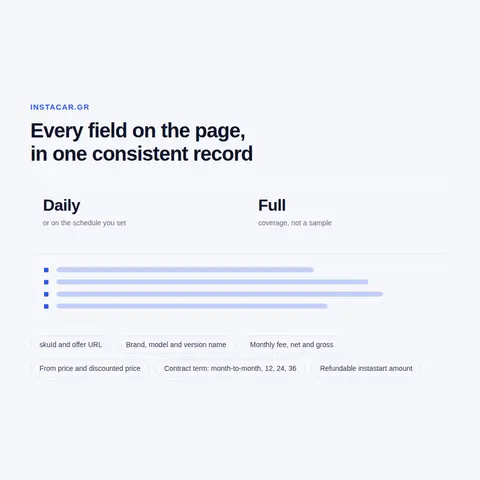
Each leasing offer carries:
The buy tree adds year, kilometres, colour, a sold flag and a finance panel with a down-payment slider and twelve, forty-eight or eighty-four instalments. Micromobility rows are shorter: range, weight, a type such as EScooter, ePatini or Fat Bike, and a monthly fee. Every vehicle page also emits schema.org Car markup, so bodyType, emissionsCO2, meetsEmissionStandard, numberOfAirbags, vehicleTransmission, driveWheelConfiguration and an engine block can be extracted from InstaCar pages without depending on the visual layout.
The filter panel is a dataset in itself: every facet ships with a live count. Price bands run up to 300, then 301 to 450, 451 to 600, 601 to 900 and 900 plus. Contract period, brand, category (Small, Medium, Large, Business), fuel (Petrol, Hybrid, Battery, Diesel, LPG, CNG) and transmission each carry their own tallies, and the offers block counts Deals of the Deals against a single Car Of The Month. Curated strips - Family, Small, Business, Value for Money - cut the fleet another way.
The split that matters commercially is idiotes against epaggelmatika: private individuals against businesses. The private view drops the Business category entirely and shrinks the fleet by roughly a fifth, and the two sides are qualified differently, with E3 forms and VAT returns replacing a payslip. Anyone sizing the Greek market needs both slices, not the headline total.
Greek specifics sit on the card. Monthly figures are quoted excluding VAT, which is how a business reads them and how a private driver does not, so the toggle state has to travel with the number. Road tax and the annual KTEO test are inside the fee, removing two line items a Greek owner would otherwise pay, while the CO2 and Euro class fields on the same card are what those road-tax bands are set from. Formatting is Greek too: dot for thousands, comma for decimals, so a van fee reads 1.437 EUR and a promo 181,50 EUR.
Addressing is shallow: a sitemap index splitting brands, static pages, categories and models, facet landings in both language trees, and numbered paging, which is how an InstaCar scraping run walks the fleet without guessing at URLs.
InstaCar is a Greek flexible-leasing operator that owns the cars it advertises and rents them by the month. That single difference changes everything downstream. Car.gr, Mobile.de and Otomoto publish adverts written by other people; instacar.gr publishes contracts on its own stock, so every row has a state, a term and an end date instead of a seller and a phone number.
The site runs three product trees side by side. Leasing is the core, covering new and like-new used cars on subscription, addressed as /leasing/brand/model with a single offer pinned by a skuId such as IC00464. Buy sells comparable stock outright as like-new used cars under /buy/brand/model, where each unit carries a 24-character hexadecimal id plus a short vehicle code printed on the page. Micromobility, operated by a separate company under the same roof, subscribes e-bikes, e-scooters and kick scooters from /micromobility/brand/model.
Two services sit alongside. Antallagi, the trade-in programme, takes your old car against a cheaper subscription after a VIN-and-photos inspection. DriveHome is a one to three month plan aimed at people who live abroad and want a car waiting when they land rather than a rental desk. A separate business page offers whole fleets to rent-a-car operators on four, six or eighteen month packages.
Greek and English mirror each other path for path, /leasing/metaxeirismena against /en/leasing/cars, with identical facet counts on both. An InstaCar scraper can therefore read the English tree while keeping Greek slugs such as idiotes, epaggelmatika, uvridika and xeirokinito as stable keys.
Get a Quote
Developers

Customers worldwide

Pages extracted

Hours saved for our clients
€199 / one-time
setup fee - included
€169 / mo
setup fee €499
€229 / mo
setup fee €499
€349 / mo
setup fee €499
€549 / mo
setup fee €799
Pricing and residual-value teams across Europe hold millions of asking prices and almost no monthly subscription rates. That is the hole InstaCar data fills: a dated read of what a Greek household or a small business pays per month for a named trim, across four contract lengths, with comprehensive insurance, servicing, road tax, the KTEO roadworthiness test, tyres, roadside assistance and a replacement car already folded into the figure.
Four groups come back for it.
The catalogue is finite and it moves. It is a fleet, not an endless board, so scraping InstaCar on a schedule is inventory tracking as much as price tracking: which offers appear, which flip to In subscription, which return with a new fee, and how long a named version stays bookable.
Daily monitoring of car listings on car.gr and autoscout24.com, collecting full technical specifications to support a European auto dealer.
Learn MoreLearn how to use web scraping to solve data problems for your organization

Leveraging advances in technology, the AI-powered web scraper has skyrocketed in demand and is helping to expand capabilities by automating tedious daily tasks and speeding up data collection from thousands of websites several times over.

Web scraping is a method of obtaining web data by extracting it from pages of web resources with the help of a program, that is, in automatic mode. It is used to syntactically convert web pages into more usable forms.

If you specialize in machine learning, you need to feed large amounts of data to the algorithms. Web scraping is the easiest and the most efficient method of collecting the data from all over the Internet.
ScrapeIt is a managed web scraping agency with automotive work already in production: we run daily specification and price collection across Greek and Italian car portals for a European dealer, so a fleet card with sixteen technical fields and five equipment groups is familiar ground. A named engineer scopes the job with you, writes the extraction, watches it when the site changes shape, and repairs it before your dashboard notices. Start with a paid sample, test it against what you expect to see, then scale to the whole fleet.
No. There is no developer portal, no documented endpoint and no partner feed anyone outside the company can sign up for. The storefront is a JavaScript application that calls its own internal services, and those are unversioned, undocumented and free to change the day a release ships, so nobody should build a product on them. What is stable is the published page: every vehicle emits schema.org Car markup with engine, emissions, dimensions and safety values, and that markup plus the rendered offer panel is what we treat as the contract.
All three public trees. Leasing offers with their term tabs and prepayment slider, the like-new cars in the buy tree with mileage, year and finance options, and the micromobility fleet of e-bikes, scooters and kick scooters. On top of that we take brand and model pages, the facet landing pages for fuel, gearbox, size, offers and the private-versus-business split, the partner locations, and the trade-in and DriveHome service pages. What we do not take is anything behind the customer login or inside the driver app, because we do not create accounts or sign in.
As separate columns, never as one number. Each offer is exported once per contract length, so Month to Month, 12, 24 and 36 months sit on their own rows with their own monthly fee and their own refundable instastart. The prepayment slider is captured as its floor, its ceiling and the default position, because the monthly figure moves with it. The displayed fee is net, so we store the net value, the VAT flag and the gross equivalent side by side. The from price and the discounted price are kept apart as well, which is the only way to see promotional depth over time.
Availability and fees deserve a daily pass, because a fleet turns over: offers switch to In subscription, come back at a different price, or disappear when a car is sold out of the buy tree. Facet counts are cheap and worth taking on the same cycle, since they give you fleet size, fuel mix and the private-versus-business split without opening a single card. Technical specifications and equipment lists barely move, so a weekly or monthly refresh is enough for those. We set the cadence per tree and show you the request volume each choice implies before anything is built.
We take what the site shows to any visitor, at a polite rate, and we stay inside the crawl rules it publishes. No sign-in, no account creation, nothing from the customer portal. Personal data is excluded by default: the customer reviews on the home page, the names attached to them and the direct contact numbers of partner sites do not go into the dataset. The platform asserts intellectual property rights over its content and databases, so the output is meant for analysis, benchmarking and modelling rather than republication of pages or photographs. Bring your use case and we will scope it with you.
Step 1 - Make a Request
You share your needs, expectations, and desired timeframe. We’ll suggest the best solution based on your request and budget.
Step 2 - Configuring Custom Web Crawlers
Our specialists configure the crawlers and extract a sample dataset for your review before proceeding with the full-scale extraction.
Step 3 - Collect and Deliver
Once you approve the sample, we launch the project and start full data collection. We gather, filter, and structure the data for easy use, delivering it on time in your preferred format.
Step 4 - Maintain and Support
Our team manages ongoing processes, monitors website changes, and supports all data extraction cycles. We can also help integrate data into your systems or create dashboards to simplify analysis.

Scrapeit Sp. z o.o.
10/208 Legionowa str., 15-099, Bialystok, Poland
NIP: 5423457175
REGON: 523384582