StubHub Scraper for Resale Prices and Seat Availability

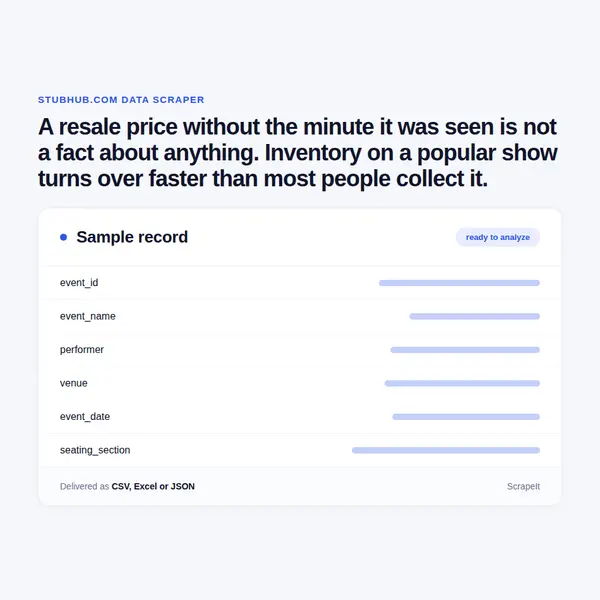
A resale price without the minute it was seen is not a fact about anything. Inventory on a popular show turns over faster than most people collect it.

StubHub Scraper
Solutions

Managed resale ticket data, run end to end by us

ScrapeIt runs the collection as a managed service. You name the events, performers or venues and the markets; we build the pipeline, run it on a tiered cadence that matches how fast each event actually moves, and hand back CSV, JSON, Excel or a push into your warehouse with observations timestamped to the minute and fee treatment recorded.

We work within the crawl rules the site publishes, using its published sitemap and event surfaces and avoiding the paths its robots file closes. Requests are paced, because a marketplace hammered by one collector becomes harder for everyone.

We collect published listing data. We do not purchase tickets, automate checkout or interact with carts in any way: automated buying is restricted or unlawful in several markets and it is not a service we offer. Listing content belongs to the marketplace, so the dataset is for analysis rather than republication. Resale is regulated differently by country, so bring the use case to your own counsel before the project starts.

Resale ticket fields in every export

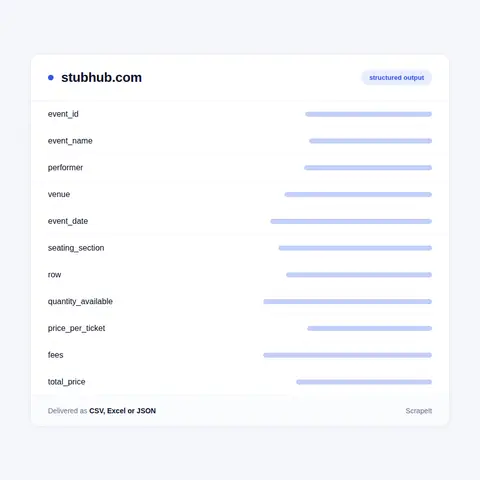
The event record covers event identifier, name, performer or team, venue, city and country, event date and local start time, on sale status and the event URL.

Listing observations are the core and they are timestamped rows rather than a current state. Each carries the seating section and row where published, the quantity available, the price per ticket as displayed, the fee component where it is shown separately, the total at checkout where reachable, the currency, and the seller type where the marketplace distinguishes brokers from individuals.

Derived measures per observation are computed from stored rows rather than supplied unexplained: the lowest available price in each seating category, the median, the count of distinct listings and the total quantity on offer. Those four together describe an inventory far better than a single get in price does.

Fee treatment is explicit. Which price the observation captured, whether fees were included, and the total where it was obtainable, all as separate fields, because the gap between headline and checkout is frequently the entire subject of the analysis.

Every row carries the observation timestamp to the minute and the market it was collected for, since prices and availability differ by country.

Resale ticket fields in every export
Matching to primary, sell-out curves and regulation

Matching to primary, sell-out curves and regulation

Matching events to the primary market is the extension that turns this into a pricing dataset rather than an inventory dump. The same show is named differently across platforms, so matching runs on venue, date and performer with fuzzy handling of tour names and supporting acts. Once matched, face value and resale price sit on the same row and the premium is a subtraction.

Sell out curves come from repeated observation and cannot be reconstructed afterwards. Total quantity available, tracked from on sale to event date, shows how fast a show sold, where it stalled and whether a late release of inventory occurred. For a promoter or a venue that curve is worth more than any single price.

Broker behaviour becomes visible at scale. Listings appearing in bulk immediately after an on sale, priced in patterns, are a different phenomenon from individuals reselling spare seats, and separating them changes what a market looks like.

Regulation varies by market and is worth knowing before scoping. Several jurisdictions cap resale prices, require disclosure of face value or restrict resale of certain events entirely. A dataset covering multiple countries should carry the market on every row so that analysis respects those differences, and anyone building a product on top needs local advice rather than ours.

How a resale marketplace differs from a box office

StubHub is a secondary marketplace: the tickets on it are being resold by people and by professional brokers, not issued by the venue. That single fact changes every assumption a collector might carry over from an ecommerce site.

There is no catalogue price. There is an inventory of individual listings, each with its own price, quantity and seat location, appearing and disappearing continuously as sellers list and buyers buy. What looks like the price of a ticket is the cheapest currently available listing in a category, which is a different quantity entirely and moves constantly.

The site publishes a sitemap in its robots file and closes a set of paths including its secure, service and internal manager routes. We work inside that: event and category surfaces via the published sitemap, none of the disallowed paths, requests paced. Some category surfaces are protected against automated access, and where that is the case the honest answer is that the sitemap and event pages carry the workable scope rather than pretending otherwise.

Fees are the other structural feature. The headline price and the amount at checkout differ, sometimes substantially, and which of them is displayed can depend on settings and jurisdiction. Any price comparison that does not record which one it captured is comparing different numbers.

Get a Quote
dev_w
25

Developers

customers
500+

Customers worldwide

pages
1 500 000 000+

Pages extracted

stime
15000+

Hours saved for our clients

Plans

Airplane

€199 / one-time

setup fee - included

Data limits100,000
Frequencyone-time
Run timeup to 5 days
Data storing7 days

Helicopter

€169 / mo

setup fee €499

Data limits250,000
Frequencymonthly
Run timeup to 5 days
Data storing14 days

Glasses

€229 / mo

setup fee €499

Data limits1,000,000
Frequencyweekly
Run timeup to 5 days
Data storing30 days

DNA

€549 / mo

setup fee €799

Data limits3,000,000
Frequency3 times daily
Run timesame day
Data storing90 days

Why cadence is the whole design problem

On a popular event, inventory turns over in minutes. Listings are added, undercut and sold, and the cheapest available price can move several times an hour in the days before a show. A dataset collected daily describes a market that no longer exists by the time it lands.

Equally, collecting every event at minute level is wasteful and impolite. An event twelve months out with forty listings does not need that attention, and running the whole catalogue at high frequency is how a project becomes both expensive and unwelcome.

So the design is tiered by event and by phase. A defined watch list of events is collected frequently, particularly through the on sale window and the final week before the date. Everything else runs daily or weekly. The tiering is agreed before collection starts and adjusts as events approach.

The second design problem is what a price means. The cheapest available listing, the median of available listings and the volume weighted average tell three different stories, and a report that says the price without saying which one is not a report. We compute all three per observation so a client can choose and so a chart can be explained.

The third is the resale premium. Face value on the primary market against the resale price for the same seating category is the comparison most people actually want, and it needs both markets collected and events matched across them. That matching, on venue, date and performer, is a substantial part of the work.

Our Blog

Reads Our Latest News & Blog

Learn how to use web scraping to solve data problems for your organization

How Artificial Intelligence Is Used In Web Scraping

How Artificial Intelligence Is Used In Web Scraping

Leveraging advances in technology, the AI-powered web scraper has skyrocketed in demand and is helping to expand capabilities by automating tedious daily tasks and speeding up data collection from thousands of websites several times over.

What is Web Scraping and What is it Used For?

What is Web Scraping and What is it Used For?

Web scraping is a method of obtaining web data by extracting it from pages of web resources with the help of a program, that is, in automatic mode. It is used to syntactically convert web pages into more usable forms.

Web Scraping for Machine Learning

Web Scraping for Machine Learning

If you specialize in machine learning, you need to feed large amounts of data to the algorithms. Web scraping is the easiest and the most efficient method of collecting the data from all over the Internet.

scrapeit logo

Who builds and keeps your ticket price feed

ScrapeIt is a managed extraction company, not a tool you have to learn. Our team builds the pipeline, watches it through on sale windows and site changes, and repairs it before the week that matters.

You see a sample first, in your format, on events you actually track, including a live on sale window so you can judge the cadence rather than take it on trust.

FAQ

How often do you need to collect for the data to be useful?

It depends on the event and the phase, which is why we tier it. A watch list of events is collected frequently through the on sale window and the final week; everything else runs daily or weekly. Running the whole catalogue at minute level is both expensive and impolite, and collecting a hot event daily produces a picture that expired before it landed.

What exactly is the price you record?

Several, deliberately. Per observation we compute the lowest available price in each seating category, the median of available listings and the count and quantity on offer, and we record whether the captured figure included fees and what the checkout total was where reachable. A report that says the price without saying which one is not a report.

Can you compare resale prices against face value?

Yes, and it is the most requested output. It needs the primary market collected too and the events matched across platforms on venue, date and performer, with fuzzy handling of tour names. Once matched, face value and resale sit on one row and the premium is a subtraction rather than an estimate.

Do you buy tickets or automate checkout?

No. We collect published listing data and nothing else. Automated purchasing is restricted or unlawful in several markets, it is a different activity from data collection, and it is not a service we offer at any price.

Is resale data regulated?

Resale itself is, and differently by country: some jurisdictions cap prices, some require face value disclosure, some restrict resale of particular events. That does not stop you analysing published listings, but it shapes what a product built on the data may do. Every row carries the market it was collected for, and you should take the use case to local counsel before building on it.

How does it Work?

Step 1 - Make a Request

You share your needs, expectations, and desired timeframe. We’ll suggest the best solution based on your request and budget.

Step 2 - Configuring Custom Web Crawlers

Our specialists configure the crawlers and extract a sample dataset for your review before proceeding with the full-scale extraction.

Step 3 - Collect and Deliver

Once you approve the sample, we launch the project and start full data collection. We gather, filter, and structure the data for easy use, delivering it on time in your preferred format.

Step 4 - Maintain and Support

Our team manages ongoing processes, monitors website changes, and supports all data extraction cycles. We can also help integrate data into your systems or create dashboards to simplify analysis.

Request a Quote

Tell us more about you and your project information.
Which sites, which fields, how often. A couple of lines is enough.

We reply within 1 business day. No obligation.

scrapiet

Scrapeit Sp. z o.o.
10/208 Legionowa str., 15-099, Bialystok, Poland
NIP: 5423457175
REGON: 523384582