Skiddle Scraper for UK Event Listings and Ticket Prices

For UK clubbing and festivals the national platforms are thin and this one is deep. Coverage of the actual market, not of the biggest names, is the reason to collect it.

Skiddle Scraper
Solutions

Managed UK event listing data, run end to end by us

ScrapeIt runs the collection as a managed service. You name the towns, regions and categories; we build the pipeline, run it on your cadence and hand back CSV, JSON, Excel or a push into your warehouse with lineups and ticket tiers as rows and festival structure preserved.

Cadence is usually daily or weekly by region, since listings appear continuously but individual events settle once published. Watch list on sales are collected more tightly where sell out timing matters. Requests are paced and crawl rules honoured.

We collect published listing data and do not purchase tickets or automate any checkout. Promoter and artist names are professional information rather than personal contact data, and we collect no contact details. Listing content belongs to the platform, promoters and venues, so the dataset is for analysis rather than republication. Bring the use case to your own counsel before the project starts.

Skiddle fields in every export

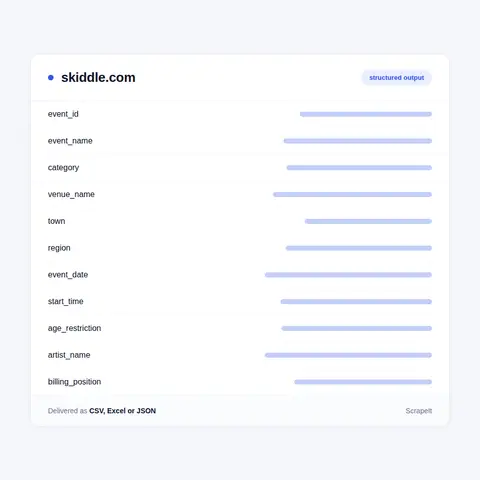
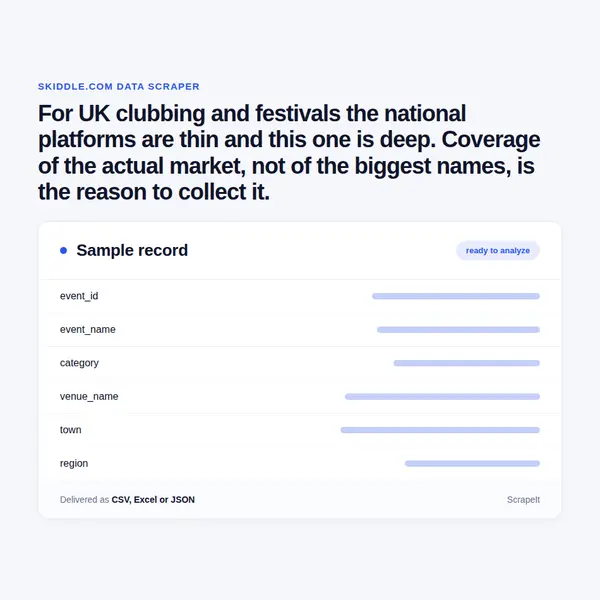
The event record covers event identifier, name, category and subcategory, venue name and address, town and region, event date, start and end times, age restriction, and the event URL.

Lineup is delivered as rows where the event publishes one, with artist or DJ names and billing position. For club and festival programming this is the substance of the listing rather than an extra, and flattening it into a string makes artist level analysis impossible.

Ticket tiers come as rows: tier name, face price, booking fee where shown separately, the total, currency, sale window and availability state. Early release and tiered pricing is standard practice in this sector, so a single price column would misrepresent most listings.

Venue records carry name, full address, town, region and coordinates where published, which supports the geographic questions that a national market analysis asks: which towns have active programming, where venues cluster and how activity is distributed outside the largest cities.

Festival listings carry additional structure where published: day splits, stage assignments and lineup by day, along with the collection timestamp on every row.

Skiddle fields in every export
Festivals, promoters and market coverage

Festivals, promoters and market coverage

Festival data deserves separate handling. Multi day events with stage assignments and lineups by day are a different structure from a single gig, and collapsing them loses the parts people want: which artists play which days, how the bill is balanced, and how prices differ between day and weekend tickets. We keep that structure where the listing publishes it.

Promoter analysis is available because promoters recur across events. Who programmes which venues, how often, and at what price points, describes a regional scene in a way no single event does, and it needs promoter names normalised rather than taken as strings.

Market coverage should be stated honestly, as everywhere. This platform is strong in the United Kingdom and in particular categories, and it is not a complete census of British events: listings not published here do not appear. For a full national picture it is usually combined with one or two other primary sources, and the deduplication between them is part of the work.

Repeat collection produces the trends that matter: events per town per month, price movement by category, venue activity over time. A single snapshot describes a week; a series describes a sector.

A UK what's on guide with ticketing attached

Skiddle is a United Kingdom events guide and ticketing platform with particular depth in clubbing, festivals and independent live music. Its coverage of towns and cities outside the largest metropolitan areas is considerably better than the international platforms manage, which is the practical reason to collect it for any British market analysis.

Discovery is organised by town and by category, with what is on pages that list events by place and date. Those surfaces respond and are enumerable, which makes systematic collection across the country practical rather than aspirational.

The category mix is distinctive. Club nights, festivals, comedy, day parties and student events are represented in a depth that a general purpose platform does not attempt, and festival listings carry lineups and day splits that matter for anyone tracking that sector.

Events carry venue, date and time, lineup where applicable, ticket tiers with prices and booking fees, age restrictions, and availability state including sold out. Because a great deal of the content is club programming, the same venue appears constantly with different events, which makes venue level analysis particularly productive here.

Get a Quote
dev_w
25

Developers

customers
500+

Customers worldwide

pages
1 500 000 000+

Pages extracted

stime
15000+

Hours saved for our clients

Plans

Airplane

€199 / one-time

setup fee - included

Data limits100,000
Frequencyone-time
Run timeup to 5 days
Data storing7 days

Helicopter

€169 / mo

setup fee €499

Data limits250,000
Frequencymonthly
Run timeup to 5 days
Data storing14 days

Glasses

€229 / mo

setup fee €499

Data limits1,000,000
Frequencyweekly
Run timeup to 5 days
Data storing30 days

DNA

€549 / mo

setup fee €799

Data limits3,000,000
Frequency3 times daily
Run timesame day
Data storing90 days

Why regional depth beats national coverage here

Every ticketing dataset covers the large venues in the large cities. That is the easy part and it is where every source agrees. The disagreement, and the value, is in everything else.

For the United Kingdom specifically, a great deal of live and club activity happens in towns that international platforms cover thinly or not at all. A market analysis built on the big platforms will describe London and a handful of cities accurately and the rest of the country badly, and it will not signal that it is doing so.

This source is the corrective. Its depth in regional programming means a national picture is actually national: which towns have active venues, how programming density varies, where price points sit outside the capital, and how the club and festival sector is distributed geographically.

The second reason is category depth. Club nights and festivals have structures that general platforms handle poorly: multi day events with day splits, lineups running to dozens of names, tiered releases and early bird windows. Collected properly those become analysable; collected generically they become a title and a date.

The third is venue level analysis. Because club venues programme constantly, this data supports questions about individual venues over time: how often they programme, at what price points, with which promoters, and whether activity is rising or falling. For anyone tracking the health of the grassroots venue sector, that is the measurement.

Our Blog

Reads Our Latest News & Blog

Learn how to use web scraping to solve data problems for your organization

How Artificial Intelligence Is Used In Web Scraping

How Artificial Intelligence Is Used In Web Scraping

Leveraging advances in technology, the AI-powered web scraper has skyrocketed in demand and is helping to expand capabilities by automating tedious daily tasks and speeding up data collection from thousands of websites several times over.

What is Web Scraping and What is it Used For?

What is Web Scraping and What is it Used For?

Web scraping is a method of obtaining web data by extracting it from pages of web resources with the help of a program, that is, in automatic mode. It is used to syntactically convert web pages into more usable forms.

Web Scraping for Machine Learning

Web Scraping for Machine Learning

If you specialize in machine learning, you need to feed large amounts of data to the algorithms. Web scraping is the easiest and the most efficient method of collecting the data from all over the Internet.

scrapeit logo

Who builds and keeps your UK events feed

ScrapeIt is a managed extraction company, not a tool you have to learn. Our team builds the pipeline, watches it as the site and its listing templates change, and repairs it before your regional coverage develops a hole.

You see a sample first, in your format, across the towns and categories you actually cover, with lineups and tiers structured so you can judge the depth on real listings.

FAQ

Why use this alongside the international platforms?

For regional coverage. The big platforms describe London and a few cities accurately and the rest of the United Kingdom thinly, without signalling that they are doing so. This source has real depth in towns outside the largest metropolitan areas, which is what makes a national market picture actually national.

Can you collect festival lineups by day?

Where the listing publishes them, yes, including stage assignments and day splits. A multi day festival collapsed into one row loses the parts people want: which artists play which days, how the bill is balanced and how day tickets are priced against weekend ones.

Do you separate booking fees from the face price?

Yes, where they are shown separately, along with the total. Tiered and early release pricing is standard in this sector, so ticket tiers are delivered as rows with their own sale windows rather than as a single price column that would misrepresent most listings.

Can I analyse individual venues over time?

Yes, and this is one of the better sources for it because club venues programme constantly. How often a venue programmes, at what price points, with which promoters and whether activity is rising or falling is exactly the measurement people use for grassroots venue health.

Is this a complete picture of UK events?

No. It is unusually deep regionally and in club and festival categories, and it remains platform coverage: events not listed here do not appear. For a full national picture it is normally combined with one or two other primary sources, with deduplication between them, and we scope that at the start rather than letting the gap surface later.

How does it Work?

Step 1 - Make a Request

You share your needs, expectations, and desired timeframe. We’ll suggest the best solution based on your request and budget.

Step 2 - Configuring Custom Web Crawlers

Our specialists configure the crawlers and extract a sample dataset for your review before proceeding with the full-scale extraction.

Step 3 - Collect and Deliver

Once you approve the sample, we launch the project and start full data collection. We gather, filter, and structure the data for easy use, delivering it on time in your preferred format.

Step 4 - Maintain and Support

Our team manages ongoing processes, monitors website changes, and supports all data extraction cycles. We can also help integrate data into your systems or create dashboards to simplify analysis.

Request a Quote

Tell us more about you and your project information.
Which sites, which fields, how often. A couple of lines is enough.

We reply within 1 business day. No obligation.

scrapiet

Scrapeit Sp. z o.o.
10/208 Legionowa str., 15-099, Bialystok, Poland
NIP: 5423457175
REGON: 523384582