DICE Scraper for Live Music Events and Ticket Prices

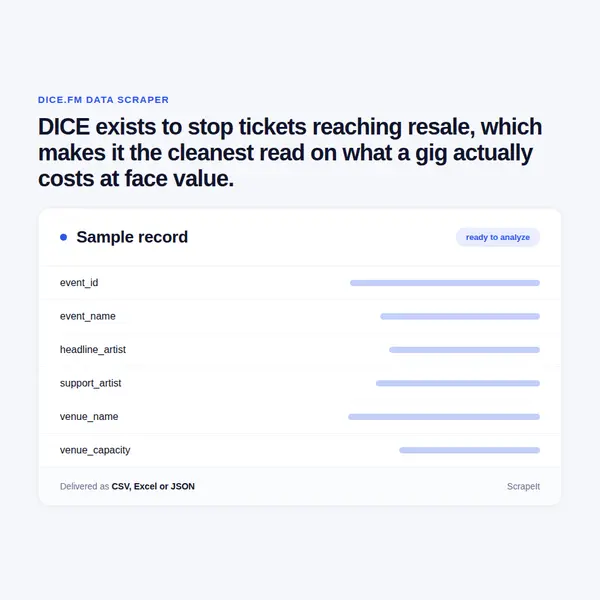
DICE exists to stop tickets reaching resale, which makes it the cleanest read on what a gig actually costs at face value.

DICE Scraper
Solutions

Managed live music event data, run end to end by us

ScrapeIt runs the collection as a managed service. You name the cities, artists or venues; we build the pipeline, run it at a cadence tight enough to catch on sale and sell out transitions where that matters, and hand back CSV, JSON, Excel or a push into your warehouse with lineups and ticket tiers as rows.

Cadence is tiered as on any ticketing source: watch list on sales collected tightly, general city listings daily. Requests are paced and crawl rules honoured.

We collect published listing data. We do not purchase tickets, join waiting lists or automate any account action, and on a platform built specifically to keep tickets away from automated buying that boundary matters more than usual. Listing content belongs to the platform, promoters and artists, so the dataset is for analysis rather than republication. Bring the use case to your own counsel before the project starts.

DICE fields in every export

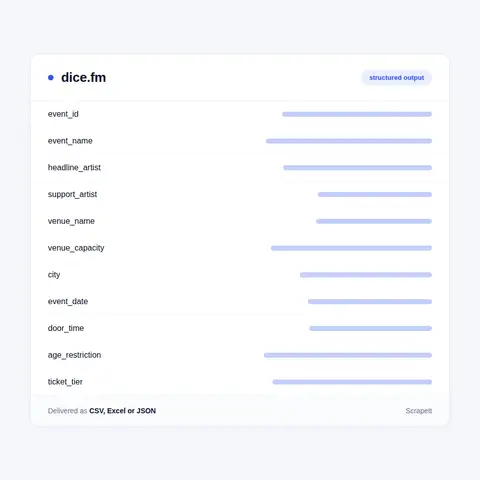
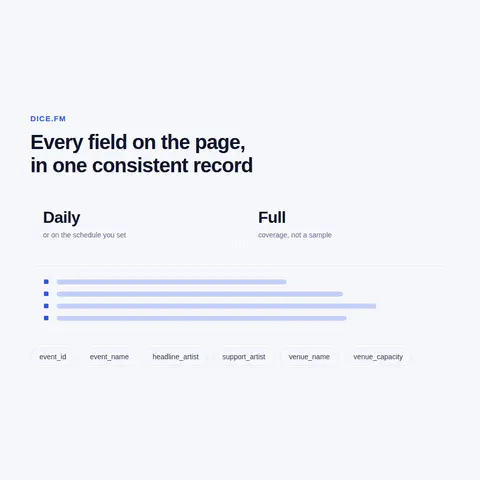
The event record covers event identifier, name, primary artist and supporting lineup as separate entries, venue name and address, city and country, event date and local start time, door and end times where published, age restriction where stated, and the event URL.

Lineup is delivered as rows rather than a text string. Support acts are the part of live music data that gets flattened away most often, and they are precisely what an artist manager or a booking agent wants to trace: who is opening for whom, in which cities, and how that changes over a tour.

Ticket tiers come as rows: tier name, price, currency, booking fee where shown separately, on sale datetime, and availability status including sold out and waiting list. The waiting list state is worth capturing specifically, because on this platform it is the signal that demand exceeded supply rather than that inventory moved to resale.

Venue records carry name, address, city, capacity where published and coordinates where available, which supports the venue level analysis that live music work usually needs.

Every row carries the city, the collection timestamp and the availability state at that moment, since sell out timing is only obtainable by repeated observation.

DICE fields in every export
Tour tracing, city coverage and sell-out timing

Tour tracing, city coverage and sell-out timing

Tour tracing follows naturally from lineup and date data. An artist's dates across cities, the venues chosen, the support acts carried and the price points set describe a tour strategy, and comparing that across artists at similar levels is a genuine competitive analysis for agents and promoters.

Sell out timing is only obtainable by watching. The gap between on sale and sold out, per city and per venue tier, is one of the more useful numbers in live music and it cannot be reconstructed after the fact. It requires collection at a cadence tight enough to catch the transition, which for a high demand on sale means minutes.

City coverage should be stated rather than assumed. The platform is much stronger in some cities than others, and its share of a city's live music varies. Any market analysis built on it is platform coverage, and combining it with other primary sources gives a fuller picture where that matters.

Combining with resale sources is the reverse of the usual comparison and is quite informative: what a comparable show costs on a platform that blocks resale versus one that permits it, controlled for venue size and artist tier, is a measurable estimate of the resale premium in a market.

A primary platform designed against resale

DICE is a live music ticketing platform built around mobile ticketing and a deliberate stance against secondary resale. Tickets are issued to an account rather than as a transferable document, and returns go through a waiting list rather than onto a resale market.

For data work that produces something unusual: a price that is genuinely face value. On platforms where resale flourishes, the observable price is contaminated by secondary inventory almost immediately. Here the listed price is close to what the artist and promoter set, which makes this the better source for any analysis of what live music actually costs.

The catalogue is organised around cities and around artists, with event pages carrying the lineup, the venue, the date and time, the ticket tiers and the sold out or waiting list state. Browse surfaces respond by city and by listing path, which makes systematic collection practical.

The audience skew matters for interpretation. This platform is strongest in independent and mid sized live music, particularly in certain cities, and thinner in stadium scale events and in non music categories. That is a feature for anyone studying the grassroots live sector and a limitation for anyone treating it as a general events source.

Get a Quote
dev_w
25

Developers

customers
500+

Customers worldwide

pages
1 500 000 000+

Pages extracted

stime
15000+

Hours saved for our clients

Plans

Airplane

€199 / one-time

setup fee - included

Data limits100,000
Frequencyone-time
Run timeup to 5 days
Data storing7 days

Helicopter

€169 / mo

setup fee €499

Data limits250,000
Frequencymonthly
Run timeup to 5 days
Data storing14 days

Glasses

€229 / mo

setup fee €499

Data limits1,000,000
Frequencyweekly
Run timeup to 5 days
Data storing30 days

DNA

€549 / mo

setup fee €799

Data limits3,000,000
Frequency3 times daily
Run timesame day
Data storing90 days

Why face value data is worth more than it looks

Anyone studying live music pricing runs into the same contamination problem: on most platforms, observable prices mix primary and secondary inventory within hours of an on sale, and separating them afterwards is guesswork. A platform that structurally prevents resale removes that problem entirely.

What that enables is a clean series. Ticket prices for comparable venues, cities and artist tiers, tracked over time, describe what live music actually costs without a resale premium sitting on top of every number. For industry research, for policy work on ticket affordability and for artists deciding what to charge, that is the dataset people have been trying to approximate.

The second use is demand measurement through the waiting list. Because returns route to a waiting list rather than to resale, the appearance and size of that list is a direct demand signal, uncontaminated by brokers. A show that sells out and generates a long waiting list is a very different data point from one that merely sells out.

The third is the grassroots picture. Independent and mid sized venues are underrepresented in every major ticketing dataset, and they are where the live sector's health is actually visible. Tracking event counts, prices and sell out rates at that tier is the closest thing to a health metric the sector has.

The fourth is lineup structure. Support slots trace artist trajectories better than headline bookings do, because an artist opens before they headline, and that transition is visible months in advance.

Our Blog

Reads Our Latest News & Blog

Learn how to use web scraping to solve data problems for your organization

How Artificial Intelligence Is Used In Web Scraping

How Artificial Intelligence Is Used In Web Scraping

Leveraging advances in technology, the AI-powered web scraper has skyrocketed in demand and is helping to expand capabilities by automating tedious daily tasks and speeding up data collection from thousands of websites several times over.

What is Web Scraping and What is it Used For?

What is Web Scraping and What is it Used For?

Web scraping is a method of obtaining web data by extracting it from pages of web resources with the help of a program, that is, in automatic mode. It is used to syntactically convert web pages into more usable forms.

Web Scraping for Machine Learning

Web Scraping for Machine Learning

If you specialize in machine learning, you need to feed large amounts of data to the algorithms. Web scraping is the easiest and the most efficient method of collecting the data from all over the Internet.

scrapeit logo

Who builds and keeps your live music feed

ScrapeIt is a managed extraction company, not a tool you have to learn. Our team builds the pipeline, watches it through on sale cycles and site changes, and repairs it before the week a tour goes on sale.

You see a sample first, in your format, for the cities or artists you actually track, including a real on sale window so you can judge whether the cadence catches the sell out.

FAQ

Why is a platform without resale better for pricing research?

Because the observable price is not contaminated. On platforms where resale flourishes, primary and secondary inventory mix within hours of an on sale and separating them afterwards is guesswork. Here the listed price stays close to what the artist and promoter set, which makes it the cleaner source for any study of what live music actually costs.

Do you collect support acts as well as headliners?

Yes, as separate rows. Support slots are the part of live music data most often flattened away, and they are what an agent or manager actually wants: artists open before they headline, so a support billing traces a trajectory months before it shows up anywhere else.

What does the waiting list tell you?

Demand beyond capacity, without broker contamination. Because returns route to a waiting list rather than to resale, its appearance and size is a direct signal. A show that sells out and generates a long waiting list is a materially different data point from one that just sells out, and that distinction is unavailable on resale friendly platforms.

Can you capture how quickly a show sold out?

Only by watching, and only if the cadence is tight enough. The gap between on sale and sold out cannot be reconstructed afterwards, so high demand events need collection at minute level through the on sale window. We tier the schedule so that happens on your watch list without running the whole catalogue that fast.

Do you interact with accounts or waiting lists?

Never. We collect published listing data and nothing else: no purchases, no waiting list entries, no account actions of any kind. On a platform built specifically to keep automation away from ticket allocation, that boundary matters more than usual, and we would decline the work rather than cross it.

How does it Work?

Step 1 - Make a Request

You share your needs, expectations, and desired timeframe. We’ll suggest the best solution based on your request and budget.

Step 2 - Configuring Custom Web Crawlers

Our specialists configure the crawlers and extract a sample dataset for your review before proceeding with the full-scale extraction.

Step 3 - Collect and Deliver

Once you approve the sample, we launch the project and start full data collection. We gather, filter, and structure the data for easy use, delivering it on time in your preferred format.

Step 4 - Maintain and Support

Our team manages ongoing processes, monitors website changes, and supports all data extraction cycles. We can also help integrate data into your systems or create dashboards to simplify analysis.

Request a Quote

Tell us more about you and your project information.
Which sites, which fields, how often. A couple of lines is enough.

We reply within 1 business day. No obligation.

scrapiet

Scrapeit Sp. z o.o.
10/208 Legionowa str., 15-099, Bialystok, Poland
NIP: 5423457175
REGON: 523384582