Eventbrite Scraper for Event Listings, Tickets and Organisers

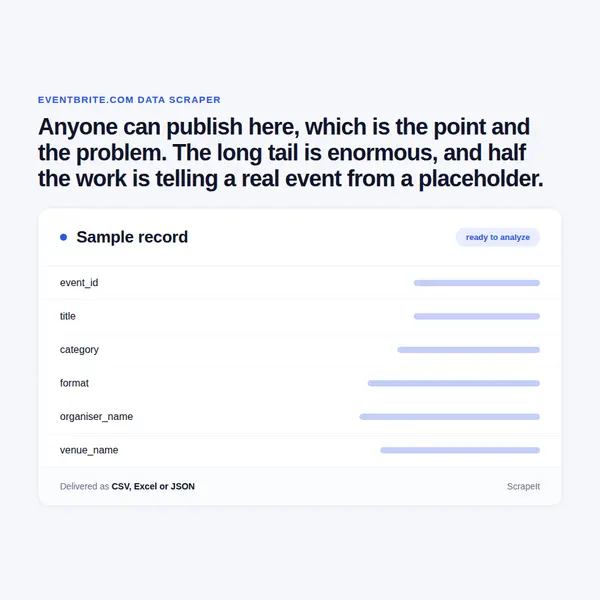
Anyone can publish here, which is the point and the problem. The long tail is enormous, and half the work is telling a real event from a placeholder.

Eventbrite Scraper
Solutions

Managed event listing data, run end to end by us

ScrapeIt runs the collection as a managed service. You name the cities, categories and date ranges; we build the pipeline, run it on your cadence and hand back CSV, JSON, Excel or a push into your warehouse, deduplicated, with recurrence modelled, ticket types as rows and online events flagged.

Cadence is usually daily or weekly per city, since listings appear continuously but individual events change slowly once published. Requests are paced and crawl rules honoured.

We collect published event listings. Organiser names are frequently individuals rather than companies, so we treat organiser records as potentially personal data: the default output carries the organiser as published without additional contact details, and we ask for a lawful basis before anything more. Listing content belongs to the organisers and the platform, so the dataset is for analysis rather than republication. Bring the use case to your own counsel before the project starts.

Eventbrite fields in every export

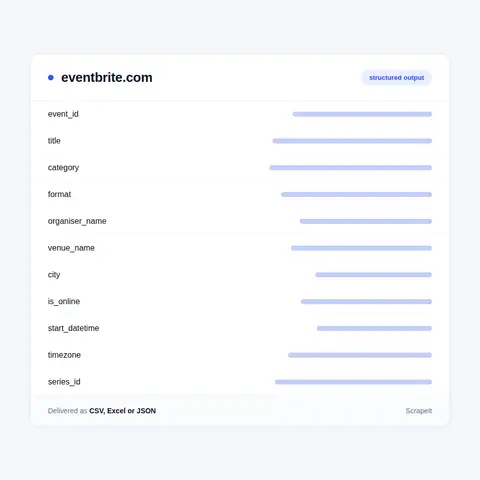
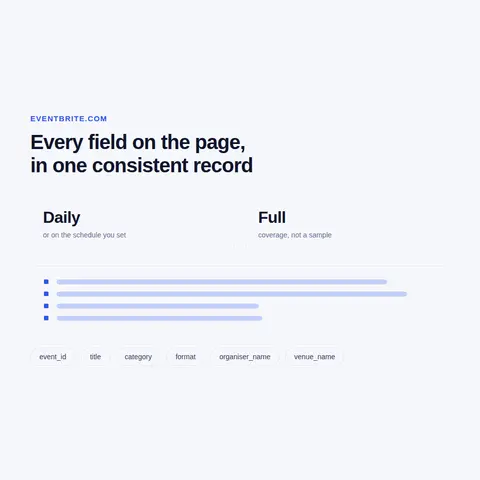
The event record covers event identifier, title, description, category and subcategory, format such as conference, class or festival, organiser name and organiser identifier, venue name and full address or an online flag, city, start and end datetime with time zone, and the event URL.

Recurrence is modelled explicitly: whether the listing is a series, the series identifier, the occurrence datetime and the position in the series. That is what allows a client to count events, occurrences or both, deliberately, rather than discovering afterwards that a yoga class contributed two hundred rows to a market analysis.

Ticket types come as rows, not a column: type name, price, currency, whether it is free or donation based, sales start and end dates, and quantity or availability status where published. Early bird tiers with their own date windows are exactly why this has to be structured.

Organiser records carry name, identifier, the events attributed to them and their locations, which supports the question of who is actually producing events in a market and how frequently.

Every row carries the city, the collection timestamp and a quality flag summarising the checks described below.

Eventbrite fields in every export
Organisers, online events and city coverage

Organisers, online events and city coverage

Organiser analysis is one of the more useful outputs. Because organiser identity is attached to every listing, a market's active producers become visible: who runs many events, who is new, who has stopped. That is a business development map for anyone selling to event organisers, and it needs no inference beyond normalising the names.

Online and hybrid events need typing rather than filtering. A large share of listings are online, and mixing them into a city's physical event count overstates local activity considerably. We flag them and let the client choose, which is a decision that changes numbers materially in some categories.

City coverage is worth stating honestly. The platform is strong in some markets and thin in others, and its share of the small event world varies by country. A city calendar built from it is platform coverage rather than a complete picture, and we describe it that way rather than letting it be read as a census.

Repeat collection turns this into a time series. New listings per week by category, price point movement and organiser activity all become trends, and for demand forecasting around a venue or a hotel that trend is the useful part rather than any single snapshot.

A self-serve platform with an enormous long tail

Eventbrite is a self service ticketing and registration platform. Organisers create their own events, from stadium scale conferences down to a yoga class in a community hall, and publish them without editorial review. That openness is why the platform holds the broadest picture of small and mid sized events in most cities, and it is also why the data needs cleaning that a curated source would not.

Discovery is organised geographically and by category, with city pages listing what is on, filterable by date and type. Those surfaces respond and are enumerable, which makes systematic city by city collection practical.

Recurrence is a structural feature that trips up naive collectors. A weekly class is often published as one event with many occurrences, sometimes as many separate events, and sometimes both. Counting occurrences as events inflates a city's event count several times over, and the inflation is not uniform between categories, so it distorts comparisons as well as totals.

Ticket types are equally varied: free registration, paid tiers, donation based entry, early bird pricing with dates attached, and capacity limits. A single price column would be wrong for most listings on the platform.

Get a Quote
dev_w
25

Developers

customers
500+

Customers worldwide

pages
1 500 000 000+

Pages extracted

stime
15000+

Hours saved for our clients

Plans

Airplane

€199 / one-time

setup fee - included

Data limits100,000
Frequencyone-time
Run timeup to 5 days
Data storing7 days

Helicopter

€169 / mo

setup fee €499

Data limits250,000
Frequencymonthly
Run timeup to 5 days
Data storing14 days

Glasses

€229 / mo

setup fee €499

Data limits1,000,000
Frequencyweekly
Run timeup to 5 days
Data storing30 days

DNA

€549 / mo

setup fee €799

Data limits3,000,000
Frequency3 times daily
Run timesame day
Data storing90 days

Why cleaning is most of the value on an open platform

On a curated platform the data arrives roughly usable. On an open one it does not, and a vendor who hands over a raw export has done the easy half of the job.

Duplicates are the first problem. The same event is frequently published more than once by the same organiser, or by an organiser and a venue separately, with slightly different titles. Without deduplication on venue, date and title similarity, a city's event count is simply wrong.

Test and placeholder listings are the second. Open platforms accumulate them, and they look like events to a parser. Simple checks on title patterns, capacity, price and organiser history remove most, and flagging the rest is more honest than silently deleting them.

Recurrence is the third and the largest distortion. A weekly class published as a series produces dozens of occurrences, and whether those should count as events depends entirely on the question being asked. We model the series explicitly so the client decides, instead of the collector deciding by accident.

Once cleaned, the platform answers questions nothing else does. What is actually happening in a city, at what scale, in which categories, produced by whom, at what price points. For venue operators, tourism boards, sponsors and anyone planning against a local calendar, that long tail is the whole dataset, and it exists nowhere else in structured form.

Our Blog

Reads Our Latest News & Blog

Learn how to use web scraping to solve data problems for your organization

How Artificial Intelligence Is Used In Web Scraping

How Artificial Intelligence Is Used In Web Scraping

Leveraging advances in technology, the AI-powered web scraper has skyrocketed in demand and is helping to expand capabilities by automating tedious daily tasks and speeding up data collection from thousands of websites several times over.

What is Web Scraping and What is it Used For?

What is Web Scraping and What is it Used For?

Web scraping is a method of obtaining web data by extracting it from pages of web resources with the help of a program, that is, in automatic mode. It is used to syntactically convert web pages into more usable forms.

Web Scraping for Machine Learning

Web Scraping for Machine Learning

If you specialize in machine learning, you need to feed large amounts of data to the algorithms. Web scraping is the easiest and the most efficient method of collecting the data from all over the Internet.

scrapeit logo

Who builds and keeps your event listings feed

ScrapeIt is a managed extraction company, not a tool you have to learn. Our team builds the pipeline, maintains the deduplication and quality rules as the platform changes, and repairs it before your city calendar fills with noise.

You see a sample first, in your format, for the cities you actually cover, with duplicates removed and recurrence modelled so you can judge the count you would actually report.

FAQ

Why is the raw event count from this platform unreliable?

Because of duplicates, test listings and recurrence. The same event gets published twice by an organiser and a venue, placeholders accumulate on any open platform, and a weekly class published as a series produces dozens of occurrences. Untreated, a city count can be several times too high, and the inflation differs by category so comparisons break too.

How do you handle recurring events?

By modelling the series explicitly: a series flag, a series identifier, the occurrence datetime and the position in the series. Whether occurrences should count as events depends on your question, so the data lets you decide rather than having the collector decide by accident.

Are ticket prices reliable here?

They are as published, and they are varied: free registration, paid tiers, donation based entry and early bird pricing with its own date window. We deliver ticket types as rows with their prices, currencies and sales windows rather than as a single price column, which would be wrong for most listings on the platform.

Do you separate online events from physical ones?

Yes, with a flag rather than by filtering. A large share of listings are online, and including them in a city's physical event count materially overstates local activity in some categories. Which way to treat them is your decision and the data supports both.

Is this a complete picture of events in a city?

No, and it should not be presented as one. It is the broadest available view of small and mid sized events in most markets, and it is still platform coverage: events not published here do not appear, and the platform's share varies by country. We describe the dataset as platform coverage rather than as a census, and we would rather say so at the start.

How does it Work?

Step 1 - Make a Request

You share your needs, expectations, and desired timeframe. We’ll suggest the best solution based on your request and budget.

Step 2 - Configuring Custom Web Crawlers

Our specialists configure the crawlers and extract a sample dataset for your review before proceeding with the full-scale extraction.

Step 3 - Collect and Deliver

Once you approve the sample, we launch the project and start full data collection. We gather, filter, and structure the data for easy use, delivering it on time in your preferred format.

Step 4 - Maintain and Support

Our team manages ongoing processes, monitors website changes, and supports all data extraction cycles. We can also help integrate data into your systems or create dashboards to simplify analysis.

Request a Quote

Tell us more about you and your project information.
Which sites, which fields, how often. A couple of lines is enough.

We reply within 1 business day. No obligation.

scrapiet

Scrapeit Sp. z o.o.
10/208 Legionowa str., 15-099, Bialystok, Poland
NIP: 5423457175
REGON: 523384582