Viagogo Scraper for International Resale Ticket Prices

The same event, the same seat, two country sites, two prices. Cross-border resale is where this platform gets interesting and where a single-market collector goes blind.

Viagogo Scraper
Solutions

Managed international resale data, run end to end by us

ScrapeIt runs the collection as a managed service. You name the events, performers and the markets you care about; we build the pipeline per storefront, match events across them, and hand back CSV, JSON, Excel or a push into your warehouse with storefront, currency and fee treatment on every row.

Cadence is tiered by event and phase, as on any resale source: watch list events frequently through their on sale and final week, everything else daily or weekly. Requests are paced and crawl rules honoured.

We collect published listing data only. We do not purchase tickets or automate checkout in any market. Listing content belongs to the marketplace, so the dataset is for analysis rather than republication, and resale regulation differs by country in ways that shape what a product built on it may do. Bring the use case to your own counsel before the project starts.

Viagogo fields in every export

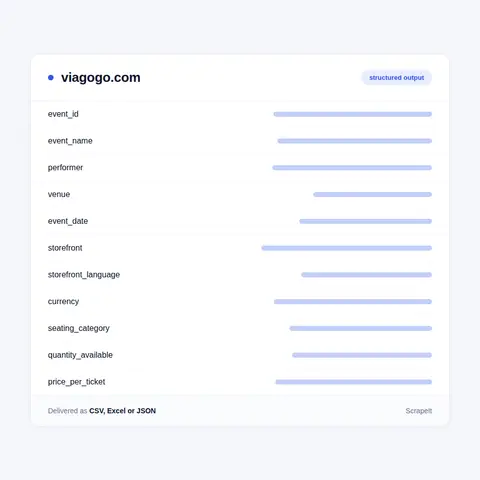
The event record covers event identifier, name, performer, venue, city and country, event date and local time, the storefront it was collected from, the storefront language and currency, and the event URL.

Listing observations carry seating category and section where published, quantity available, price per ticket as displayed, fee treatment, the estimated or shown total, the currency, and any restriction noted on the listing such as ticket delivery method or seating together.

Storefront is a first class field on every row rather than an afterthought, because on this platform the same listing viewed from two countries is two observations with different numbers. Recording only a price and a currency loses the reason they differ.

Derived measures per observation and per storefront follow the same pattern as any resale collection: lowest available in each seating category, median, listing count and total quantity, all computed from stored rows.

Currency handling keeps the quoted currency as collected and records any conversion separately with its rate and date, so exchange movement is never mistaken for ticket price movement, which is a genuine risk in a multi market series.

Viagogo fields in every export
Storefront mapping, regulation and matching

Storefront mapping, regulation and matching

Storefront mapping is set up at the start. Which markets matter, which languages they use, which currencies they quote and how fees are presented in each. That mapping is the frame every later comparison depends on, and getting it wrong produces charts that look like price movement and are actually storefront movement.

Event matching across storefronts is not trivial. Event names are localised, performer names are transliterated in some markets, and venue names vary. We match on date, venue geography and performer identity rather than on strings, keeping the surface forms so any join can be audited.

Regulation differs enough between markets to affect scope. Ticket resale is restricted or capped in several jurisdictions, and rules on fee display and on face value disclosure vary widely. We record the market on every row so analysis can respect those boundaries, and we tell clients plainly that what a product may do with the data is a question for local counsel rather than for us.

Matching to the primary market runs the same way as elsewhere in this section, on venue, date and performer, and it is what turns an inventory dataset into a premium measurement.

One marketplace, many country storefronts

Viagogo is an international resale marketplace operating localised storefronts across a large number of countries, each in its own language and currency. The underlying inventory overlaps heavily, but what a visitor is shown, and at what price, depends on the storefront they land on.

That is the defining feature for data work. An event with international demand can be listed to buyers in a dozen markets simultaneously, with prices converted, fees applied differently and availability presented differently. Collecting one storefront gives you one market's view and quietly hides the arbitrage that makes this platform interesting.

Category and event surfaces respond and are enumerable per storefront, which makes systematic collection across markets practical rather than theoretical. As on any resale marketplace, the inventory is a set of individual listings rather than a catalogue, and it turns over continuously.

Fees and the presentation of the final price vary by market, partly because consumer protection rules differ. Some jurisdictions require all inclusive pricing to be shown up front; others do not. A cross market price comparison that does not account for that is comparing regulatory regimes rather than markets.

Get a Quote
dev_w
25

Developers

customers
500+

Customers worldwide

pages
1 500 000 000+

Pages extracted

stime
15000+

Hours saved for our clients

Plans

Airplane

€199 / one-time

setup fee - included

Data limits100,000
Frequencyone-time
Run timeup to 5 days
Data storing7 days

Helicopter

€169 / mo

setup fee €499

Data limits250,000
Frequencymonthly
Run timeup to 5 days
Data storing14 days

Glasses

€229 / mo

setup fee €499

Data limits1,000,000
Frequencyweekly
Run timeup to 5 days
Data storing30 days

DNA

€549 / mo

setup fee €799

Data limits3,000,000
Frequency3 times daily
Run timesame day
Data storing90 days

Why cross-market collection is the point here

A domestic collector on a domestic platform answers a domestic question. This platform is international by design, and the interesting questions are the ones a single storefront cannot answer.

The first is price divergence. The same event, the same seating category, shown at materially different prices to buyers in different countries, is a fact about demand and about fee structures, and it is invisible unless several storefronts are collected in parallel and compared with currency handled honestly.

The second is availability divergence. Inventory shown to one market may not be shown to another, and an event that appears sold out from one storefront can have listings visible from another. For anyone modelling demand or investigating distribution, that asymmetry is the finding.

The third is fee presentation. Consumer protection rules differ, and where all inclusive pricing is mandatory the headline number means something different from a market where fees appear at checkout. Any cross border comparison has to record how the price was presented or it is measuring regulation rather than price.

The fourth is the same as on any resale platform: face value against resale. That needs the primary market collected alongside and events matched, and it is the comparison most clients arrive wanting.

Our Blog

Reads Our Latest News & Blog

Learn how to use web scraping to solve data problems for your organization

How Artificial Intelligence Is Used In Web Scraping

How Artificial Intelligence Is Used In Web Scraping

Leveraging advances in technology, the AI-powered web scraper has skyrocketed in demand and is helping to expand capabilities by automating tedious daily tasks and speeding up data collection from thousands of websites several times over.

What is Web Scraping and What is it Used For?

What is Web Scraping and What is it Used For?

Web scraping is a method of obtaining web data by extracting it from pages of web resources with the help of a program, that is, in automatic mode. It is used to syntactically convert web pages into more usable forms.

Web Scraping for Machine Learning

Web Scraping for Machine Learning

If you specialize in machine learning, you need to feed large amounts of data to the algorithms. Web scraping is the easiest and the most efficient method of collecting the data from all over the Internet.

scrapeit logo

Who builds and keeps your international ticket feed

ScrapeIt is a managed extraction company, not a tool you have to learn. Our team builds and maintains the per storefront collection, watches it as markets and templates change independently, and repairs it before a market quietly drops out of your comparison.

You see a sample first, in your format, across the storefronts you actually need, with the same event matched between them so you can see the divergence on real listings.

FAQ

Why collect more than one country site?

Because the interesting facts are the differences between them. The same event and seating category can be shown at materially different prices and availability in different markets, and that divergence is invisible from a single storefront. Collecting one country and calling it the platform answers a narrower question than most clients think they are asking.

How do you keep currency movement out of the price series?

By storing the quoted currency exactly as collected and recording any conversion separately, with the rate and the date it used. In a multi market series it is otherwise very easy to publish a chart showing ticket prices rising when what actually moved was an exchange rate.

How do you match the same event across storefronts?

On date, venue geography and performer identity rather than on strings, because event names are localised and performer names are transliterated differently in some markets. Every surface form encountered is kept so a match can always be audited rather than taken on trust.

Do fees make cross-border comparison unreliable?

Only if you ignore them. Consumer protection rules differ, and in markets where all inclusive pricing is mandatory the headline figure means something different from a market where fees appear at checkout. We record how the price was presented on every row, so a comparison measures price rather than regulation.

Is collecting resale data legal?

Collecting published listings for analysis is ordinary market research, and we do it on public pages within the site's crawl rules, without ever purchasing or automating checkout. What differs by country is resale regulation itself, including price caps and disclosure requirements, which shapes what a product built on the data may do. Take that to local counsel before you build on it.

How does it Work?

Step 1 - Make a Request

You share your needs, expectations, and desired timeframe. We’ll suggest the best solution based on your request and budget.

Step 2 - Configuring Custom Web Crawlers

Our specialists configure the crawlers and extract a sample dataset for your review before proceeding with the full-scale extraction.

Step 3 - Collect and Deliver

Once you approve the sample, we launch the project and start full data collection. We gather, filter, and structure the data for easy use, delivering it on time in your preferred format.

Step 4 - Maintain and Support

Our team manages ongoing processes, monitors website changes, and supports all data extraction cycles. We can also help integrate data into your systems or create dashboards to simplify analysis.

Request a Quote

Tell us more about you and your project information.
Which sites, which fields, how often. A couple of lines is enough.

We reply within 1 business day. No obligation.

scrapiet

Scrapeit Sp. z o.o.
10/208 Legionowa str., 15-099, Bialystok, Poland
NIP: 5423457175
REGON: 523384582