Instacart Scraper for Retailer Prices and Product Data

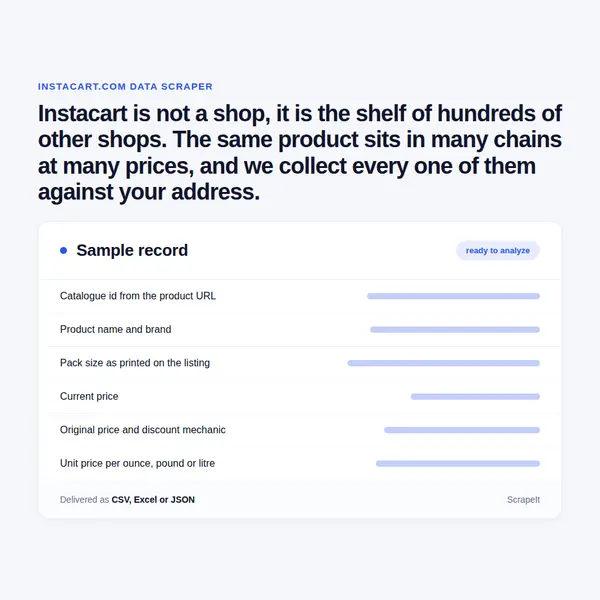
Instacart is not a shop, it is the shelf of hundreds of other shops. The same product sits in many chains at many prices, and we collect every one of them against your address.

Instacart Scraper
Solutions

Instacart scraping we set up, run and keep running

We run the Instacart scraper for you as a managed job. You name the postcodes, the banners and the SKUs or categories that matter; we design the schema, build the crawl, run it on your cadence and hand back the rows. Anti-bot handling, proxy rotation and CAPTCHA solving are part of the service, not an extra you have to arrange - this marketplace is closed to plain automated clients, and getting through it is our job rather than yours.

Delivery is CSV, JSON, Excel, a feed into your warehouse or an endpoint we host. Typical shapes are a product table, an offer table keyed on product and banner and postcode, a promotions table from the weekly ads, and a retailer table. We publish only what the marketplace shows any visitor; names of customers and shoppers are not collected.

Instacart product fields we extract from every item page

What we extract from Instacart is a retail record, not a menu line. Two joined tables come out of the crawl: the product, which is global, and the offer, which belongs to one chain at one address.

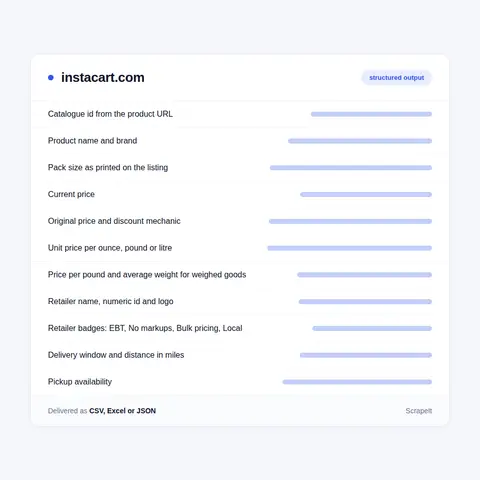
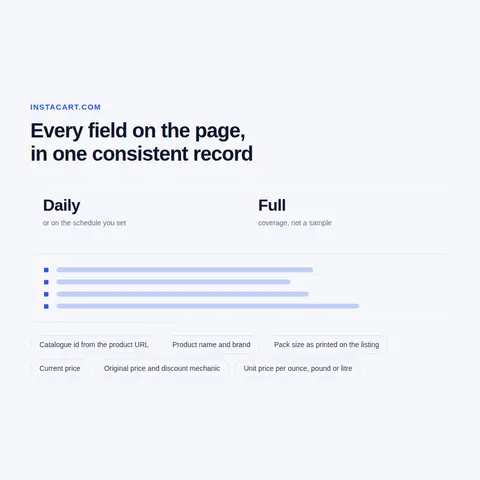
  • Product identity - catalogue id from the URL, name, brand with its own brand page, pack size as printed (24 oz, 1 gal, 2 ct), the variant note when a listing says 2 sizes or 3 sizes, and the four-level category path with the id of each level.
  • Price - current price, original price where a promotion runs, the discount in the platform's own words (50% off, $2.40 off, Buy 1 get 1 free, Spend $35 save $6) and the unit price, for instance $1.24/oz.
  • Weighted goods - estimated package price, price per pound and average weight, which the listing marks as an estimate because the shopper weighs it in the aisle.
  • Availability - the stock wording (Many in stock), the unavailable state, and the replacement rules a buyer can set in advance: Find Best Match, Pick Specific Replacement, Don't Replace.
  • Content - description, full ingredient list, directions, the allergen warning line such as Contains: milk, nutrition per serving with calories, protein, fat and sugar, and the diet filters Organic, Vegan, Kosher, Gluten Free, Sugar Free, Fat Free.
  • Images - packshot and thumbnails, delivered through an image server that resizes on request, so one row can carry several widths.
  • Reviews - average rating, review count, the star histogram and syndicated review text with handle, date and the site it came from.
  • The retailer block - chain name and numeric id, logo, delivery promise, distance in miles, pickup availability and the badges: EBT, No markups, Low prices, Loyalty savings, Bulk pricing, Local, Farther away.
  • Cross-chain offers - the same item priced at the other stores near that address and a tail line that counts the rest, in the form available at 14 stores from $4.09.

Every row carries the postcode it was collected against. Without that column an Instacart price is not a fact, it is a rumour.

Instacart product fields we extract from every item page
Retailers, weekly ads and the fee stack behind the basket

Retailers, weekly ads and the fee stack behind the basket

The chain itself is a record worth having. Each storefront carries a name, a numeric id, a logo, a delivery window and a pickup window, distance from the delivery point, the aisle tree it publishes, and tags that describe the trade: Groceries, Wholesale, Convenience, Retail, Organic, Butcher Shop, Alcohol, EBT. Some banners sell alcohol, some run a pharmacy hub with prescription delivery, some accept EBT SNAP, and the warehouse clubs are shoppable without a club membership. Move the postcode and the roster changes completely: a San Francisco address returns Safeway, Costco, Sprouts, Rainbow Grocery and Mollie Stone's, while a Miami address returns Publix, ALDI, BJ's Wholesale Club, The Fresh Market, Milam's Markets and two liquor stores.

Weekly ads are a separate feed. Every flyer page is dated to a savings window and lists the deal mechanic per item, so a promotion calendar can be rebuilt week by week per banner. The basket total is another layer again: delivery fee by retailer, window and order size, service fee that varies by cart, a pickup fee where the chain charges one, priority and long-distance fees, a convenience fee on the fastest orders, bottle deposit and bag fees by state, plus regulatory fees in some cities. An Instacart+ membership waives delivery fees on qualifying orders but not service fees, so the same cart carries two totals depending on the account.

How Instacart puts hundreds of grocery chains on one shelf

Instacart sells no inventory of its own. It is a marketplace that puts other retailers shelves online: Costco, Safeway, Walmart, Target, ALDI, Publix, Sprouts Farmers Market, BJ's Wholesale Club, CVS, Petco, Total Wine and hundreds of regional chains and single-site grocers. Maplebear Inc., trading as Instacart, lists what a partner branch stocks, sends a personal shopper into that branch and delivers the basket. The marketplace currently counts about 500 retail banners, roughly 80,000 store locations and about 14,000 cities across the United States and Canada, over a catalogue it puts at around one billion shoppable products. Canada runs on instacart.ca on the same machinery.

The addressing follows that shape. A retailer sits at /store/costco/storefront, its aisles at /store/safeway/collections/dairy, its weekly ad at /store/safeway/flyer. A product has one global page, /products/2720127-kraft-parmesan-grated-cheese-24-oz, where the numeric prefix is the catalogue id and the chain is chosen by a retailerSlug parameter; ask for a chain that does not carry the item and the page is simply not there. Above the stores sits a public taxonomy, /categories/316-food/1326-dairy/1329-cheese/3192-parmesan, with an id at every level, plus city landing pages such as /grocery-delivery/fl/near-me-in-miami-fl. Carts, orders and the signed-in item view sit behind a login, and we do not go there.

Get a Quote
dev_w
25

Developers

customers
500+

Customers worldwide

pages
1 500 000 000+

Pages extracted

stime
15000+

Hours saved for our clients

Plans

Airplane

€199 / one-time

setup fee - included

Data limits100,000
Frequencyone-time
Run timeup to 5 days
Data storing7 days

Helicopter

€169 / mo

setup fee €499

Data limits250,000
Frequencymonthly
Run timeup to 5 days
Data storing14 days

Glasses

€229 / mo

setup fee €499

Data limits1,000,000
Frequencyweekly
Run timeup to 5 days
Data storing30 days

DNA

€549 / mo

setup fee €799

Data limits3,000,000
Frequency3 times daily
Run timesame day
Data storing90 days

Grocery price comparison between chains in one city

This is what makes Instacart price data unlike any single chain's website. A supermarket publishes its own prices and nothing else. Instacart holds the same product from many chains at once and prints them one under the other, so a single pass against one postcode returns a five-ounce cup of grated parmesan at $6.19 in one banner and $3.99 in a neighbourhood market, with a count of the other stores carrying it and the cheapest of those. No retailer site can build that table, because no retailer knows what the shop across the road charges today.

That is why buyers scrape Instacart rather than ten separate grocery sites. The same crawl answers three questions at once: what a named SKU costs in every banner near a point, which banners stock it at all and which quietly do not, and how private label sits against the national brand on the same shelf. Assortment gaps show up as missing rows; a promotion shows up as an original price with a strike through it and a mechanic beside it.

One caveat has to be said out loud. Retail partners set the prices on the marketplace, and the platform states that some of them price differently from their own aisles; the chains that do not are flagged No markups. So an Instacart price is a marketplace price, and it is the right number for comparing baskets across banners, not a substitute for a shelf audit.

Our Blog

Reads Our Latest News & Blog

Learn how to use web scraping to solve data problems for your organization

How Artificial Intelligence Is Used In Web Scraping

How Artificial Intelligence Is Used In Web Scraping

Leveraging advances in technology, the AI-powered web scraper has skyrocketed in demand and is helping to expand capabilities by automating tedious daily tasks and speeding up data collection from thousands of websites several times over.

What is Web Scraping and What is it Used For?

What is Web Scraping and What is it Used For?

Web scraping is a method of obtaining web data by extracting it from pages of web resources with the help of a program, that is, in automatic mode. It is used to syntactically convert web pages into more usable forms.

Web Scraping for Machine Learning

Web Scraping for Machine Learning

If you specialize in machine learning, you need to feed large amounts of data to the algorithms. Web scraping is the easiest and the most efficient method of collecting the data from all over the Internet.

scrapeit logo

The team behind your Instacart price feed

ScrapeIt owns the pipeline so you do not have to. There is nothing to install and no dashboard to babysit: our engineers write the crawler, watch it while the marketplace shifts - grocery layouts and pricing rules move constantly - and repair it before a column goes empty on your side.

A sample cut of real rows for your own postcodes lands before anything is signed, so the schema is agreed on data you can read rather than on a promise. After that you get files or an endpoint on a schedule, and a named engineer who answers when something changes shape.

FAQ

Does Instacart have a public API for product and price data?

No. The developer documentation is real but it points the other way: the Cross-platform Catalog is how a brand or chain sends its catalogue in, Connect APIs and Shopping Widgets put Instacart machinery on a retailer's own site, the Ads API is for advertisers, and the Data Hub is a Snowflake clean room for partners. The Developer Platform API only builds shoppable links out of your own recipe or list. There is no public Instacart API that returns the catalogue, prices or store rosters to a data buyer, which is why the data is collected from the published pages instead.

Is the price on Instacart the same as the price on the shelf?

Not always, and we will not pretend otherwise. Retail partners set item prices on the marketplace themselves. The platform says openly that while many chains use their everyday store prices, some set marketplace prices that differ from in-store, and it labels the ones that do not with a No markups badge on the store card. We carry that badge through as a column, so you can tell which rows are shelf-equivalent and which are marketplace-only, and compare like with like across banners.

How much does the delivery postcode change what you can collect?

It changes everything. The list of banners, the aisles inside them, the availability of a given item, the delivery promise and the price are all resolved against one delivery point. A product page opened for a chain that does not serve that address returns nothing at all. So coverage is planned as a list of postcodes, not as a list of pages: you name the metros or the catchments around your stores, and every row we return is stamped with the point it was collected against.

Which fields do you deliver, and what is simply not published?

We deliver catalogue id, name, brand, pack size, category path with ids, current and original price, discount mechanic, unit price, weighted-item price per pound and average weight, stock wording, images, description, ingredients, directions, allergen warnings, nutrition per serving, diet flags, ratings with review text, and the retailer block with badges, distance and delivery window. Not published: real-time inventory counts, wholesale cost, the shelf price inside the physical store, and anything behind the account login such as orders or personal carts.

Is it legal to scrape Instacart given the terms of use?

We are straight about it. The Instacart terms forbid scraping, crawling, data mining, harvesting or otherwise collecting content except through interfaces the company authorises, treat robots.txt as part of the contract, and separately forbid using marketplace data to train machine-learning models or to build a competing service. The robots file admits a short list of named search and AI crawlers and closes the site to everyone else. That is a contractual restriction rather than a criminal one, and how you handle it is a call for your counsel; we take only publicly displayed pages, never personal data, and we scope the work to what your lawyers approve.

How does it Work?

Step 1 - Make a Request

You share your needs, expectations, and desired timeframe. We’ll suggest the best solution based on your request and budget.

Step 2 - Configuring Custom Web Crawlers

Our specialists configure the crawlers and extract a sample dataset for your review before proceeding with the full-scale extraction.

Step 3 - Collect and Deliver

Once you approve the sample, we launch the project and start full data collection. We gather, filter, and structure the data for easy use, delivering it on time in your preferred format.

Step 4 - Maintain and Support

Our team manages ongoing processes, monitors website changes, and supports all data extraction cycles. We can also help integrate data into your systems or create dashboards to simplify analysis.

Request a Quote

Tell us more about you and your project information.
Which sites, which fields, how often. A couple of lines is enough.

We reply within 1 business day. No obligation.

scrapiet

Scrapeit Sp. z o.o.
10/208 Legionowa str., 15-099, Bialystok, Poland
NIP: 5423457175
REGON: 523384582