Misfits Market Scraper for Surplus Grocery Availability

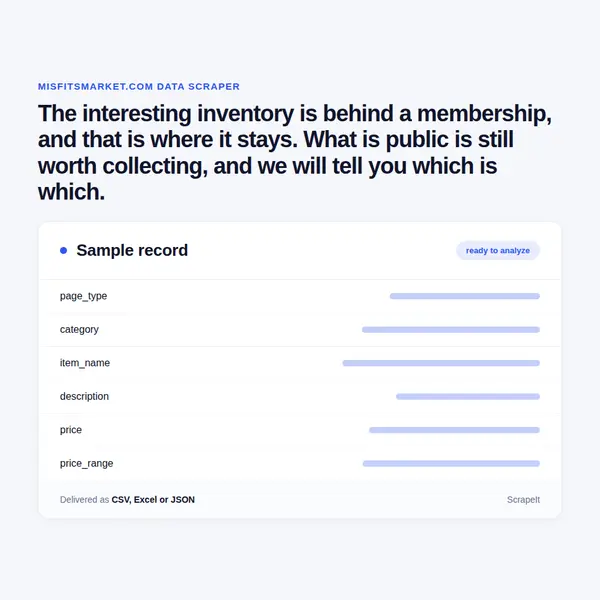
The interesting inventory is behind a membership, and that is where it stays. What is public is still worth collecting, and we will tell you which is which.

Misfits Market Scraper
Solutions

Managed public grocery data, run end to end by us

ScrapeIt runs the collection as a managed service. You name the scope; we collect the public layer with access level marked on every row, claims and coverage as their own records, and hand back CSV, JSON, Excel or a push into your warehouse.

Where your question needs the gated catalogue we will say so at the first conversation rather than delivering a partial file and letting you discover the gap.

We collect public pages only, honour the crawl rules including the requested delay, and do not bypass memberships or create accounts. Terms restrict commercial reuse, so the dataset is for analysis rather than republication, and your counsel should see the use case before the project starts.

Misfits Market fields in every export

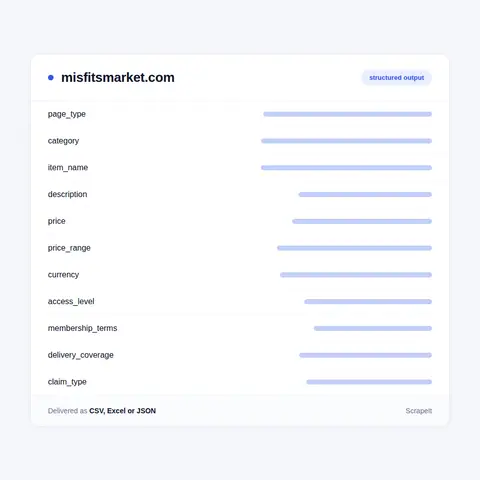
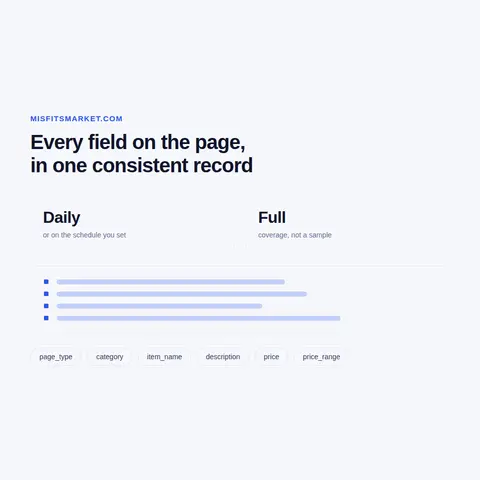
Public records carry page type, category, product or programme name, description, any published price or price range, delivery coverage statements, membership terms as stated and the address.

Access level is recorded on every row: public, or known to exist behind the membership and therefore not collected. A dataset that silently omits the gated part looks complete and misleads whoever inherits it.

Sustainability and sourcing claims are collected as their own records where published, since for research into food waste and surplus retail the claims themselves are the object of study.

Delivery coverage statements are kept as published text plus any structured geography, because coverage on a national surplus grocer is uneven and the statement is the only public source for it.

Every row carries the collection timestamp.

Misfits Market fields in every export
Claims analysis, coverage and scope

Claims analysis, coverage and scope

Sustainability claims analysis is the most defensible use of this source: what is asserted about food waste reduction and sourcing, how it is framed, and how it changes - a subject of genuine research and regulatory interest.

Delivery coverage mapping answers where a surplus grocery model reaches, which for anyone studying food access is a concrete question with a public answer.

Pricing structure comparison against conventional grocers works on published price ranges and membership terms rather than on SKU-level prices, which is coarser and still informative.

Scope limits, stated once and held: no membership bypass, no account creation, no gated catalogue. Where a client needs the inventory itself, the route is a commercial conversation with the company rather than a technical one with us.

Surplus groceries and a membership boundary

Misfits Market is a United States online grocer selling surplus, imperfect and rescued food at a discount, delivered as a box built from a weekly rotating selection.

Two things shape any project here, and the first is a boundary. The shopping catalogue - the actual rotating inventory a member browses - sits behind a membership. It is not open to an unauthenticated request and we do not bypass memberships. A brief that assumes the full catalogue is collectable needs correcting before anybody is charged.

What is public is the programme structure: how the service works, category and product marketing pages, pricing structure, delivery coverage and the sustainability claims the business is built on. That is a smaller dataset and for several kinds of research it is the relevant one.

The second thing is rotation. Even behind the membership, the inventory is surplus-driven, which means it changes with what is available rather than following a fixed range. A conventional catalogue model does not describe it.

Crawl rules are published, allow the site broadly and ask for a one second delay between requests.

Get a Quote

dev_w
25

Developers

customers
500+

Customers worldwide

pages
1 500 000 000+

Pages extracted

stime
15000+

Hours saved for our clients

Plans

Airplane

€199 / one-time

setup fee - included

Data limits100,000
Frequencyone-time
Run timeup to 5 days
Data storing7 days

Helicopter

€169 / mo

setup fee €499

Data limits250,000
Frequencymonthly
Run timeup to 5 days
Data storing14 days

Glasses

€229 / mo

setup fee €499

Data limits1,000,000
Frequencyweekly
Run timeup to 5 days
Data storing30 days

DNA

€549 / mo

setup fee €799

Data limits3,000,000
Frequency3 times daily
Run timesame day
Data storing90 days

Why a partial source still earns a place

It would be easy to write this source off as gated and move on, and for a pricing brief that is the right call - we will say so.

For other questions the public layer is what matters. Research into food waste and surplus retail is about the model rather than the SKU list: how the proposition is framed, what sourcing claims are made, how pricing is structured against conventional grocery, and where the service reaches. All of that is public.

The second point is that surplus inventory is structurally different from ordinary retail assortment. It is supply-driven - the range reflects what was surplus that week - so even with full access, a fixed catalogue model would be the wrong shape. Anyone planning such a project should understand that before designing the schema.

The third is the access-level field, which matters more on a partial source than anywhere. Marking what exists but was not collected is the difference between an honest partial dataset and one that quietly understates a market.

The fourth is that we do not bypass memberships, sign up for accounts or work around access controls, and we say so rather than being asked.

Our Blog

Reads Our Latest News & Blog

Learn how to use web scraping to solve data problems for your organization

How Artificial Intelligence Is Used In Web Scraping

How Artificial Intelligence Is Used In Web Scraping

Leveraging advances in technology, the AI-powered web scraper has skyrocketed in demand and is helping to expand capabilities by automating tedious daily tasks and speeding up data collection from thousands of websites several times over.

What is Web Scraping and What is it Used For?

What is Web Scraping and What is it Used For?

Web scraping is a method of obtaining web data by extracting it from pages of web resources with the help of a program, that is, in automatic mode. It is used to syntactically convert web pages into more usable forms.

Web Scraping for Machine Learning

Web Scraping for Machine Learning

If you specialize in machine learning, you need to feed large amounts of data to the algorithms. Web scraping is the easiest and the most efficient method of collecting the data from all over the Internet.

scrapeit logo

Who builds and keeps your feed

ScrapeIt is a managed extraction company, not a tool you have to learn. Our team builds the pipeline, watches it as the public pages change, and tells you when the public and gated boundary moves rather than letting your coverage shift silently.

You see a sample first, in your format, with access level marked so you can see immediately how much of your question the public layer actually answers.

FAQ

Can you get the full product catalogue?

No. The shopping catalogue is behind a membership and we do not bypass memberships or create accounts. If that is what your brief needs, the route is a commercial conversation with the company rather than a technical one with us.

Then what is worth collecting?

The programme layer: how the proposition is framed, sourcing and sustainability claims, pricing structure, membership terms and delivery coverage. For food waste and surplus retail research that is the relevant material, not the SKU list.

Why mark access level on every row?

Because a dataset that silently omits the gated part looks complete and misleads whoever inherits it. Marking what exists but was not collected is what makes a partial dataset honest rather than merely incomplete.

Would a fixed catalogue model work here anyway?

No, and this is worth knowing before designing a schema. Surplus inventory is supply-driven - the range reflects what happened to be surplus that week - so even with full access a fixed assortment model would be the wrong shape.

How fast do you collect?

At the one second interval the site's crawl rules request. It is a small public surface, so pacing costs nothing here and honouring a stated request is simply how we work.

How does it Work?

Step 1 - Make a Request

You share your needs, expectations, and desired timeframe. We’ll suggest the best solution based on your request and budget.

Step 2 - Configuring Custom Web Crawlers

Our specialists configure the crawlers and extract a sample dataset for your review before proceeding with the full-scale extraction.

Step 3 - Collect and Deliver

Once you approve the sample, we launch the project and start full data collection. We gather, filter, and structure the data for easy use, delivering it on time in your preferred format.

Step 4 - Maintain and Support

Our team manages ongoing processes, monitors website changes, and supports all data extraction cycles. We can also help integrate data into your systems or create dashboards to simplify analysis.

Request a Quote

Tell us more about you and your project information.
Which sites, which fields, how often. A couple of lines is enough.

We reply within 1 business day. No obligation.

scrapiet

Scrapeit Sp. z o.o.
10/208 Legionowa str., 15-099, Bialystok, Poland
NIP: 5423457175
REGON: 523384582