DoorDash Scraper for Menus, Fees and Store Data

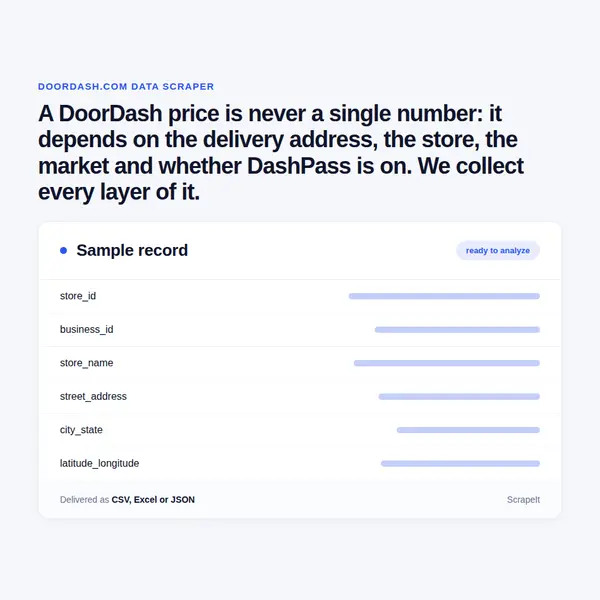
A DoorDash price is never a single number: it depends on the delivery address, the store, the market and whether DashPass is on. We collect every layer of it.

DoorDash Scraper
Solutions

Managed DoorDash scraping, run end to end by us

ScrapeIt runs the DoorDash scraper as a managed service. You name the markets, delivery addresses and fields; we build the crawl, run it on your cadence and hand back CSV, JSON, Excel or a push into your warehouse. Anti-bot handling, proxy rotation and CAPTCHA solving are part of the service rather than something you arrange, and this platform is defended hard enough that some days it is the bulk of the work.

We take only what the site shows without an account: no sign-in, no order history, no checkout. We do not collect the names of review authors or couriers, or anything else that identifies a private person. Merchant details, menus, prices and fees are the product.

The DoorDash terms of service forbid automated collection and systematic retrieval of site content without written permission. We say so rather than bury it: take the use case to your own counsel first, and we scope the work to what counsel signs off.

DoorDash restaurant and menu fields in every export

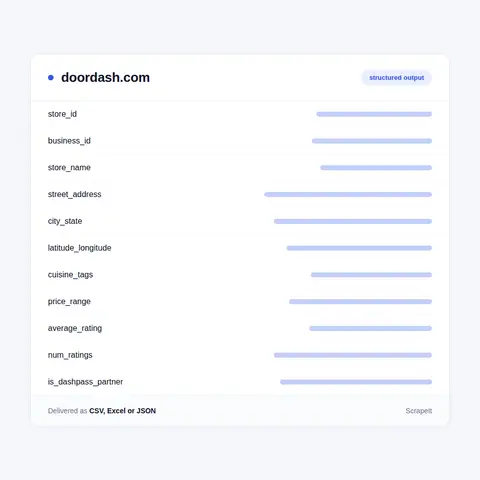
The store record is the spine of any DoorDash scraper: store id, business id, name, street address, city, state, latitude and longitude, cuisine tags with their own ids, the dollar-sign price range, opening hours as displayed, delivery, pickup and group-order flags, the DashPass badge, the merchant's own website and store phone, and an active flag. Closed and delisted locations still render, with a plain notice that the store is not available right now, so a churn series comes free with the crawl.

Ratings come in two shapes and we keep both. The screen shows a bucket, (100+) or (2k+), while the record underneath holds the exact count and the average to one decimal. Written reviews are far rarer than ratings: a sushi bar with 168 ratings carried three public reviews. Each review has a liked or disliked verdict, a date, an order tag and the text, with dish names linked inside it.

Menus are sections, items and options. A section has a name and a position. An item has a name, description, price, image, serving size, dietary tags, badges and a struck-through price when a deal runs. Deals appear in the merchant's own grammar - a headline reading 2 for $8.95 beside a Buy 1, get 1 free badge - so DoorDash menu data ships with the raw display string and a parsed number side by side. Options sit in named groups with prices of their own, and a sold-out item stays on the menu carrying an unavailable flag instead of vanishing.

Then the money, which is where a delivery dataset earns its keep. An order is priced in layers: item subtotal, delivery fee, service fee, small order fee, long distance fee, regulatory response fee, weather impact fee, optional express delivery fee, estimated tax and the Dasher tip, plus bag and bottle charges where local law requires them. We extract DoorDash data for every layer the public pages expose - the delivery fee, the surcharge on stores farther away, the deal tags, the subtotal thresholds - and we say plainly that the finalised service fee and tax are computed in the cart, so the reconstruction is a model, not a receipt.

DoorDash restaurant and menu fields in every export
Grocery, convenience and pharmacy data beyond restaurants

Grocery, convenience and pharmacy data beyond restaurants

Restaurants are half the platform. DoorDash also carries groceries, convenience, alcohol, medicine, pet supplies, beauty, flowers and general retail, and those storefronts do not behave like a menu. In place of courses they have aisles - Drinks, Confectionery, Snacks, Frozen, Household, Dairy and Eggs, Prepared Food, Medicine, Pantry, Personal Care, Bakery, Pet Care, Beauty - with a search box scoped to that single shop.

The item record grows to match. Alcohol lines carry a minimum age requirement, pharmacy lines carry a prescription flag and a prescription id, loose produce and meat carry a continuous quantity with a unit, an increment and a purchase type so the price reads per pound rather than per pack, and any retail line can carry a substitution preference. Grocery and retail shops also add a caution restaurants never show: the listed price is an estimate, and the difference is refunded if the shop charges less.

National product pages, at /products/slug/ugp_uuid or urpc_uuid, sit above the shops with a category path such as Grocery, Pantry, Canned and Jarred, and publish an aggregate offer - low price, high price and stock status across every shop stocking the line. That band is a market signal on its own.

DashPass shifts the arithmetic again. A member pays no delivery fee, a reduced service fee and no long distance fee above a subtotal minimum, and in the older fee markets the service fee drops from 15 percent of subtotal to 5 percent on eligible restaurant orders. Any DoorDash price worth quoting is therefore two numbers, with the subscription and without, and we deliver both.

How DoorDash arranges stores, cities and menus

DoorDash is the food delivery marketplace of the United States, and it also runs in Canada, Australia and New Zealand. Every merchant location has its own page at /store/name-city-id, and the trailing number is the identifier that matters: it is global, it survives renames and it is the key we build a DoorDash data feed around. Chains carry a second identifier, the business, at /business/name-id, so one brand with two hundred branches is one business and two hundred stores.

Convenience shops sit on a separate path, /convenience/store/name-city-id. In California alone the sitemaps list roughly 86,600 restaurant stores and 18,600 convenience stores, and across 131 regional files - one per US state, Canadian province, Australian state and New Zealand region - there are currently around 856,000 store addresses (September 2026). Outside the United States the locale sits in the path itself, /en-CA/, /en-AU/, /en-NZ/, and the currency field switches with it.

Discovery pages sit above the stores. A city page at /food-delivery/city-state-restaurants - roughly 9,900 of them for the United States, 1,825 for Australia, 571 for Canada - lists what delivers nearby; dish pages at /dish/name-near-me and cuisine pages at /cuisine/name-near-me cut the same catalogue by what people actually order; grocery, alcohol, medicine, pet, beauty and flower storefronts hang off /p/ landing pages. That layout is the map a DoorDash scraper walks, and it is why coverage is planned by city and cuisine rather than by page number.

Get a Quote
dev_w
25

Developers

customers
500+

Customers worldwide

pages
1 500 000 000+

Pages extracted

stime
15000+

Hours saved for our clients

Plans

Airplane

€199 / one-time

setup fee - included

Data limits100,000
Frequencyone-time
Run timeup to 5 days
Data storing7 days

Helicopter

€169 / mo

setup fee €499

Data limits250,000
Frequencymonthly
Run timeup to 5 days
Data storing14 days

Glasses

€229 / mo

setup fee €499

Data limits1,000,000
Frequencyweekly
Run timeup to 5 days
Data storing30 days

DNA

€549 / mo

setup fee €799

Data limits3,000,000
Frequency3 times daily
Run timesame day
Data storing90 days

Why DoorDash price monitoring starts with an address

Ask what a burrito costs on DoorDash and the honest answer is a question back: delivered where? The list of stores, the menu, the availability and the entire fee stack are computed against one delivery point. With no address set, a store page reports the distance to a default location and an unavailable status reading Too far away; a convenience storefront draws its aisles and no items at all; a national product page publishes a price band, a low and a high, and asks for an address before it will name a store. A DoorDash price scraper that skips this step returns a number belonging to nobody.

So we scrape DoorDash from a defined set of delivery points - postcodes, neighbourhoods, the blocks around your own branches - and every row carries the address it was collected for. That is what makes the useful comparisons possible: one dish across three chains in a single suburb, one chain across forty suburbs, this week's menu against last week's.

The second reason is markup. Restaurants set their delivery prices themselves, and the platform says so in the footnote under every menu: prices may differ from in-store and between delivery and pickup. The chain record even carries a differential pricing flag. Line the DoorDash menu up against the merchant's own ordering page and the spread is a number nobody publishes for you.

Our Blog

Reads Our Latest News & Blog

Learn how to use web scraping to solve data problems for your organization

How Artificial Intelligence Is Used In Web Scraping

How Artificial Intelligence Is Used In Web Scraping

Leveraging advances in technology, the AI-powered web scraper has skyrocketed in demand and is helping to expand capabilities by automating tedious daily tasks and speeding up data collection from thousands of websites several times over.

What is Web Scraping and What is it Used For?

What is Web Scraping and What is it Used For?

Web scraping is a method of obtaining web data by extracting it from pages of web resources with the help of a program, that is, in automatic mode. It is used to syntactically convert web pages into more usable forms.

Web Scraping for Machine Learning

Web Scraping for Machine Learning

If you specialize in machine learning, you need to feed large amounts of data to the algorithms. Web scraping is the easiest and the most efficient method of collecting the data from all over the Internet.

scrapeit logo

Who builds and keeps your DoorDash data feed

ScrapeIt is a managed extraction company, not a tool you have to learn. Our team builds the DoorDash scraping pipeline, watches it while the site changes - and a delivery marketplace changes weekly - and repairs it before your dashboard goes quiet.

You see a sample first, in your format, against your own delivery addresses. Approve it and the full run follows on the cadence you choose, from a single snapshot to several passes a day for a restaurant data feed that has to stay current.

FAQ

Does DoorDash have a public API for menu and price data?

No. The Drive API on the DoorDash developer portal is a dispatch interface: a merchant calls it to request a Dasher for an order placed on the merchant's own site, and it returns delivery status and tracking, not a catalogue. Merchant and partner integrations sit behind onboarding and serve the merchant's own stores. There is no public DoorDash API that hands a data buyer store listings, menus, item prices or fee rules, and the site itself runs on a private internal layer. So a DoorDash data feed has to be collected from the rendered pages, which is exactly what our managed service does.

Which fields can you deliver, and which are simply not published?

We deliver store identity and address, cuisine tags, price range, hours, rating average and exact rating count, review text and verdicts, full menus with sections, item prices, options and sold-out flags, the delivery fee shown on the storefront, distance and delivery time estimates, deal badges and DashPass eligibility. Not published anywhere on the site: order volumes, merchant commission rates, Dasher earnings and price history. The finalised service fee, small order fee and tax are calculated in the cart, so we model them from the published fee rules rather than claim a receipt.

Can I get DoorDash prices for my own delivery catchment?

Yes, and it is the right way to buy this data. You give us a list of postcodes, street addresses or map points - the blocks around your branches, a competitor's catchment, a whole metro cut into tiles - and we run the crawl against each of them. Every row is stamped with the delivery point it belongs to, so a menu, a fee and an availability flag can be compared across neighbourhoods honestly. Coverage of a city is planned by district, cuisine and vertical, because the public listings show a capped set of nearby stores rather than the full catalogue.

How often can the data refresh, and in what formats?

From a one-time snapshot to several passes a day. Menus and store status change constantly, fees move with market rules and promotions, so most price monitoring clients run daily or twice daily on a defined address list, with a wider structural sweep weekly. Delivery is CSV, JSON, Excel, Parquet, or a direct load into S3, BigQuery, a database or an endpoint you own. Schemas are agreed before the first full run and kept stable, so downstream joins on store id and item id keep working between passes.

Is it legal to scrape DoorDash, given the terms of service?

We are direct about this. The DoorDash consumer terms forbid using robots, spiders, crawlers or extraction software to scrape, copy, index or monitor the site, forbid collecting content by automated means without prior written permission, and forbid systematic retrieval of content including content reachable without logging in. There is also a bar on commercial use of the content and on using it to train an AI system. We work only on public pages, never behind a login, and we do not collect personal data about reviewers or couriers, but we ask every client to have their own counsel approve the use case before the project starts.

How does it Work?

Step 1 - Make a Request

You share your needs, expectations, and desired timeframe. We’ll suggest the best solution based on your request and budget.

Step 2 - Configuring Custom Web Crawlers

Our specialists configure the crawlers and extract a sample dataset for your review before proceeding with the full-scale extraction.

Step 3 - Collect and Deliver

Once you approve the sample, we launch the project and start full data collection. We gather, filter, and structure the data for easy use, delivering it on time in your preferred format.

Step 4 - Maintain and Support

Our team manages ongoing processes, monitors website changes, and supports all data extraction cycles. We can also help integrate data into your systems or create dashboards to simplify analysis.

Request a Quote

Tell us more about you and your project information.
Which sites, which fields, how often. A couple of lines is enough.

We reply within 1 business day. No obligation.

scrapiet

Scrapeit Sp. z o.o.
10/208 Legionowa str., 15-099, Bialystok, Poland
NIP: 5423457175
REGON: 523384582