ISAP Sejm API Data for Every Act in Dziennik Ustaw and Monitor Polski

One Polish statute can live in ISAP as a published PDF, an official consolidated text and an unofficial unified one. We deliver ISAP data with every version labelled, dated and linked.

ISAP Scraper
Solutions

How an ISAP data feed is built: corpus, text layer, refresh

ISAP scraping done properly is mostly API work. The Chancellery publishes Poland's ELI API openly and points machine traffic there, so that is our road. Anti-bot handling, proxy rotation and CAPTCHA solving stay in our toolkit for sources that need them; ISAP is not one. We agree the corpus - one journal or both, full history or acts in force, which types - then the text layer: metadata only, published PDFs, unified texts, article-level HTML, or OCR for old scans. A nightly or weekly diff runs off the change feed, and every file is checked for completeness, because long downloads sometimes break off. We price an ISAP feed on those choices, not per record. Delivery is JSON, JSONL, CSV, Parquet or a database load, each row stamped with ELI, text type and change time.

Fields the ISAP API returns per act: ELI, dates, status and relations

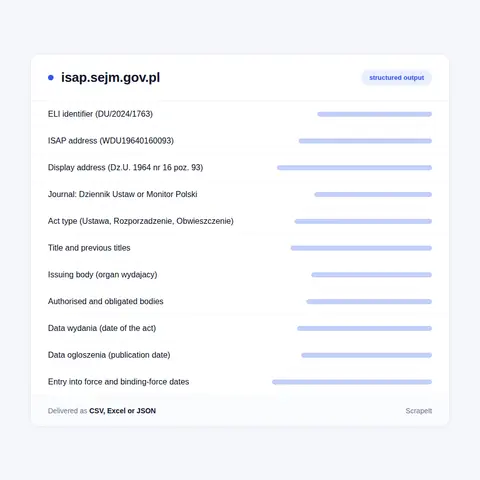
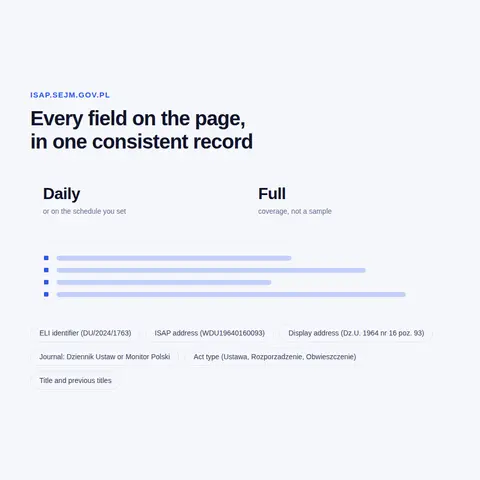
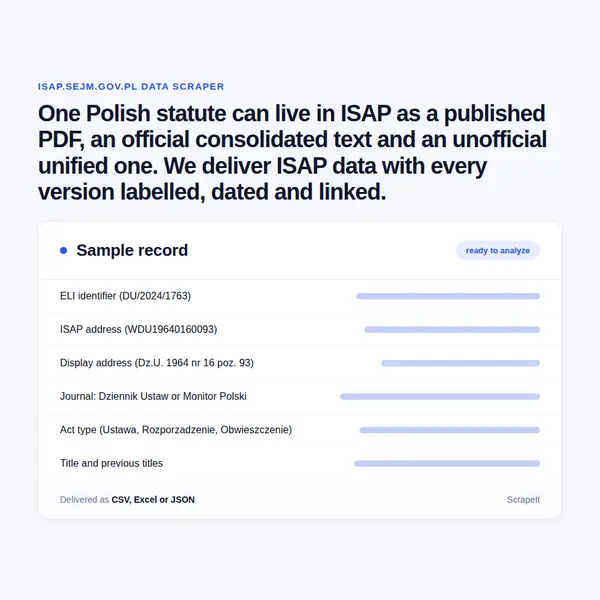
In the ISAP API every act answers to three keys. The ELI is journal, year and position: DU/2024/1763. The ISAP address packs the same into fourteen characters - W, the journal code, the year, a three-digit issue number and a four-digit position - so WDU19640160093 is Dz.U. 1964 nr 16 poz. 93. Issue numbers ended with 2011, and from 2012 that block is zeros. The display address is the citation lawyers actually write. Twenty-one Monitor Polski acts from 1946 and 2000 share positions across issues, so their ELI carries the issue as well: MP/1946/0490096.

  • Description. Act type from a list of 51 - Ustawa, Rozporzadzenie, Obwieszczenie, Uchwala, Postanowienie and the rest - title and any previous titles, the issuing body, authorised and obligated bodies from a list of 639 institution names, keywords from a list of 2,476 terms, and proper names.
  • Dates. Data wydania, the date the title carries; data ogloszenia, the day of publication; entry into force; the start of binding force; repeal and expiry dates; and, on a consolidated text, the legal status date it reflects. A comment field lists provisions with their own start dates: the March 2026 amendment to the CEIDG act takes effect on five different days, the last in November 2028.
  • Status. Fifteen values, from obowiazujacy, uchylony and uznany za uchylony to akt jednorazowy, akt objety tekstem jednolitym and nieobowiazujacy - uchylona podstawa prawna, plus a separate flag reading IN_FORCE, NOT_IN_FORCE or UNKNOWN.
  • Relations. Twenty types: legal basis down to the article, implementing acts, amending and amended acts with the date each change bites, repeals and deemed repeals, consolidated texts, amendments made after the latest consolidation, Constitutional Tribunal rulings, corrigenda and cross-references.
  • Links out. EU directives by CELEX number, and Sejm prints tied to the legislative process behind a statute.
  • Texts. A typed file list: O for the published text, T and U for the Chancellery's own copy and unified version of a statute, H for HTML.

Fields the ISAP API returns per act: ELI, dates, status and relations
Published, consolidated or unified: which ISAP download is the law

Published, consolidated or unified: which ISAP download is the law

A statute can come out of an ISAP download in four shapes, and only two are official. The tekst ogloszony is the journal PDF as published, the binding wording. For older acts it is a scan with a machine-read text layer, and the 1964 Civil Code arrives as the whole 59-page issue, introductory act included.

The tekst jednolity is an official consolidation: a notice from the Marshal of the Sejm or a minister, published in Dziennik Ustaw as a position of its own, with its own ELI and a legal status date. The Civil Code's latest is Dz.U. 2026 poz. 795, stated as at 19 May 2026. These notices fill close to a third of the journal: 589 of the 1,900 positions of 2025.

The tekst ujednolicony is the Chancellery's working consolidation, for statutes only and without legal force. Its first page names the consolidated text and every later amendment folded in, and it is typically rebuilt one to five weeks after an amendment appears, so some are always behind the journal. The one for the VAT act runs past 400 pages.

The HTML text follows the published wording, which is why the Civil Code in HTML still opens with the 1964 rules for units of the socialised economy. It can be requested down to one article, paragraph, point or letter, with the unit tree as JSON.

What the ISAP database covers: Dziennik Ustaw since 1918, Monitor Polski since 1930

ISAP, the Internetowy System Aktow Prawnych, is the Polish legal acts database kept by the Chancellery of the Sejm. The ISAP database describes every act published in the two official journals issued by the Prime Minister, in force or long repealed. Dziennik Ustaw carries statutes, regulations, ratified treaties, consolidated texts and Constitutional Tribunal judgments; Monitor Polski carries resolutions, orders, presidential decisions and official notices. In September 2026 the index held 97,841 Dziennik Ustaw positions going back to 1918 and 66,684 Monitor Polski positions going back to 1930, with the war years missing from both.

Each record is written in two passes. When an act is catalogued, the Chancellery links it to what it amends, repeals or implements. The reverse links arrive later, as newer acts amend, consolidate or repeal it, so a record from 1964 can still change this week. The Government Legislation Centre prepares the journals themselves, and legal portals lay the same acts out in their own way; ISAP is where the state records each act's status and the graph tying it to the rest of Polish law, next to the published PDF.

The web interface at isap.sejm.gov.pl is built for people: automated visitors meet a human check that itself sends machine traffic to api.sejm.gov.pl and eli.gov.pl. A separate collection holds the acts of the Polish authorities in exile from 1939 to 1990, unlinked to the main base.

Get a Quote
dev_w
25

Developers

customers
500+

Customers worldwide

pages
1 500 000 000+

Pages extracted

stime
15000+

Hours saved for our clients

Plans

Airplane

€199 / one-time

setup fee - included

Data limits100,000
Frequencyone-time
Run timeup to 5 days
Data storing7 days

Helicopter

€169 / mo

setup fee €499

Data limits250,000
Frequencymonthly
Run timeup to 5 days
Data storing14 days

Glasses

€229 / mo

setup fee €499

Data limits1,000,000
Frequencyweekly
Run timeup to 5 days
Data storing30 days

DNA

€549 / mo

setup fee €799

Data limits3,000,000
Frequency3 times daily
Run timesame day
Data storing90 days

Why legal-tech, compliance and AI teams run an ISAP scraper

Compliance monitoring. An ISAP scraper earns its keep on the changes a title search misses. About 5,300 regulations in Dziennik Ustaw carry the status nieobowiazujacy - uchylona podstawa prawna: they lapsed by operation of law when the provision behind them was repealed, and the repealing statute rarely names them one by one. ISAP records the link on both sides; the 2023 act on the Common Agricultural Policy Strategic Plan alone lists 79 acts deemed repealed. Amendments also land long before they bite - the Civil Code has one waiting for November 2028 - so a watchlist has to read dated relations, not headlines.

Legal-tech. Citation resolution needs the index behind the citation: turn Dz.U. 2024 poz. 1763 into an ELI, find the article of the statute a regulation rests on, list every implementing act issued under that article, and flag the Constitutional Tribunal rulings that cut into a code.

Training legal models. A corpus is only as good as its version labels. Teams that scrape ISAP by pulling text.html alone get the wording as published rather than as in force, and nothing recent: in September 2026 no position from 2025 or 2026 had an HTML text, and Monitor Polski has never had one. We extract ISAP data at article level where HTML exists and from PDF where it does not, with ELI, text type and date on every passage.

Our Blog

Reads Our Latest News & Blog

Learn how to use web scraping to solve data problems for your organization

How Artificial Intelligence Is Used In Web Scraping

How Artificial Intelligence Is Used In Web Scraping

Leveraging advances in technology, the AI-powered web scraper has skyrocketed in demand and is helping to expand capabilities by automating tedious daily tasks and speeding up data collection from thousands of websites several times over.

What is Web Scraping and What is it Used For?

What is Web Scraping and What is it Used For?

Web scraping is a method of obtaining web data by extracting it from pages of web resources with the help of a program, that is, in automatic mode. It is used to syntactically convert web pages into more usable forms.

Web Scraping for Machine Learning

Web Scraping for Machine Learning

If you specialize in machine learning, you need to feed large amounts of data to the algorithms. Web scraping is the easiest and the most efficient method of collecting the data from all over the Internet.

scrapeit logo

ScrapeIt as the team behind your Polish legislation API

ScrapeIt is a managed web scraping company. For ISAP we build the collectors, keep the relation graph and each text version in step, watch every run and adapt when the API gains a field, a status or a file type. You receive the feed; nobody on your side maintains a crawler.

We are independent of the Chancellery of the Sejm and the Government Legislation Centre. Individual acts in Monitor Polski - orders and decorations, professor titles, appointments - name private people; we deliver them as act records and never compile those names into lists.

FAQ

Is there an official ISAP Sejm API or ELI API for Poland, and what is missing from it?

Yes. The Chancellery of the Sejm runs the ELI API at api.sejm.gov.pl/eli, mirrored at eli.gov.pl: free, keyless, JSON, documented in OpenAPI. It lists acts by journal and year, searches titles, types, keywords, three kinds of date and an in-force flag, and returns details, relations, structure, PDF and HTML texts, plus a change feed of up to 500 records per call. It is the official Polish legislation API, but it offers no full-text search inside acts, no bulk export, no HTML for Monitor Polski or for recent years, and no local law from the sixteen voivodeship journals.

Can I download ISAP acts in bulk, PDFs and HTML included?

Not as one file. A complete ISAP download means walking both journals year by year, close to two hundred lists, then fetching details and files act by act. PDFs exist for nearly every position; HTML for about 40 per cent of Dziennik Ustaw, with full or near-full coverage from 2012 to 2024 and a minority of acts before that. Old scans are heavy: one 1964 issue weighs about 35 MB. We deliver the set as files plus a manifest with ELI, text type, size and checksum, so gaps and truncated files show up at once.

What is the difference between tekst jednolity and tekst ujednolicony?

The tekst jednolity is official: a notice published in Dziennik Ustaw as its own position, stating an act as it stood on a legal status date. The tekst ujednolicony is the Chancellery's unified version of a statute, without legal force, rebuilt after amendments and labelled with the positions it was built from. Between two consolidations, the wording in force is the last tekst jednolity plus the amendments listed after it. Regulations get no unified PDF at all, so for them that assembly is the only route. We keep every version separate and tie them together by ELI.

How quickly do new acts and amendments reach an ISAP feed?

New positions reach the index within a working day or two of publication, and the reverse links on older acts follow as the Chancellery processes them. The change feed returns every record touched since a timestamp, sorted by change time, up to 500 per call; an ordinary week brings about two hundred. Maintenance sometimes re-stamps records in bulk - over 31,000 Dziennik Ustaw records carry a March 2024 change date - so our diff compares content rather than timestamps and reports new acts, status flips and new relations separately.

Can ISAP data be reused commercially, including to train AI models?

Polish copyright law keeps normative acts and their official drafts outside its protection, in article 4 of the copyright act, so the texts themselves are free to reuse, commercial and training use included, and the Chancellery publishes the API openly with no key or sign-up. Unified texts carry a Chancellery mark and have no legal force, so we label them as reference text, never as law. Personal data is thin but present in Monitor Polski individual acts, and it stays inside the act record. This describes the sources; it is not legal advice for your use case.

How does it Work?

Step 1 - Make a Request

You share your needs, expectations, and desired timeframe. We’ll suggest the best solution based on your request and budget.

Step 2 - Configuring Custom Web Crawlers

Our specialists configure the crawlers and extract a sample dataset for your review before proceeding with the full-scale extraction.

Step 3 - Collect and Deliver

Once you approve the sample, we launch the project and start full data collection. We gather, filter, and structure the data for easy use, delivering it on time in your preferred format.

Step 4 - Maintain and Support

Our team manages ongoing processes, monitors website changes, and supports all data extraction cycles. We can also help integrate data into your systems or create dashboards to simplify analysis.

Request a Quote

Tell us more about you and your project information.
Which sites, which fields, how often. A couple of lines is enough.

We reply within 1 business day. No obligation.

scrapiet

Scrapeit Sp. z o.o.
10/208 Legionowa str., 15-099, Bialystok, Poland
NIP: 5423457175
REGON: 523384582