LexLege vs ISAP: a private reading layer over Dziennik Ustaw
Before buying LexLege data, know what LexLege is: a private legal information service, not an official publisher. It grew up in the ArsLege group of Prawomaniacy sp. z o.o., an Olsztyn company known for ArsLege law exam tests, and in 2026 it moved under Puls Biznesu, the Bonnier Business Polska daily. The old lexlege.pl address now forwards to lexlege.pb.pl, where the service calls itself a System Informacji Prawnej. The interface is Polish only.
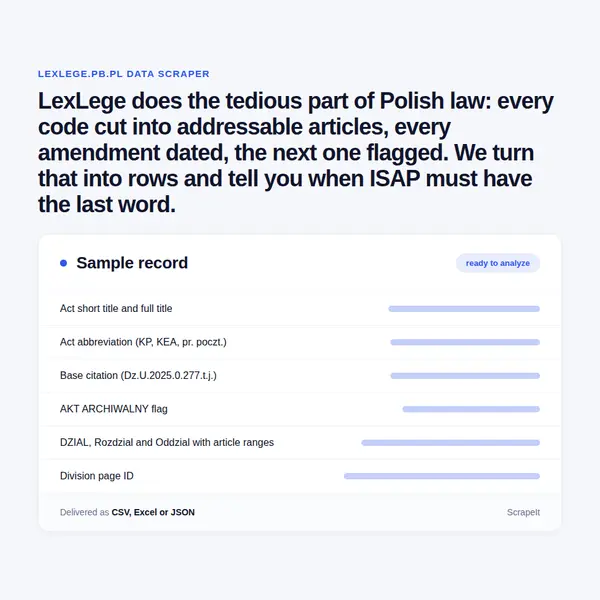
The statute text is not LexLege's own work. Act pages name the Dziennik Ustaw position they are built on - for Kodeks pracy the official tekst jednolity Dz.U.2025.0.277.t.j. - and LexLege's editors fold every later amending act into that base. The site calls the result ujednolicone teksty, the Polish term for an unofficial consolidation, and that is exactly what it is. The first-hand record is ISAP, the Sejm Chancellery's register of acts from Dziennik Ustaw and Monitor Polski; anyone who needs the complete Polish legal acts database should start there. LexLege is a reading layer on top of it.
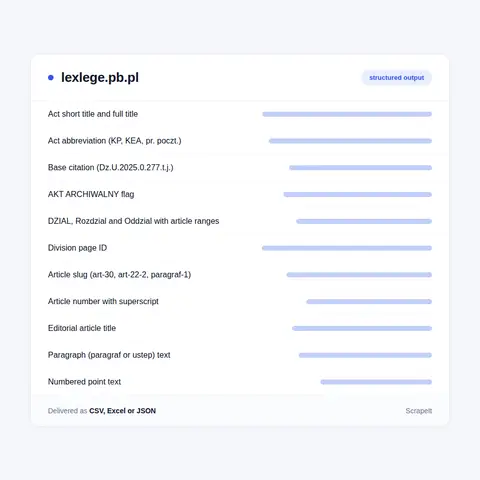
What the layer adds is structure. ISAP records each act with its text as published and its consolidations as PDF files; LexLege serves the wording in force article by article, every article at its own address, with an editorial title, a dated change log and a calendar of changes not yet in force. The catalogue is curated rather than complete: about 1,290 documents in its act list in September 2026 - roughly 590 statutes, 340 regulations and 300 repealed acts kept under an AKT ARCHIWALNY label. It also carries texts the official journals never print, such as the ethics codes of advocates, legal advisers, notaries and bailiffs and the Warsaw exchange rulebooks for NewConnect and Catalyst.
Get a Quote