Legifrance Scraper for French Codes, Decrees and Case Law

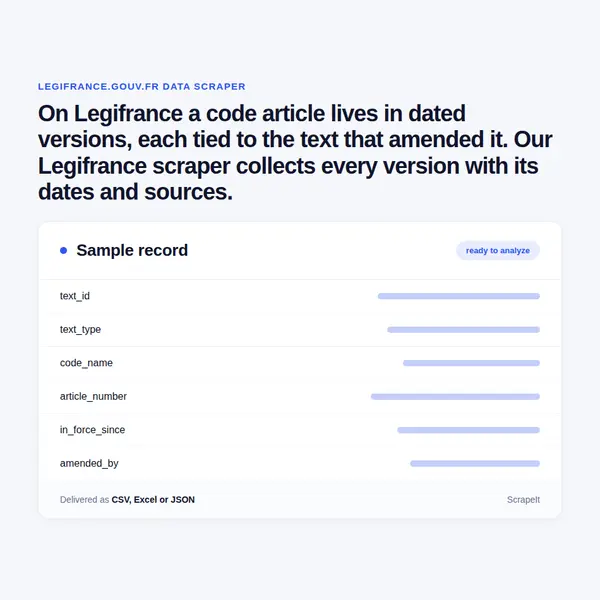
On Legifrance a code article lives in dated versions, each tied to the text that amended it. Our Legifrance scraper collects every version with its dates and sources.

Plans from €169 a month · Free project assessment · Reply within 1 business day

CSV · Excel · JSON · XML · FTP · SFTP · Amazon S3 · Google Cloud

legifrance.gouv.fr
Legifrance Scraper for French Codes, Decrees and Case Law
legifrance.gouv.frwhat you get
Typical fields for public registers
record_identity_namestatusregistered_ataddressdocument_url
Delivery

API, JSON feed or CSV, XLSX and JSON files

Schedule

One-time, monthly, weekly, daily or 3 times a day

How a Legifrance Scraping Project Works

  1. You send

    Légifrance pages, filters, fields and a schedule

  2. We run the scrapers

    Built, monitored and repaired by our team

  3. You receive the data

    API, JSON feed or CSV, XLSX and JSON files

You describe the corpus - a list of codes followed article by article, every decree one ministry signs, Chambre sociale decisions since a given year, or the agreements filed under a set of IDCC numbers. The crawler that collects it is ours to build, run and keep working through every change to Legifrance's pages, and anti-bot handling, pacing, proxy rotation and page rendering are part of the service, not a task left to you.

Runs are one-off or scheduled: daily, weekly or on demand. Every row keeps the identifier Legifrance gives the text or article, so a later run updates the same record instead of duplicating it. Scope and volume are settled in a free project assessment, and field documentation is part of the delivery.

Legifrance Data We Extract

Legifrance is several databases behind one search box, and each keeps its own kind of record. We deliver one table per kind, joined on the identifiers in the site's addresses: LEGIARTI for a code article, JORFTEXT for a Journal officiel text, JURITEXT for a court decision, KALICONT for a collective agreement, ACCOTEXT for a company agreement.

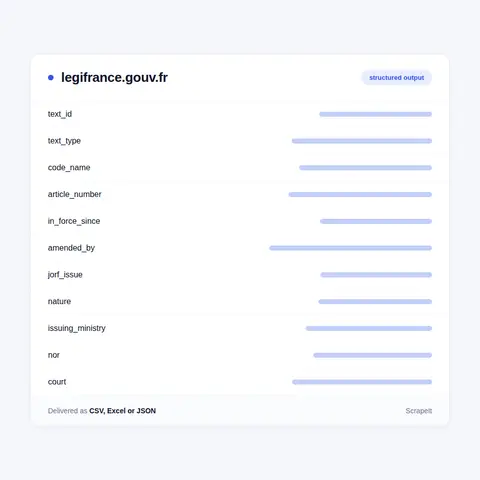
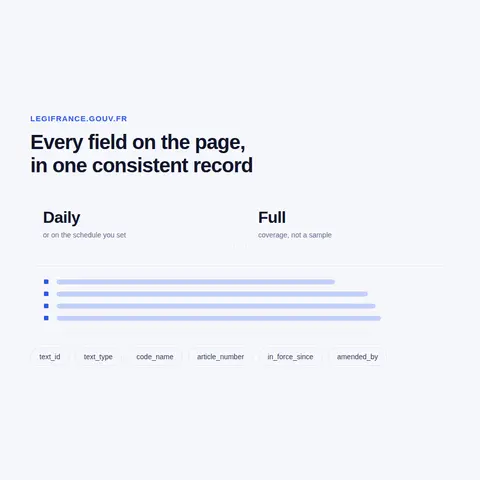
  • Code articlescode name (Code civil, Code du travail and the rest), article number, the path of titles and chapters with their article ranges, the text, the En vigueur depuis le date (in force since), the Création and Modifié par lines naming the law, ordinance or decree behind each wording with its JORF date, the list of earlier versions and the ABROGÉ mark on repealed parts.
  • Journal officiel textsJORF issue number and date, Texte n° within the issue, section (Textes généraux, Mesures nominatives, Avis et communications) and ministry heading, the full title, which opens with the nature of the text (Décret, Arrêté and so on), the NOR, the ELI of the text and of the issue, the signing authority and the Vu visas.
  • Court decisionscourt and chamber, date, N° de pourvoi (appeal number), ECLI, Publié au bulletin or not, Solution (Rejet, Cassation, Cassation partielle), the Audience publique date, the Décision attaquée with its court and date, the Texte intégral, and the Analyse block: Titrages et résumés, Précédents jurisprudentiels and Textes appliqués.
  • Collective agreementstitle, IDCC number, the Texte de base with its titles and articles, the Textes Attachés (annexes, accords and avenants) and the Textes Salaires, the pay avenants, with the (non en vigueur) mark on those that no longer apply.
  • Accords d'entrepriseRaison sociale, SIRET, APE code and IDCC of the employer, Thématiques such as Télétravail, the Signataires (unions such as CFTC or CFE-CGC), Date de signature, Date de publication sur Légifrance, the Dates d'application and the filing Référence.

Legifrance pseudonymises private parties in court decisions - letters in brackets such as M. [D] [E] in recent decisions, X... or Y... in older ones - while companies and public bodies keep their names; we never try to restore identities. The Président and Avocat(s) lines and the Mesures nominatives of the Journal officiel name people, so they stay out by default.

Legifrance Data We Extract
Scraping Legifrance Collections and Version History

Scraping Legifrance Collections and Version History

The record is half of a Legifrance project; the other half is choosing the records and following how they change.

  • Case law slicesJurisprudence judiciaire filters by Publication au bulletin, Nature de la décision, Formation (the Chambre sociale and the other chambers), Décision attaquée, the Siège de la cour of the appeal court, the Type de juridiction of first instance and a Date de décision range. We cut a run along those lines and merge it on the JURITEXT identifier.
  • Journal officiel by issuereach issue can be filtered by Nature de texte and by Émetteurs, the ministry or authority behind the text, so a run can follow one ministry every publication day.
  • Article versions over timeVoir les versions, Comparer les versions and the À la date du selector give the wording of an article on any past date. Collected once, they form a history; collected on a schedule, they show which articles changed and which text changed them.
  • Agreement updatesa watchlist of IDCC numbers catches each new avenant, salary grids included, once it is attached to the agreement.
  • Other collectionsadministrative, constitutional and financial case law, Circulaires et instructions, CNIL deliberations and Dossiers législatifs follow the same pattern.

The Legifrance Database and How It Is Organised

Source
legifrance.gouv.fr
Category
public registers
Delivery
API, JSON feed, CSV, XLSX
Plans
From €169 a month
Get a quote

Legifrance (written Légifrance on the site) calls itself le service public de la diffusion du droit - the public service that puts French law online. It sits under the editorial responsibility of the Secrétariat général du Gouvernement, which shares its editorial design, updates and technical upkeep with the DILA, the Prime Minister's directorate for legal and administrative information. Everything is in French, and dates are typed in the JJ/MM/AAAA format.

The menu shows how the material is arranged. Droit national en vigueur (national law in force) holds the Constitution, the codes, the Textes consolidés, Jurisprudence, Circulaires et instructions and the Accords collectifs, split into Accords de branche et conventions collectives and Accords d'entreprise. Publications officielles holds the Journal officiel, the Bulletins officiels, the Débats parlementaires and Documents administratifs. Autour de la loi covers codification, the Guide de légistique, Statistiques de la norme and, under Législatif et réglementaire, Dossiers législatifs and Etudes d'impact des lois. Two further menus point to European Union and international law.

Three things matter to anyone who needs the data. Codes are consolidated: an article has a current version and a dated chain of earlier ones. The Journal officiel is the numbered, dated record of new texts, issue by issue. Case law spans the Cour de cassation, the Conseil d'État and the Conseil constitutionnel, and Cour de cassation decisions carry an ECLI next to the appeal number.

25Developers
500+Customers
1.5BPages extracted
15,000+Hours saved for our clients

Légifrance scraping plans and pricing

Airplane

€199one-time

Setup fee included

100,000
One-time
Up to 5 days
7 days

Helicopter

€169/ mo

Setup fee €499

250,000
Monthly
Up to 5 days
14 days

Glasses

€229/ mo

Setup fee €499

1,000,000
Weekly
Up to 5 days
30 days

Microscope popular

€349/ mo

Setup fee €499

2,000,000
Daily
Same day
60 days

DNA

€549/ mo

Setup fee €799

3,000,000
3 times daily
Same day
90 days

Delivery: CSV, JSON or XLSX files, our API or a JSON feed. MCP server on request.

Full plan details

Why Teams Collect Legifrance Records

Legal texts have buyers well beyond law firms, and each needs a different slice of Legifrance.

  • Legal research and publishingEditors and legal-tech teams need codes article by article with the in-force date and the amending text, so a search tool can say what the law read on a given day.
  • Regulatory watchCompliance teams follow the décrets and arrêtés of the ministries that regulate them, filtered by émetteur and nature, and want the NOR and the JORF issue for each citation.
  • Pay and HRPayroll providers track the Textes Salaires of each IDCC to apply new minimum rates; HR teams compare company agreements on télétravail or bonuses by theme and signatory union.
  • Litigation analyticsDecisions with chamber, solution, appeal court and date show how often a given cour d'appel is overturned and which chambers publish in the bulletin.
  • Academic workResearchers build corpora of decisions or decrees with stable identifiers they can cite.

About ScrapeIt

ScrapeIt is a managed scraping service: we design, run and repair the crawlers and deliver the data. Legal sources change slowly but forgive little - an article delivered with the wrong in-force date is worse than none - so we keep the site's own identifiers and dates on every row and re-check versions on each run. You set the corpus and the schedule; collection, parsing and quality checks are ours.

FAQ

Still unsure? Write to info@scrapeit.io

Do you offer a Legifrance API for codes and case law?

Yes. The ScrapeIt Legifrance API returns article numbers, En vigueur depuis le dates, Modifié par references, JORF issue numbers, ECLI and Solution fields as JSON from an endpoint we host, refreshed on the schedule you set. The same data can also be delivered as XML or JSONLines files, to Amazon S3 or straight into your database.

Is it legal to scrape Legifrance?

Yes. Legifrance publishes French law for everyone: codes, the Journal officiel, collective agreements and case law are open to any visitor without an account. We collect only publicly available data - everything a visitor can see on Legifrance - and we collect it legally, keeping court decisions pseudonymised exactly as the site shows them.

Can you track changes in French codes article by article?

Yes. Each run compares the article text and its En vigueur depuis le date with the previous run, and a changed article arrives with the Modifié par reference naming the ordinance, decree or law behind the change. When the En vigueur depuis le date of a new version lies after the run date, the row is flagged as not yet in force, so you see a change before it applies.

How often is the Journal officiel published, and how fresh can the feed be?

The Journal officiel comes out on most days of the week, Sundays included, and its issue numbers run through the calendar year, each issue with its own ELI address. A daily run collects each new issue with its texts, nature, issuing ministry and NOR, and can be limited to the ministries and kinds of text you follow.

What does a Legifrance dataset of court decisions contain?

One row per decision, keyed on its JURITEXT identifier, with the court, chamber, date, N° de pourvoi, ECLI, Publié au bulletin flag, Solution, the Décision attaquée and the Texte intégral. The Titrages et résumés, Précédents jurisprudentiels and Textes appliqués of the Analyse block come as separate fields, so decisions can be grouped by the articles they apply.

How it works

  1. 1

    Make a request

    You share your needs, expectations, and desired timeframe. We'll suggest the best solution based on your request and budget.

  2. 2

    We configure the crawlers

    Our specialists configure the crawlers and extract a sample dataset for your review before proceeding with the full-scale extraction.

  3. 3

    Collect and deliver

    Once you approve the sample, we launch the project and start full data collection. We gather, filter, and structure the data for easy use, delivering it on time in your preferred format.

  4. 4

    Maintain and support

    Our team manages ongoing processes, monitors website changes, and supports all data extraction cycles. We can also help integrate data into your systems or create dashboards to simplify analysis.

Request a quote

Tell us which sites, which fields and how often. A couple of lines is enough to start.

  • We reply within 1 business day
  • A sample dataset before the full run
  • We sign an NDA on request
  • Delivery by API, JSON feed or files
Which sites, which fields, how often. A couple of lines is enough.

This form is protected by Google reCAPTCHA, which loads when you start filling it in. If you prefer not to use it, email us at info@scrapeit.io. Privacy & Cookie Policy

We reply within 1 business day. No obligation.

Légifrance data from €169/month. Free project assessment, reply within 1 business day.