USAspending scraper for federal award and recipient data

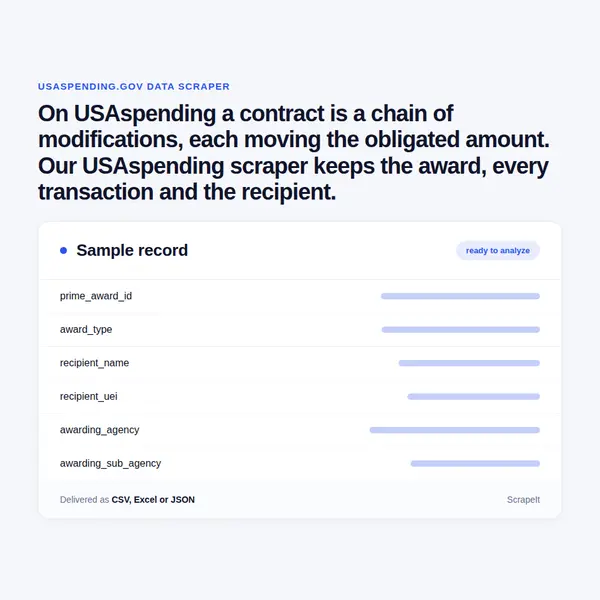
On USAspending a contract is a chain of modifications, each moving the obligated amount. Our USAspending scraper keeps the award, every transaction and the recipient.

Plans from €169 a month · Free project assessment · Reply within 1 business day

CSV · Excel · JSON · XML · FTP · SFTP · Amazon S3 · Google Cloud

usaspending.gov
USAspending scraper for federal award and recipient data
usaspending.govwhat you get
Typical fields for public registers
record_identity_namestatusregistered_ataddressdocument_url
Delivery

API, JSON feed or CSV, XLSX and JSON files

Schedule

One-time, monthly, weekly, daily or 3 times a day

Scrape USAspending without running a pipeline

  1. You send

    USAspending pages, filters, fields and a schedule

  2. We run the scrapers

    Built, monitored and repaired by our team

  3. You receive the data

    API, JSON feed or CSV, XLSX and JSON files

You name the slice - awarding agencies and sub-agencies, award types, NAICS or PSC codes, assistance listings, recipients, places of performance, fiscal years - and we build the collection, run it and maintain it as USAspending changes its pages. Scripted rendering, pacing and proxy rotation are handled on our side.

Results arrive as one table per level you need: prime awards, transactions, sub-awards, recipients. Every award keeps the Unique Award Key the site uses in its own addresses, so reruns update rows instead of duplicating them, and amounts stay exact to the cent rather than the rounded millions and billions on the summary cards. Files go out as CSV, Excel, JSON or JSONLines, to Amazon S3 or Google Cloud Storage, or through our API.

USAspending federal awards, field by field

An award page on USAspending opens with its type - Definitive Contract, Delivery Order, Project Grant - and the identifier that type uses: a PIID for contracts, a FAIN for financial assistance. Behind it sits the Unique Award Key, a string such as CONT_AWD that chains the PIID, the agency code and, for orders, the parent IDV. We collect:

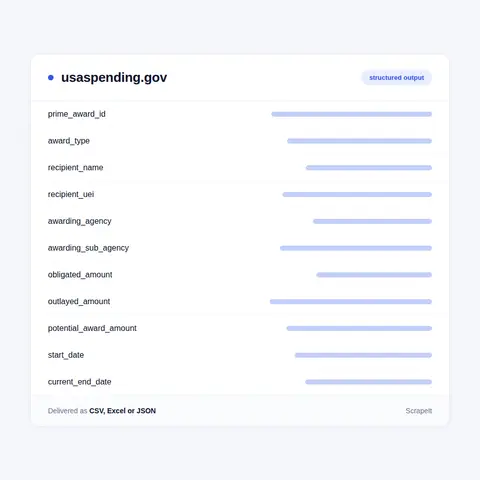
  • Award identityPrime Award ID, PIID or FAIN, Unique Award Key, award type, status with the time remaining, and the Parent Award Unique Key for task and delivery orders.
  • Agenciesawarding agency, awarding sub-agency and funding agency, plus each federal account that paid for the award with its combined obligated amount.
  • Recipientrecipient name, recipient UEI, address and congressional district.
  • Moneyobligated amount, outlayed amount, current award amount and potential award amount for contracts; non-federal funding and total funding for grants; COVID-19 and infrastructure obligations and outlays; disaster emergency fund codes.
  • Datesstart date, current end date and potential end date, or period of performance start and end.
  • ClassificationNAICS at each level the page prints, from two-digit sector to six-digit industry; product and service code from the products-or-services split down to the four-character code; the assistance listing number and title for grants.
  • Place of performancecity, state and ZIP of the primary place of performance, next to the recipient location.
  • Descriptionthe award description as the agency entered it, often in capitals.

Award pages also hold Legislative Mandates, Competition Details and Acquisition Details, which we add when the project needs them. Executive Compensation names people, so it stays out by default, and awards to individuals are not part of what we deliver.

USAspending federal awards, field by field
Recipient profiles, transactions and sub-awards

Recipient profiles, transactions and sub-awards

The award table is the start. Other layers of the site fill in what a single award cannot show:

  • Transaction historyevery modification as its own row: Modification Number, Action Date, Amount, Action Type such as B: Supplemental Agreement for Work Within Scope, and Transaction Description. This is where an order's value grows step by step.
  • Sub-awardssubcontracts and subgrants the prime recipient reports, with their count and total value.
  • Recipient profileseach recipient as Parent Recipient, Child Recipient or plain Recipient, with UEI, Legacy DUNS, the other names it is known by, business types, total awarded amount and transaction count, and top-five tables by awarding agency, sub-agency, federal account, NAICS, PSC, country and state.
  • Agency profilesbudgetary resources, obligations and outlays by sub-component, and award obligations, transactions and new awards by sub-agency for each award type.

Profiles and summary cards show today's totals. Run the same slice weekly and you also keep how they moved: obligations added month by month, end dates pushed out, potential value raised, new child recipients appearing under a parent.

About USAspending and how it is organised

Source
usaspending.gov
Category
public registers
Delivery
API, JSON feed, CSV, XLSX
Plans
From €169 a month
Get a quote

USAspending.gov is the federal government's public record of its spending, run by the Treasury's Bureau of the Fiscal Service. It grew out of the Federal Funding Accountability and Transparency Act, and the DATA Act widened it to agencies' direct spending, linked to the programmes behind each award. SAM.gov shows what the government intends to buy; USAspending shows the money once it is committed and paid, with every modification after.

Advanced Search filters by keyword, recipient, award ID, fiscal year or custom dates, location, agency, award type, recipient type, award amount, assistance listing, NAICS, Disaster Emergency Fund Code, Treasury Account Symbol, PSC, type of contract pricing, type of set aside and extent competed. Results split into Contracts, Contract IDVs, Grants, Direct Payments, Loans and Other, and can be viewed as prime awards or as sub-awards. Agency, recipient and award pages each have their own address.

A fiscal year runs from October 1 to September 30. Sections state their own cut-off - one agency profile can show status of funds through one month and award spending through the next - so we stamp every row with the date its section states.

25Developers
500+Customers
1.5BPages extracted
15,000+Hours saved for our clients

USAspending scraping plans and pricing

Airplane

€199one-time

Setup fee included

100,000
One-time
Up to 5 days
7 days

Helicopter

€169/ mo

Setup fee €499

250,000
Monthly
Up to 5 days
14 days

Glasses

€229/ mo

Setup fee €499

1,000,000
Weekly
Up to 5 days
30 days

Microscope popular

€349/ mo

Setup fee €499

2,000,000
Daily
Same day
60 days

DNA

€549/ mo

Setup fee €799

3,000,000
3 times daily
Same day
90 days

Delivery: CSV, JSON or XLSX files, our API or a JSON feed. MCP server on request.

Full plan details

Uses of a USAspending dataset

Most buyers of USAspending data want one of four answers.

  • Who wins in my marketFilter by NAICS, PSC and awarding sub-agency, rank recipients by obligated amount, and you have the competitive map of a federal niche, with UEIs that join to your CRM.
  • What is about to recompeteCurrent and potential end dates on contracts and IDVs show which awards run out next fiscal year - the starting list for capture planning.
  • Where the money landsPlace of performance, recipient location and congressional district let economic developers, advocacy groups and journalists total federal spending by state, district or city.
  • How a programme pays outAssistance listing, obligations against outlays and the federal account behind each award show how fast grant money actually leaves the Treasury.

Investors and analysts read the same rows for listed contractors: a parent recipient's obligations by agency and quarter, task orders under a large IDV, and modifications that raise potential value.

About ScrapeIt

ScrapeIt builds and runs data collection for clients who need records rather than tools. With USAspending that usually means joining levels the site keeps on separate pages - award, transaction, sub-award, recipient, agency - into one keyed dataset and keeping it current. You get field documentation, a sample on your own agencies or codes before you commit, and runs one-off or daily, weekly or on demand. Plans start from EUR 169 a month, or EUR 199 for a one-time extract.

FAQ

Still unsure? Write to info@scrapeit.io

Do you offer a USAspending API for award data?

Yes. The ScrapeIt USAspending API serves Prime Award ID, recipient name and UEI, awarding sub-agency, obligated and outlayed amounts and NAICS code as JSON from an endpoint we host, updated on the schedule you choose. If files suit you better, the same awards come as CSV or Excel, as JSONLines on Amazon S3, or loaded into your database.

Is it legal to scrape USAspending?

Yes. USAspending exists to publish federal award data, and amounts, recipients, agencies and places of performance are open to every visitor. We collect only publicly available data - all that a visitor can see on USAspending - and we collect it legally. Executive names stay out by default, and we do not build profiles of individual recipients.

Can you track contract modifications on USAspending?

Yes. Each award's Transaction History lists modifications with number, action date, amount, action type and description, and we deliver them as a separate table keyed to the Unique Award Key. Scheduled reruns also catch changes to the end dates and to potential award amount, so an extension or a ceiling increase shows up on the next run.

How often is USAspending updated, and how often should you collect?

Each section of the site states the date its data runs through, and on one agency page those dates can differ by a month. A weekly run catches new awards and modifications for most uses; a daily run suits teams watching a few agencies or IDVs closely. Every row carries our capture date and the section's own cut-off.

Can you build a USAspending database for one agency or NAICS code?

Yes, and most projects start that way: every prime award from one awarding sub-agency, or every contract under a set of NAICS codes, across the fiscal years you choose. Transactions and sub-awards link by Unique Award Key and recipients by UEI, loaded into your database or delivered as CSV, JSON or XML files.

How it works

  1. 1

    Make a request

    You share your needs, expectations, and desired timeframe. We'll suggest the best solution based on your request and budget.

  2. 2

    We configure the crawlers

    Our specialists configure the crawlers and extract a sample dataset for your review before proceeding with the full-scale extraction.

  3. 3

    Collect and deliver

    Once you approve the sample, we launch the project and start full data collection. We gather, filter, and structure the data for easy use, delivering it on time in your preferred format.

  4. 4

    Maintain and support

    Our team manages ongoing processes, monitors website changes, and supports all data extraction cycles. We can also help integrate data into your systems or create dashboards to simplify analysis.

Request a quote

Tell us which sites, which fields and how often. A couple of lines is enough to start.

  • We reply within 1 business day
  • A sample dataset before the full run
  • We sign an NDA on request
  • Delivery by API, JSON feed or files
Which sites, which fields, how often. A couple of lines is enough.

This form is protected by Google reCAPTCHA, which loads when you start filling it in. If you prefer not to use it, email us at info@scrapeit.io. Privacy & Cookie Policy

We reply within 1 business day. No obligation.

USAspending data from €169/month. Free project assessment, reply within 1 business day.