USPTO Scraper for Patents, Trademarks and Status Histories

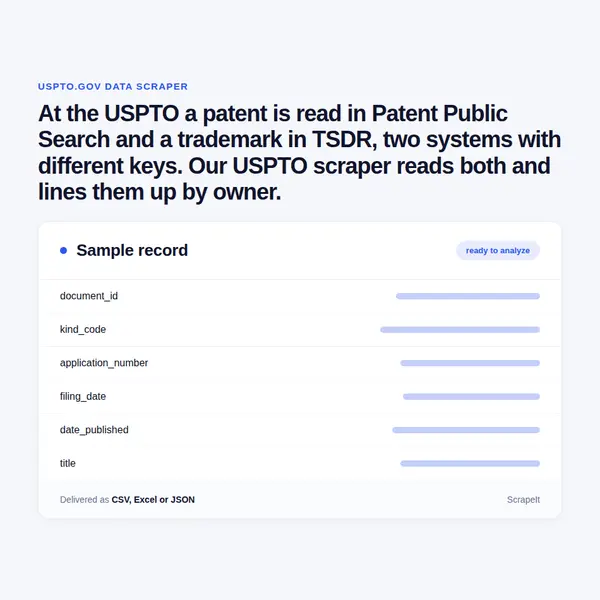
At the USPTO a patent is read in Patent Public Search and a trademark in TSDR, two systems with different keys. Our USPTO scraper reads both and lines them up by owner.

Plans from €169 a month · Free project assessment · Reply within 1 business day

CSV · Excel · JSON · XML · FTP · SFTP · Amazon S3 · Google Cloud

uspto.gov
USPTO Scraper for Patents, Trademarks and Status Histories
uspto.govwhat you get
Typical fields for public registers
record_identity_namestatusregistered_ataddressdocument_url
Delivery

API, JSON feed or CSV, XLSX and JSON files

Schedule

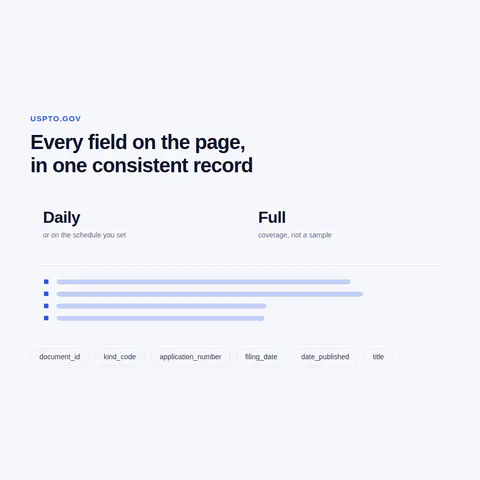
One-time, monthly, weekly, daily or 3 times a day

How to Scrape USPTO Records as a Managed Service

  1. You send

    USPTO pages, filters, fields and a schedule

  2. We run the scrapers

    Built, monitored and repaired by our team

  3. You receive the data

    API, JSON feed or CSV, XLSX and JSON files

You describe the slice you need - CPC subclasses, assignee or owner names, serial numbers, international classes, a filing date window, live or dead - and we build the crawlers for Patent Public Search, Trademark Search and TSDR, run them and repair them when the USPTO changes a screen. Both search systems are script-rendered, so page rendering, pacing, proxy rotation and CAPTCHA handling are part of the service. Once Patent Public Search asks for a USPTO.gov sign-in, as it has announced, the run uses an account registered through the USPTO's own sign-up form, or yours.

That is how to scrape USPTO records without code: you send the scope, we send rows keyed on the document ID or serial number. Runs are one-off or scheduled - daily for a trademark watch list, weekly for a patent portfolio - after a free project assessment, with field documentation in the first delivery.

USPTO Data Scraper: Patent and Trademark Fields

The USPTO data scraper returns two record types, each on the identifier the Office itself uses. A patent document carries its patent number with a kind code, as in US 11000000 B2, and the application number it grew from, written as series and serial, as in 16/568903. A trademark carries its serial number from filing and, once registered, a registration number.

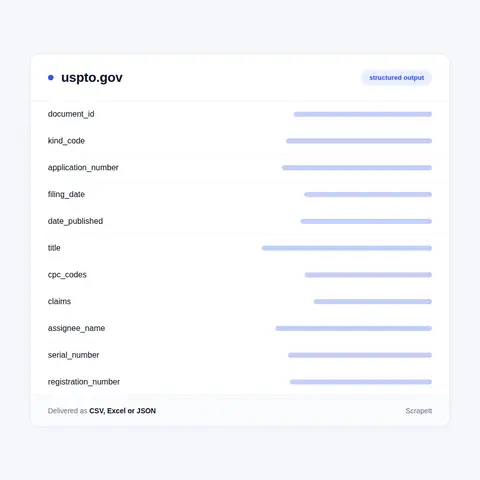
  • Patent identitydocument ID and kind code, date published, application number, filing date and the domestic priority (continuity data) that links a patent to its provisional or parent applications.
  • Classificationevery CPC code under CPC Current with its type, inventive (CPCI) or additional (CPCA), and its date, plus the current US class.
  • Texttitle, abstract, the description sections from field and background to detailed description, and the numbered claims, kept apart so claim 1 can be read on its own.
  • Assigneecompany assignee name, city, state, country and type code. Inventor names are personal data and are left out by default; their country can stay as a column.
  • Markliteral elements, standard character claim, mark drawing type, register, such as Principal, mark type, serial and registration numbers.
  • Statusthe TM5 common status descriptor, such as LIVE/REGISTRATION/Issued and Active, the status text, status date, and the filing, publication, notice of allowance and registration dates.
  • Goods and serviceseach statement with its international class, primary class, US classes, class status, first use and use in commerce dates, with deleted goods still marked by brackets.
  • Owner and basisowner name and address for companies, legal entity type, state or country where organized, and the filing basis flags: use, intent to use, 44D, 44E and 66A.
  • Prosecution historyevery dated entry, from new application entered to published for opposition, statement of use, Section 8 and 15 filings and renewals.

Attorney and correspondent names and e-mail addresses sit on the same case page; they are personal data, so they stay out of the rows unless a project calls for them. Delivery is CSV, JSON, JSONLines or XLSX.

USPTO Data Scraper: Patent and Trademark Fields
Building a USPTO Patent Dataset Over Time

Building a USPTO Patent Dataset Over Time

Single documents are the easy part. Coverage starts from search: Patent Public Search reads three collections - US-PGPUB for pre-grant publications, USPAT for granted patents and USOCR for older patents scanned into text - and we query them by CPC code, assignee, date range or keyword, then merge on the application number so a published application and the patent it became sit in one family row.

On the trademark side, Trademark Search filters by status - Live splits into Registered and Pending, Dead into Cancelled and Abandoned - and by class from 001 to 045 plus the coordinated classes. A patent search or a trademark search becomes a list of IDs, and each ID is then read in full.

Repeated runs add what a single pass cannot show. A mark moves from pending to published for opposition to registered; a registration misses its Section 8 declaration and turns dead; an owner address changes. TSDR also carries an assignment abstract of title and a proceedings section, so transfers of ownership and opposition or cancellation cases join the record, and a portfolio can be followed owner by owner rather than mark by mark.

How the USPTO Database Is Organised

Source
uspto.gov
Category
public registers
Delivery
API, JSON feed, CSV, XLSX
Plans
From €169 a month
Get a quote

The United States Patent and Trademark Office is the federal agency, part of the US Department of Commerce, that examines and grants patents and registers trademarks. What people call the USPTO database is several public systems, split along the same line as the Office.

Patents are read in Patent Public Search, a workspace with Quick Search and Enhanced Search, a results grid and a document viewer that shows the full publication: bibliographic block, CPC table, abstract, description and claims. A query can be as narrow as one patent number or a field-coded search across all three collections.

Trademarks are found in Trademark Search, the cloud system that replaced TESS, which lists each filing with its wordmark, status, goods and services, class, serial number and owners, and the owner's entity type and home state or country. The case file itself lives in TSDR, Trademark Status and Document Retrieval: one page per serial number with mark information, goods and services, basis, current owner, prosecution history and the documents behind them.

Status has its own vocabulary. A live mark is registered or pending; a dead trademark is abandoned or cancelled, and Trademark Search defines a cancelled mark as one whose owner failed to submit the renewal documents. A dead mark keeps its full file, which is why abandoned names stay searchable for years.

25Developers
500+Customers
1.5BPages extracted
15,000+Hours saved for our clients

USPTO scraping plans and pricing

Airplane

€199one-time

Setup fee included

100,000
One-time
Up to 5 days
7 days

Helicopter

€169/ mo

Setup fee €499

250,000
Monthly
Up to 5 days
14 days

Glasses

€229/ mo

Setup fee €499

1,000,000
Weekly
Up to 5 days
30 days

Microscope popular

€349/ mo

Setup fee €499

2,000,000
Daily
Same day
60 days

DNA

€549/ mo

Setup fee €799

3,000,000
3 times daily
Same day
90 days

Delivery: CSV, JSON or XLSX files, our API or a JSON feed. MCP server on request.

Full plan details

What USPTO Data Is Used For

Patent and trademark records answer different questions, and most buyers need both: who owns an idea, and who owns a name.

  • Trademark clearance and watchingNew filings in a class with similar literal elements, read weekly, show a conflict while it is still pending; the published for opposition date tells a brand owner when the window to object opens.
  • Portfolio auditsEvery mark held by one owner name, with registration dates and the last post-registration entry, shows which Section 8 and 9 filings fall due and which marks were allowed to lapse.
  • Competitive patent intelligenceCounts by assignee and CPC subclass over filing dates show where a competitor is investing, and pre-grant publications show it before any patent is granted.
  • Transactions and valuationAssignee names, assignments and continuity data trace who owns a family and how it was built, the first questions in IP due diligence.
  • Research and text modelsClaims and abstracts labelled with CPC codes form a corpus for classification and prior-art search, and the claims are where the scope of each patent is written.
  • Abandoned trademark researchNames given up in a class are candidates for a new brand, once a fresh clearance confirms nobody else has filed since.

About ScrapeIt

ScrapeIt is a managed web scraping service: we build, run and repair the crawlers and deliver the data on the schedule you set. Registers like the USPTO are a particular kind of job - two record families on stable public keys, long status histories and changes that matter more than the snapshot. Companies are collected as the register shows them; personal data is handled under GDPR and inventors, attorneys and individual owners are left out by default. Plans start from EUR 169 a month, or EUR 199 for a one-time extract.

FAQ

Still unsure? Write to info@scrapeit.io

Do you offer a USPTO API for patent and trademark records?

Yes. The ScrapeIt USPTO API returns the document ID and kind code, CPC codes, assignee, trademark serial number, TM5 status and owner as JSON from an endpoint we host, refreshed on the schedule you set. The same records also come as CSV, JSONLines or XLSX files, to Amazon S3, or straight into your database.

Is it legal to scrape USPTO?

Yes. Patent publications, trademark case files and their prosecution histories are published by the Office for anyone to read. We collect only publicly available data - everything a visitor can see on the USPTO search systems and TSDR - and we collect it legally. Names of inventors, attorneys and individual owners are personal data and stay out of the dataset by default.

Can you build a USPTO dataset of dead and abandoned trademarks?

Yes. Trademark Search splits dead marks into Cancelled and Abandoned, and TSDR adds the status text, status date and the last prosecution entry behind each label. We pull every abandoned trademark in the classes you choose, with goods and services and owner, so you can see which names were given up and when.

How often is USPTO data updated, and can you track trademark status changes?

The Office adds prosecution entries as it acts on a file, and each TSDR page is stamped with the time it was generated. We re-read your watch list daily or weekly and keep every status, status date and new entry, and if you ask for it we add a change file listing each mark or application whose status moved since the last run.

Can you deliver full claims and CPC codes for a patent set?

Yes. Each patent row carries the numbered claims as separate items, the abstract, and every CPC Current code with its inventive or additional type and date. A set can be defined by CPC subclass, assignee, publication date or a list of patent numbers, and published applications are linked to the grants they became.

How it works

  1. 1

    Make a request

    You share your needs, expectations, and desired timeframe. We'll suggest the best solution based on your request and budget.

  2. 2

    We configure the crawlers

    Our specialists configure the crawlers and extract a sample dataset for your review before proceeding with the full-scale extraction.

  3. 3

    Collect and deliver

    Once you approve the sample, we launch the project and start full data collection. We gather, filter, and structure the data for easy use, delivering it on time in your preferred format.

  4. 4

    Maintain and support

    Our team manages ongoing processes, monitors website changes, and supports all data extraction cycles. We can also help integrate data into your systems or create dashboards to simplify analysis.

Request a quote

Tell us which sites, which fields and how often. A couple of lines is enough to start.

  • We reply within 1 business day
  • A sample dataset before the full run
  • We sign an NDA on request
  • Delivery by API, JSON feed or files
Which sites, which fields, how often. A couple of lines is enough.

This form is protected by Google reCAPTCHA, which loads when you start filling it in. If you prefer not to use it, email us at info@scrapeit.io. Privacy & Cookie Policy

We reply within 1 business day. No obligation.

USPTO data from €169/month. Free project assessment, reply within 1 business day.