Tata 1mg Scraper for the 1mg Medicine Database and Lab Test Prices

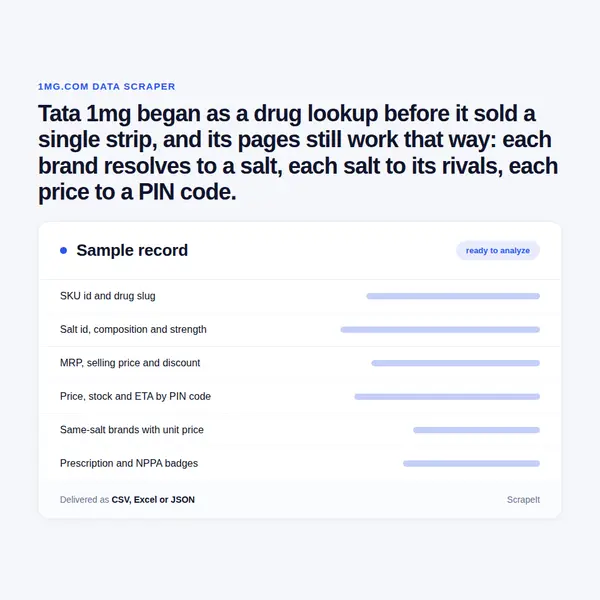
Tata 1mg began as a drug lookup before it sold a single strip, and its pages still work that way: each brand resolves to a salt, each salt to its rivals, each price to a PIN code.

Tata 1mg Scraper
Solutions

A 1mg medicine API of your own: scoping salts, PIN codes and cadence

A Tata 1mg scraping project is scoped by three choices. The spine: a salt list, a therapeutic class, a marketer or the full catalog. The panel: the PIN codes and cities that stand for your market, because price, stock and delivery promise resolve per location and lab prices per city. The layers: reference text, commerce fields, substitutes, lab tests or all of them, on a cadence that suits price monitoring or a periodic product feed. If you are weighing a Tata 1mg alternative such as PharmEasy or Netmeds, each source goes onto the same salt-keyed schema.

1mg.com is closed to automated clients at the edge, so anti-bot handling, proxy rotation and CAPTCHA solving are part of the service, and sections that render only in a browser are collected with a rendering crawler. Delivery is CSV, JSON, XLSX, a database load or a Tata 1mg API we host, with salt id, SKU id, PIN code and collection time on every row.

The 1mg medicine dataset, field by field, from salt to PIN code

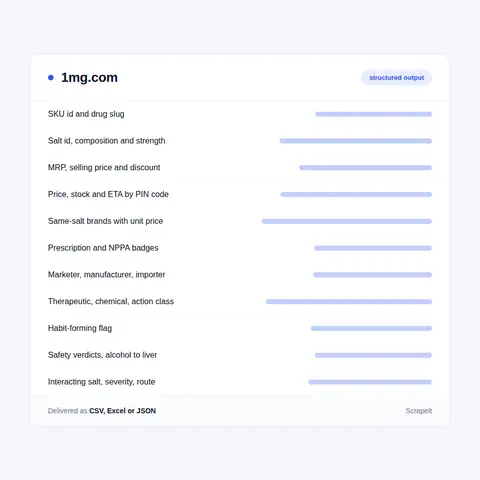
The 1mg medicine dataset rests on one page type, the drug page, and it is dense. The header gives the product name, the pack exactly as sold (strip of 15 tablets, bottle of 60 ml syrup), the composition with strength linked to its salt page, the marketer, and badges such as Prescription or NPPA Regulated, the second linking to the circulars of the national drug price regulator.

Identity and supply chain. A general information block repeats the salt and strength and adds salt synonyms (acetaminophen beside paracetamol), storage conditions and the marketer. Marketer, manufacturer and importer are printed as three parties with addresses, so the brand owner and the plant that makes the product are separate fields. A fact box adds therapeutic class, a habit-forming flag and, for single-salt products, chemical class and action class; the breadcrumb carries class and sub-class with numeric ids.

Reference layer. Product introduction, uses, benefits, common side effects, how to use, how it works, quick tips, questions and answers, references and related lab tests. Safety advice, which stands in for a contraindications section, covers alcohol, pregnancy, breast feeding, driving, kidney and liver, each with a verdict on a fixed scale: SAFE, SAFE IF PRESCRIBED, CAUTION, CONSULT YOUR DOCTOR, UNSAFE. Interaction entries name the interacting salt, its severity, the route, the effect and the advice. Each drug page also names a writer and a reviewer with medical degrees and prints a last-updated stamp.

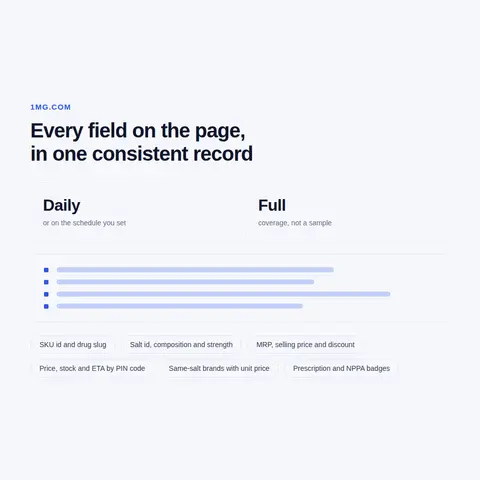
Commerce layer. MRP, selling price and discount percent inclusive of taxes, coupon prices unlocked above an order value, a flag for Care Plan member pricing, minimum and maximum order quantity, stock, a delivery promise for the current PIN code, return eligibility and the expiry month of the batch on sale. Substitutes print a price per tablet or unit and how much cheaper or costlier each one is than the product in view.

The 1mg medicine dataset, field by field, from salt to PIN code
Beyond medicines: the 1mg products list, lab prices by city and consults

Beyond medicines: the 1mg products list, lab prices by city and consults

Health products. Everything that is not a medicine sits under /otc/: vitamins and supplements, nutrition drinks, skin and hair care, Ayurveda and homeopathy, and devices such as glucometers. Each item carries a three-level business category (Devices, Diabetes Care, Diabetic Combo), the marketer and, where imported, the importer, an average rating with counts, and a flag that separates the store's own Tata 1mg label from outside brands. Category listings accept a brand filter in the address and print discounted price, original price and discount per tile, the natural source for a 1mg products list by category.

Lab tests. A test page gives other names for the test, who it suits, the earliest report time, the number of parameters, samples required, fasting and preparation, and the breakdown of what it measures, conducted by Tata 1mg Labs. Prices are set city by city: every test has a price page per city plus a table comparing cities, and packages are grouped per city into themes such as senior citizen or diabetes. City price pages fix the city in the address, while listings follow the location chosen in the session.

Consults and conditions. Doctor consultations run on chat, organized by specialty, and a doctor and clinic directory with its own sitemap addresses profiles by city with DR and PLC codes. Condition guides join the verticals: key facts, necessary tests linked to lab pages, medicines linked to salt pages and specialists to consult.

Tata 1mg: a medicine database for India with a pharmacy attached

Tata 1mg is an Indian online pharmacy that grew out of a drug reference, and that history shapes every page. It started as HealthKartPlus, a generic medicine search and price comparison tool, before it delivered anything, and has traded as Tata 1mg since Tata Digital took a majority stake, which puts it in one group with BigBasket, Tata CLiQ and Croma. From Gurugram it now sells medicines and health products, books lab tests and runs doctor consultations, yet a drug page still reads as a pharmacology entry first and a listing second. For a buyer assembling a medicine database India-wide, that makes each product page a reference record as much as an offer.

Every object has its own address and a numeric id. A branded medicine is /drugs/ plus a slug that ends in the SKU id, and a health product sits under /otc/ with an otc prefix on its id. The molecule is a page of its own under /generics/, one per salt and one per salt combination, while brand families, marketers, therapeutic classes and complete substitute lists each have a tree: /brands/, /marketer/, /drugs-therapeutic-classes/ and /drugs-substitutes/. Lab tests live under /labs/, the doctor and clinic directory under /doctors/, condition guides under /diseases/.

robots.txt leaves the catalog open and names three sitemaps, for the store, for labs and for doctors. It closes internal search, the lookup behind the interaction checker, the community section, the cart and the checkout steps, including the one where a prescription is attached. Drug pages are published in English and Hindi, while the Tamil, Telugu, Marathi and Gujarati drug paths are closed to crawlers.

Get a Quote
dev_w
25

Developers

customers
500+

Customers worldwide

pages
1 500 000 000+

Pages extracted

stime
15000+

Hours saved for our clients

Plans

Airplane

€199 / one-time

setup fee - included

Data limits100,000
Frequencyone-time
Run timeup to 5 days
Data storing7 days

Helicopter

€169 / mo

setup fee €499

Data limits250,000
Frequencymonthly
Run timeup to 5 days
Data storing14 days

Glasses

€229 / mo

setup fee €499

Data limits1,000,000
Frequencyweekly
Run timeup to 5 days
Data storing30 days

DNA

€549 / mo

setup fee €799

Data limits3,000,000
Frequency3 times daily
Run timesame day
Data storing90 days

Why a Tata 1mg scraper keys on the salt id, never the brand name

A typical brief sounds simple: every brand of one salt, with prices. A Tata 1mg scraper answers it by walking ids, not by matching names. The salt page lists brand families with marketer, price range and variant count; each brand page lists its variants with strength, form, pack and a prescription marker; each drug page returns price and stock for a PIN code. Combination salts have ids of their own, so alprazolam alone never merges with alprazolam plus propranolol, and a synonym such as acetaminophen lands on the existing record instead of a new one.

The text layer needs the same discipline. Reference copy is written per brand and form, so the strengths of a brand share it, and a few SKUs carry the text written for another brand with the same composition. Deduplicate it by salt and form, not by SKU, or a 1mg dataset stores one leaflet many times over. Empty cells carry meaning too: combination products usually have no chemical or action class, which is a property of the product, not a failed parse.

Dates need care. Last-updated times on drug pages cluster in a nightly batch window and many older SKUs share one identical published timestamp, so changes are found by comparing text, while salt pages carry real editorial dates, printed in UTC rather than IST. The markup inside a drug page also holds its own offer price and stock flag, which can trail the live price box, so Tata 1mg price data is read from the price box resolved for a PIN code.

Our Blog

Reads Our Latest News & Blog

Learn how to use web scraping to solve data problems for your organization

How Artificial Intelligence Is Used In Web Scraping

How Artificial Intelligence Is Used In Web Scraping

Leveraging advances in technology, the AI-powered web scraper has skyrocketed in demand and is helping to expand capabilities by automating tedious daily tasks and speeding up data collection from thousands of websites several times over.

What is Web Scraping and What is it Used For?

What is Web Scraping and What is it Used For?

Web scraping is a method of obtaining web data by extracting it from pages of web resources with the help of a program, that is, in automatic mode. It is used to syntactically convert web pages into more usable forms.

Web Scraping for Machine Learning

Web Scraping for Machine Learning

If you specialize in machine learning, you need to feed large amounts of data to the algorithms. Web scraping is the easiest and the most efficient method of collecting the data from all over the Internet.

scrapeit logo

Who builds, runs and repairs your Tata 1mg dataset

ScrapeIt runs the job as a managed service. We build the crawler, run it on your schedule, watch it and repair it when a template changes, and you receive files or an endpoint without keeping scraping engineers of your own.

We are not affiliated with Tata 1mg or Tata Digital. We read robots.txt before planning a crawl, stay out of the paths it closes and never sign in to an account.

FAQ

Is there a public Tata 1mg API or 1mg API documentation?

No. Tata 1mg runs no public developer program, publishes no API documentation and issues no keys. The partner portal at partners.1mg.com is built for sellers: registration asks for a GSTIN, a bank account and licenses for the product category, and listings, orders and settlements sit behind a login. It is a selling channel, not a catalog feed. What we deliver instead is a 1mg medicine API built on the public pages, keyed on salt id and SKU id, with a schema that stays fixed when the site changes its templates.

What does a 1mg medicine dataset contain, and how do we join it?

Keys first: SKU id and slug, a salt id for each composition, brand, marketer id and therapeutic class id. Then the product: name, pack, form, strength, prescription, NPPA and habit-forming flags, marketer, manufacturer, importer and storage. Then reference text and safety verdicts, interactions with severity, substitutes with unit price, and price, discount, stock and delivery promise per PIN code. Join on salt id for a molecule view, on SKU id for a price series, and on salt synonyms when your master data uses international names.

Can you pull Tata 1mg prices and stock for specific PIN codes and cities?

Yes, that is the normal setup. The storefront resolves a city and a six-digit PIN code before it prints price, stock or a delivery promise, and it reports separately whether a location is served for medicines and for health products. Without a chosen location it falls back to a default city, so we pin the location on every request and store it on the row. Lab tests work by city instead: each test has a price page per city, and the same test can cost different amounts from one city to the next.

How often does the 1mg products list change, and how is it delivered?

Price, coupon tiers and stock are the fast fields, and the delivery promise is computed per location and time of day. Substitute lists move as brands launch or go out of stock. Reference text changes slowly and is best tracked by comparing text, not stamps. A common plan is daily or weekly price monitoring on a watchlist, a monthly pass over the full catalog and lab price pages, and a quarterly pass over salt pages and class trees. Delivery is CSV, JSON, XLSX, a database load or an endpoint, with a run timestamp on every row.

Is it legal to scrape Tata 1mg, and do you collect prescriptions or patient data?

We collect only what the site shows an anonymous visitor, at a polite request rate, after reading robots.txt and staying out of the paths it closes, which include search, the interaction lookup and checkout. Nothing behind a login is touched. We do not collect prescriptions, medical records, individual lab results or reviews with their authors: the scope is the public catalog and reference information about medicines and tests. Reuse of the content is governed by the Tata 1mg terms of use, so we make no blanket legal claim and scope each project with the client and their counsel.

How does it Work?

Step 1 - Make a Request

You share your needs, expectations, and desired timeframe. We’ll suggest the best solution based on your request and budget.

Step 2 - Configuring Custom Web Crawlers

Our specialists configure the crawlers and extract a sample dataset for your review before proceeding with the full-scale extraction.

Step 3 - Collect and Deliver

Once you approve the sample, we launch the project and start full data collection. We gather, filter, and structure the data for easy use, delivering it on time in your preferred format.

Step 4 - Maintain and Support

Our team manages ongoing processes, monitors website changes, and supports all data extraction cycles. We can also help integrate data into your systems or create dashboards to simplify analysis.

Request a Quote

Tell us more about you and your project information.
Which sites, which fields, how often. A couple of lines is enough.

We reply within 1 business day. No obligation.

scrapiet

Scrapeit Sp. z o.o.
10/208 Legionowa str., 15-099, Bialystok, Poland
NIP: 5423457175
REGON: 523384582