Why the prescription split should survive into the data
It would be easy to collect both catalogues, concatenate them and hand over a price list. The result would be technically complete and quietly unusable for anything with a regulatory dimension.
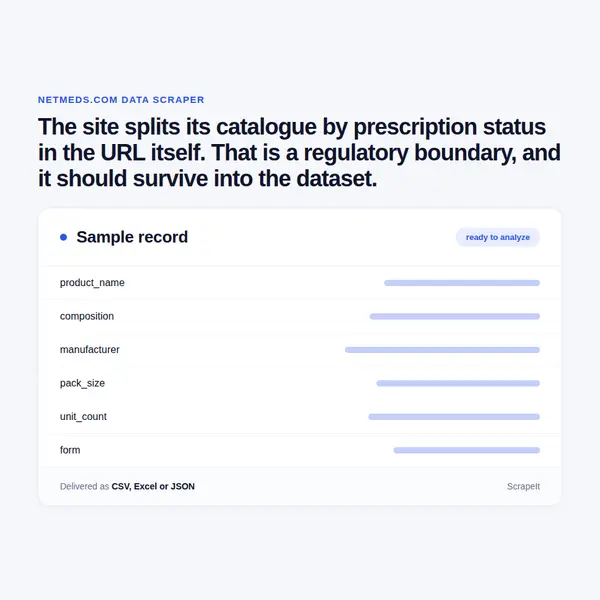
Prescription and over the counter products are governed differently. What may be advertised, to whom, and in what terms differs, and a client building a comparison tool, a price index or a content product needs to know which side of that line each row sits on. The site encodes it in the URL; throwing it away is a decision, not a default.
The second reason is analytical. Price dynamics differ sharply between the two. Over the counter products behave like retail, with promotional cycles and basket effects; prescription medicines are shaped by regulated ceilings and generic competition. Averaging them produces a series that describes neither.
The third is the non medicine catalogue, which is large. Wellness and personal care products will dominate any aggregate drawn across the whole site, and a client analysing pharmaceutical pricing needs them separable rather than silently included.
The fourth, as on any pharmacy source, is that this is one platform and not the market. Online pharmacy pricing is a meaningful slice of Indian retail and it is not offline retail, where most of the volume still sits.