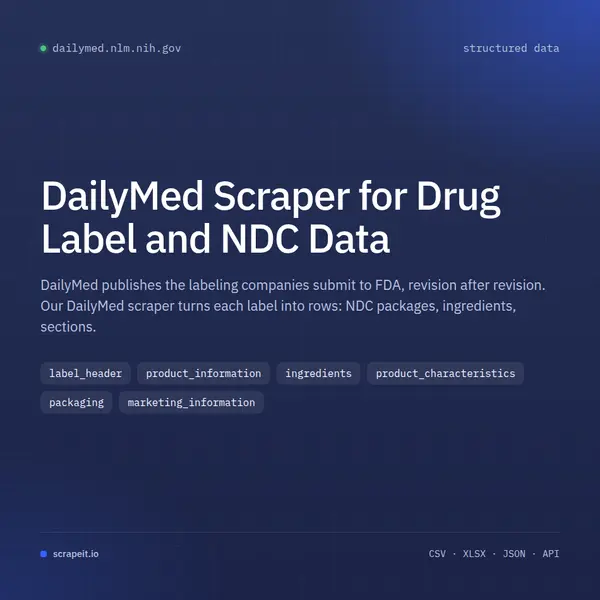
DailyMed Scraper for Drug Label and NDC Data

DailyMed publishes the labeling companies submit to FDA, revision after revision. Our DailyMed scraper turns each label into rows: NDC packages, ingredients, sections.

Plans from €169 a month · Free project assessment · Reply within 1 business day

CSV · Excel · JSON · XML · FTP · SFTP · Amazon S3 · Google Cloud

dailymed.nlm.nih.gov
DailyMed Scraper for Drug Label and NDC Data
dailymed.nlm.nih.govwhat you get
Typical fields for health sites
namespecialtyaddresspriceratingreviews
Delivery

API, JSON feed or CSV, XLSX and JSON files

Schedule

One-time, monthly, weekly, daily or 3 times a day

Scrape DailyMed Without Running a Crawler

  1. You send

    DailyMed pages, filters, fields and a schedule

  2. We run the scrapers

    Built, monitored and repaired by our team

  3. You receive the data

    API, JSON feed or CSV, XLSX and JSON files

Give us the scope - every human prescription label, one drug class, a list of NDCs or application numbers, a set of labelers - and we build, run and maintain the crawl that covers it. Labels are long documents with nested tables, so most of the work is parsing: the product information block, ingredient tables with UNII codes, and numbered sections that differ between prescription, OTC and animal labels. We map them to one documented schema, re-run on the schedule you choose and tell you which set IDs moved to a new version since the last delivery. Start with a free project assessment and a sample built from the labels you care about.

DailyMed Data: Fields We Extract From Each Label

A DailyMed label is addressed by its set ID, a long identifier in the page address that stays the same while the label is revised; every revision gets a new version number. We keep both, so each row says which version it came from.

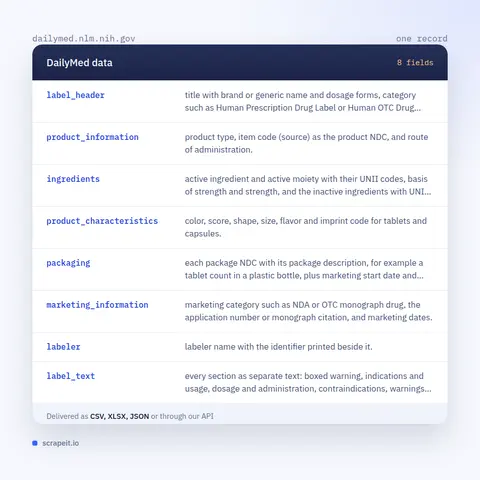
  • Label headertitle with brand or generic name and dosage forms, category such as Human Prescription Drug Label or Human OTC Drug Label, DEA schedule, marketing status, packager and updated date, plus the set ID from the page address and the version number from the label's archive list.
  • Product informationproduct type, item code (source) as the product NDC, and route of administration.
  • Ingredientsactive ingredient and active moiety with their UNII codes, basis of strength and strength, and the inactive ingredients with UNII codes of their own.
  • Product characteristicscolor, score, shape, size, flavor and imprint code for tablets and capsules.
  • Packagingeach package NDC with its package description, for example a tablet count in a plastic bottle, plus marketing start date and marketing end date.
  • Marketing informationmarketing category such as NDA or OTC monograph drug, the application number or monograph citation, and marketing dates.
  • Labelerlabeler name with the identifier printed beside it.
  • Label textevery section as separate text: boxed warning, indications and usage, dosage and administration, contraindications, warnings and precautions, adverse reactions, drug interactions, use in specific populations, description, clinical pharmacology, how supplied/storage and handling; for OTC products the Drug Facts headings - active ingredient, purpose, uses, warnings, directions, other information.

Sections come as plain text or with their markup kept, whichever your pipeline prefers, with the section name in its own column, so indications or boxed warnings can be compared across thousands of labels without opening one.

DailyMed Data: Fields We Extract From Each Label
Versions, Classes and the DailyMed Drug Database

Versions, Classes and the DailyMed Drug Database

One label is a document; the value of a DailyMed dataset lies in the links around it.

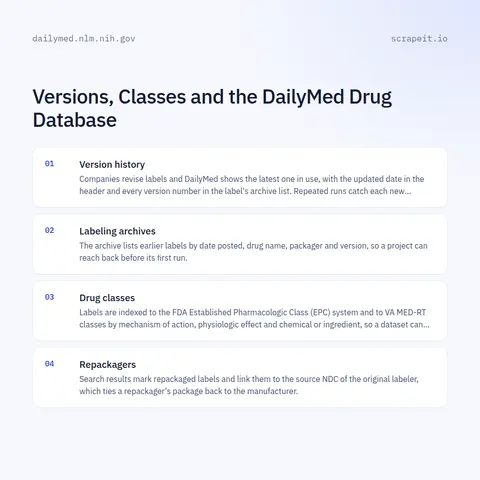
  • Version historycompanies revise labels and DailyMed shows the latest one in use, with the updated date in the header and every version number in the label's archive list. Repeated runs catch each new version, and comparing sections between versions shows what changed: a new boxed warning, an extra contraindication, a package withdrawn.
  • Labeling archivesthe archive lists earlier labels by date posted, drug name, packager and version, so a project can reach back before its first run.
  • Drug classeslabels are indexed to the FDA Established Pharmacologic Class (EPC) system and to VA MED-RT classes by mechanism of action, physiologic effect and chemical or ingredient, so a dataset can cover one drug class at a time.
  • Repackagerssearch results mark repackaged labels and link them to the source NDC of the original labeler, which ties a repackager's package back to the manufacturer.
  • Search scopesall drugs, human drugs or animal drugs, and in advanced search any ingredient, UNII code, application number or a word inside one label section.

Package photos and the figures printed in a label can travel with the row as image links.

About the DailyMed Database

Source
dailymed.nlm.nih.gov
Category
health sites
Delivery
API, JSON feed, CSV, XLSX
Plans
From €169 a month
Get a quote

DailyMed is the site of the National Library of Medicine, part of NIH, for the labeling that companies submit to the US Food and Drug Administration. It shows the most recent labeling submitted and in use, stored as Structured Product Labeling (SPL) documents. NLM does not review the content before it appears, so a label on DailyMed can differ from the latest version FDA approved - a detail that matters to anyone who treats it as the reference text.

Coverage is wider than prescription drugs. DailyMed carries prescription and nonprescription drugs and biologics for human use, certain medical devices, medical gases and drugs for animal use, plus regulated but unapproved products such as dietary supplements, medical foods, cosmetics and unapproved drugs. Prescription labeling comprises the Prescribing Information with its Highlights and numbered sections, patient labeling such as a Medication Guide, and carton and container labeling; nonprescription products carry the Drug Facts panel instead.

Search mirrors that structure: tabs for all drugs, human drugs and animal drugs, results sorted by relevance, alphabetically or with repackaged labels last, and an advanced search that reaches NDC codes, set IDs, document IDs, drug classes, ingredients and individual label sections.

25Developers
500+Customers
1.5BPages extracted
15,000+Hours saved for our clients

DailyMed scraping plans and pricing

Airplane

€199one-time

Setup fee included

100,000
One-time
Up to 5 days
7 days

Helicopter

€169/ mo

Setup fee €499

250,000
Monthly
Up to 5 days
14 days

Glasses

€229/ mo

Setup fee €499

1,000,000
Weekly
Up to 5 days
30 days

Microscope popular

€349/ mo

Setup fee €499

2,000,000
Daily
Same day
60 days

DNA

€549/ mo

Setup fee €799

3,000,000
3 times daily
Same day
90 days

Delivery: CSV, JSON or XLSX files, our API or a JSON feed. MCP server on request.

Full plan details

Why Teams Collect DailyMed Labels

Drug labels are the reference text that pharmacies, payers, software vendors and manufacturers all work from, and DailyMed publishes them as companies submit them.

  • Drug databases and pharmacy softwareNDC packages, strengths, routes and imprint codes keep a product catalogue or a pill identifier current.
  • Label change monitoringVersion-by-version comparison of boxed warnings, contraindications and adverse reactions feeds regulatory and drug safety teams.
  • Generic entry trackingNew set IDs under an active ingredient, with marketing category, application number and marketing start date, show when another labeler enters a molecule.
  • Excipient researchInactive ingredients with UNII codes show which excipients a class of products uses, a question for allergen checks and supply planning.
  • Text corporaSection-tagged indications and dosage text make a ready corpus for search tools and language models; we deliver the text, not medical advice.

About ScrapeIt

ScrapeIt is a managed data extraction service. We build and maintain the crawlers, parse what they collect and deliver documented datasets on your schedule. For document-heavy sources such as DailyMed the parsing is the product: section names, ingredient tables and package lists sit in fixed columns, so two versions of a label compare line by line. Formats include CSV, Excel, JSON, JSONLines and XML, delivered through our API, SFTP, Amazon S3 or a load into your database. An MCP server is available on request.

FAQ

Still unsure? Write to info@scrapeit.io

Do you offer a DailyMed API for label and NDC data?

Yes. The ScrapeIt DailyMed API returns set ID, version, package NDCs, active ingredients with strength, marketing category and label sections as JSON from an endpoint we host, refreshed on the schedule you set. The same data also comes as CSV or XLSX files, JSONLines or a load into your database.

Is it legal to scrape DailyMed?

Yes. DailyMed shows the full labeling of each product, with its ingredients, packages and marketing information, to any visitor without an account. We collect only publicly available data - everything a visitor can see on DailyMed - and we collect it legally.

Can you track DailyMed label changes between versions?

Yes. A label keeps its set ID while the version number and updated date change with each revision, so we store every version we collect and mark the sections whose text changed. A weekly run suits safety monitoring; a daily run suits teams that watch a short list of products.

Can a DailyMed dataset cover OTC and animal drugs as well?

Yes. DailyMed separates human and animal drugs and names each label's category, prescription or OTC, in its header. OTC labels follow the Drug Facts layout rather than numbered sections, so we map both into one schema with a label type column and leave fields that exist on only one kind empty rather than guessed.

How do you scrape DailyMed for every NDC of a drug?

We start from the active ingredient or drug class, collect every set ID it returns, repackaged labels included, and read the packaging table of each one. Every package NDC arrives with its package description, marketing dates and, for a repackager's label, the source NDC, so one ingredient becomes a full package list across labelers.

How it works

  1. 1

    Make a request

    You share your needs, expectations, and desired timeframe. We'll suggest the best solution based on your request and budget.

  2. 2

    We configure the crawlers

    Our specialists configure the crawlers and extract a sample dataset for your review before proceeding with the full-scale extraction.

  3. 3

    Collect and deliver

    Once you approve the sample, we launch the project and start full data collection. We gather, filter, and structure the data for easy use, delivering it on time in your preferred format.

  4. 4

    Maintain and support

    Our team manages ongoing processes, monitors website changes, and supports all data extraction cycles. We can also help integrate data into your systems or create dashboards to simplify analysis.

Request a quote

Tell us which sites, which fields and how often. A couple of lines is enough to start.

  • We reply within 1 business day
  • A sample dataset before the full run
  • We sign an NDA on request
  • Delivery by API, JSON feed or files
Which sites, which fields, how often. A couple of lines is enough.

This form is protected by Google reCAPTCHA, which loads when you start filling it in; the Google Privacy Policy and Terms of Service apply. If you prefer not to use it, email us at info@scrapeit.io. Privacy & Cookie Policy

We reply within 1 business day. No obligation.

DailyMed data from €169/month. Free project assessment, reply within 1 business day.