Healthline Scraper for Articles and Medical Review Data

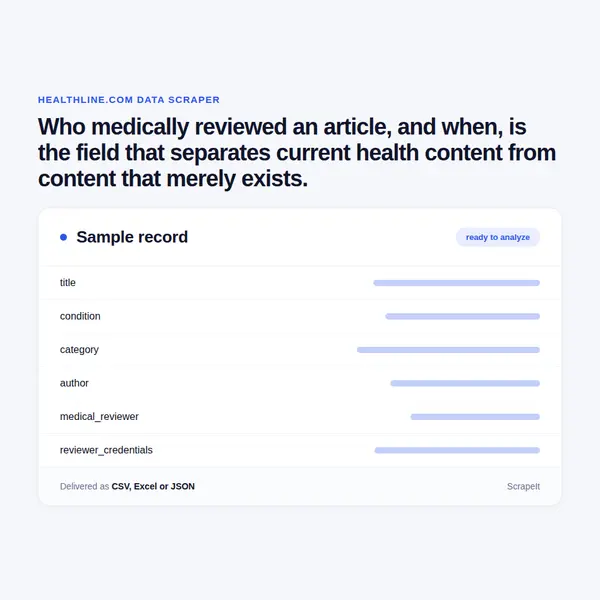
Who medically reviewed an article, and when, is the field that separates current health content from content that merely exists.

Healthline Scraper
Solutions

Managed health content data, run end to end by us

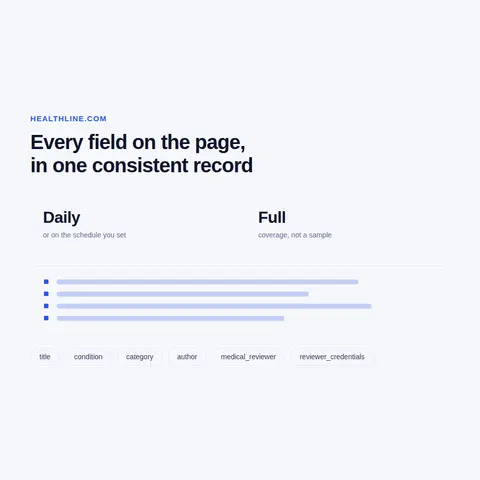
ScrapeIt runs the collection as a managed service. You name the conditions or topics; we build the pipeline with all three dates, reviewer credentials and section structure preserved, and hand back CSV, JSON, Excel or a push into your warehouse.

Collection is paced to the five-second interval the site requests, so a large corpus is a slow job and we quote the realistic duration up front rather than discovering it in delivery.

This is consumer health publishing, not clinical guidance. It suits content strategy, search research and competitive analysis; anything touching patient care needs authoritative sources and your own clinical governance. Content is copyrighted, so the dataset is for measurement rather than republication.

Healthline fields in every export

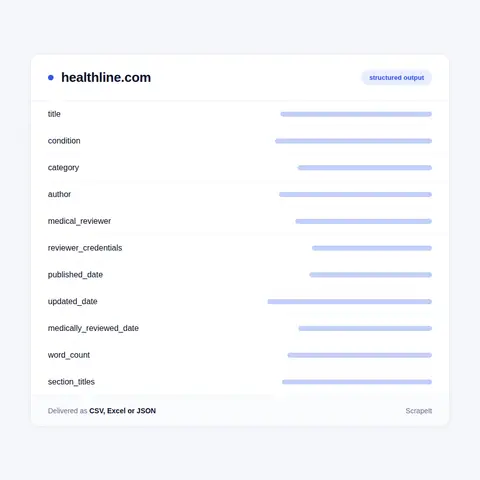
Article records carry the title, topic and condition, category, author, medical reviewer as credited, publication date, last medical review date, last updated date, word count, section structure and the address.

Three dates are kept apart: published, updated and medically reviewed. They mean different things, they diverge, and a corpus that keeps one of them and calls it the date cannot answer the only quality question worth asking of health content.

Reviewer credentials are recorded as published, since a review by a physician and a review by a dietitian are different claims about the same article.

Section structure is preserved rather than flattened, because health articles follow a recognisable shape - symptoms, causes, treatment, when to see a doctor - and comparing coverage depth across publishers is a section-level question.

Every row carries the collection timestamp and a revision count where re-collection shows the article changed.

Healthline fields in every export
Gap analysis, review freshness and rights

Gap analysis, review freshness and rights

Content gap analysis against a client's own library is the most direct commercial output: which conditions are uncovered, which sections are thin, and where a competitor has depth. It is a set difference once both sides are structured.

Review freshness distribution across a competitor's library shows whether they maintain content or accumulate it - a strategic read that is invisible from a sitemap count.

Search-facing structure analysis - headings, question formats, section ordering - supports content teams working on health topics, where the format conventions are unusually stable and worth matching deliberately.

On rights we are direct: the content is copyrighted and terms restrict reuse. Measurement and analysis are the deliverable; republication is not, and anything surfacing article text to end users is a licensing conversation with the publisher rather than a scraping project.

Consumer health publishing at scale

Healthline is one of the largest consumer health publishers, covering conditions, symptoms, treatments, nutrition and wellness for a general audience rather than for clinicians.

It carries a structural feature that makes it more useful as data than most health content: articles are attributed to a medical reviewer with a review date. That turns a content corpus into something with a quality dimension - not a guarantee of accuracy, but a recorded claim about who checked the piece and when.

For anyone doing competitive content analysis in health, that field is the one that matters. Coverage depth is easy to count; currency of review is what distinguishes a maintained library from a large one.

The crawl rules are published and ask for a five-second delay between requests, which sets the pace of any collection here. Article sections respond directly with substantial content.

Get a Quote
dev_w
25

Developers

customers
500+

Customers worldwide

pages
1 500 000 000+

Pages extracted

stime
15000+

Hours saved for our clients

Plans

Airplane

€199 / one-time

setup fee - included

Data limits100,000
Frequencyone-time
Run timeup to 5 days
Data storing7 days

Helicopter

€169 / mo

setup fee €499

Data limits250,000
Frequencymonthly
Run timeup to 5 days
Data storing14 days

Glasses

€229 / mo

setup fee €499

Data limits1,000,000
Frequencyweekly
Run timeup to 5 days
Data storing30 days

DNA

€549 / mo

setup fee €799

Data limits3,000,000
Frequency3 times daily
Run timesame day
Data storing90 days

Why review dates are the analytical spine

Health content analysis usually starts as a volume exercise - who covers what, how many articles per condition - and stops being useful at exactly that point.

Volume says little. A publisher with four hundred articles on a condition, last reviewed four years ago, is in a different position from one with eighty reviewed this year. Review recency is the differentiator and it is published on the page, so collecting it costs nothing and not collecting it wastes the project.

The second reason is content gap analysis, which is what most clients are really buying. Which conditions and which sections within a condition a competitor covers, at what depth and how recently, is a content roadmap in data form - and it needs the section structure as well as the dates.

The third is that this is consumer content, not clinical guidance, and we say so in the first conversation. It is fit for content strategy, search research and competitive analysis. It is not a source for anything touching patient care, and a client who needs that needs authoritative sources and clinical governance.

The fourth is pacing. The site asks for five seconds between requests, which makes a large corpus a slow job. We quote the real duration rather than the one that assumes we ignore the request.

Our Blog

Reads Our Latest News & Blog

Learn how to use web scraping to solve data problems for your organization

How Artificial Intelligence Is Used In Web Scraping

How Artificial Intelligence Is Used In Web Scraping

Leveraging advances in technology, the AI-powered web scraper has skyrocketed in demand and is helping to expand capabilities by automating tedious daily tasks and speeding up data collection from thousands of websites several times over.

What is Web Scraping and What is it Used For?

What is Web Scraping and What is it Used For?

Web scraping is a method of obtaining web data by extracting it from pages of web resources with the help of a program, that is, in automatic mode. It is used to syntactically convert web pages into more usable forms.

Web Scraping for Machine Learning

Web Scraping for Machine Learning

If you specialize in machine learning, you need to feed large amounts of data to the algorithms. Web scraping is the easiest and the most efficient method of collecting the data from all over the Internet.

scrapeit logo

Who builds and keeps your health content feed

ScrapeIt is a managed extraction company, not a tool you have to learn. Our team builds the pipeline, watches it as article templates and reviewer conventions change, and repairs it before a freshness analysis goes stale itself.

You see a sample first, in your format, over the conditions you actually cover, with the three dates separated so you can see immediately how much of a competitor's library is genuinely maintained.

FAQ

Why three different dates?

Because published, updated and medically reviewed mean different things and they diverge. A corpus that keeps one of them and calls it the date cannot answer the only quality question worth asking of health content, which is how recently somebody checked it.

Is article volume a useful metric?

Barely. Four hundred articles last reviewed four years ago is a different position from eighty reviewed this year. Review recency is the differentiator, it is published on the page, and collecting it costs nothing.

Can I use this for clinical purposes?

No, and we say it first rather than last. This is consumer health publishing. It suits content strategy, search research and competitive analysis; anything touching patient care needs authoritative sources and your own clinical governance.

How fast can you collect a large corpus?

Slowly and reliably. The site asks for five seconds between requests and we honour it, so a large library is measured in days rather than hours. We quote the real duration rather than the one that assumes we ignore the request.

Can I republish the articles?

No. The content is copyrighted and terms restrict reuse. Measurement and analysis are the deliverable; anything surfacing article text to your users is a licensing conversation with the publisher, not a scraping project.

How does it Work?

Step 1 - Make a Request

You share your needs, expectations, and desired timeframe. We’ll suggest the best solution based on your request and budget.

Step 2 - Configuring Custom Web Crawlers

Our specialists configure the crawlers and extract a sample dataset for your review before proceeding with the full-scale extraction.

Step 3 - Collect and Deliver

Once you approve the sample, we launch the project and start full data collection. We gather, filter, and structure the data for easy use, delivering it on time in your preferred format.

Step 4 - Maintain and Support

Our team manages ongoing processes, monitors website changes, and supports all data extraction cycles. We can also help integrate data into your systems or create dashboards to simplify analysis.

Request a Quote

Tell us more about you and your project information.
Which sites, which fields, how often. A couple of lines is enough.

We reply within 1 business day. No obligation.

scrapiet

Scrapeit Sp. z o.o.
10/208 Legionowa str., 15-099, Bialystok, Poland
NIP: 5423457175
REGON: 523384582