Zocdoc API and Scraper for Providers, Insurance Plans and Open Slots

Zocdoc documents its API in the open but hands keys only to partners. We collect the marketplace itself: who is bookable, for which plan and visit reason, and how soon.

Zocdoc Scraper
Solutions

Scoping a Zocdoc scraping project by specialty, ZIP code and plan

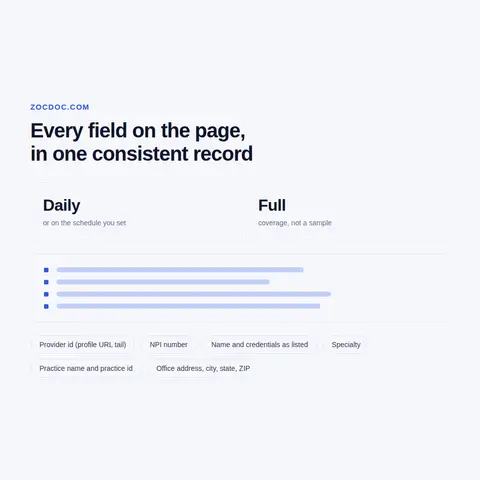
A Zocdoc scraping project is defined by a grid you choose: specialties or visit reasons, places down to the neighborhood or ZIP code, and the carriers or plans that matter to you, crossed the way the directory already crosses them. Depth is the second choice - the roster alone, the roster with insurance, or the roster plus a daily new-patient availability snapshot. zocdoc.com is closed to automated clients at the edge, so anti-bot handling, proxy rotation and CAPTCHA solving are part of the service. We stay out of search and booking paths and never log in. Delivery is CSV, JSON, XLSX, a database load or a Zocdoc API of your own, with provider key, NPI, place, plan and capture time on every row.

What a Zocdoc scraper extracts from each provider profile

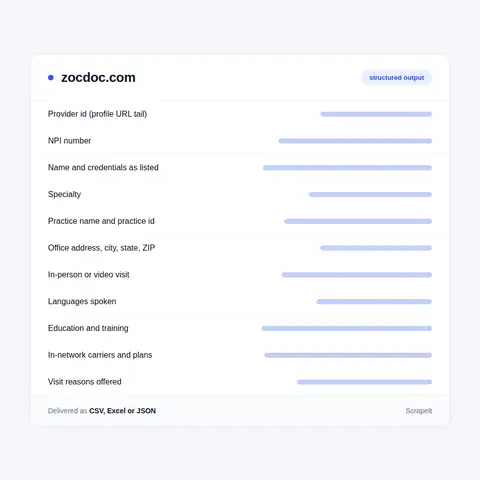
The first thing a Zocdoc scraper reads is the provider profile. It carries the name as listed with credentials - MD, DO, NP, APRN, DPT and the rest - the specialty title, a free-text statement, education and training, languages spoken, practice names and the ten-digit NPI. Each office location has street, suite, city, state and ZIP; one clinician can hold several, and a video visit counts as a location of its own. Accepted insurance shows as named carriers plus a count of further in-network plans, with a plan checker beside it. Visit reasons come as a full list and a shorter popular list, and the scheduling block prints open appointments per day for the coming days, flags new-patient availability and links to later dates.

Ratings and badges. Three averages - overall, wait time and bedside manner - with a review count; highlight lines such as highly recommended or excellent wait time, each backed by a share of patient ratings; and the Patient Choice badge, shown in search and on the profile. We carry them as numbers on the provider row.

Practice pages and listing cards. A practice page pools every provider's availability over a two-week window, with insurances accepted, all office locations and a practice-level rating. A listing card gives distance in miles, address, rating and review count, then either Accepts with a few carriers and a count of more or, once the page is filtered by plan, In-network with that carrier. Tags follow - video visits, accepting new patients, years of experience, areas of expertise - then the next available date, while the page itself is stamped with the day its availability was last updated.

Keys. The numeric tail of the profile address is the provider key; practices, places and carriers have ids of their own. Carrier ids end in m for medical and vision plans and d for dental ones, so UnitedHealthcare is 323m on a primary care listing and 243d on a dental one. We extract Zocdoc data with those keys intact, so two runs join and diff cleanly.
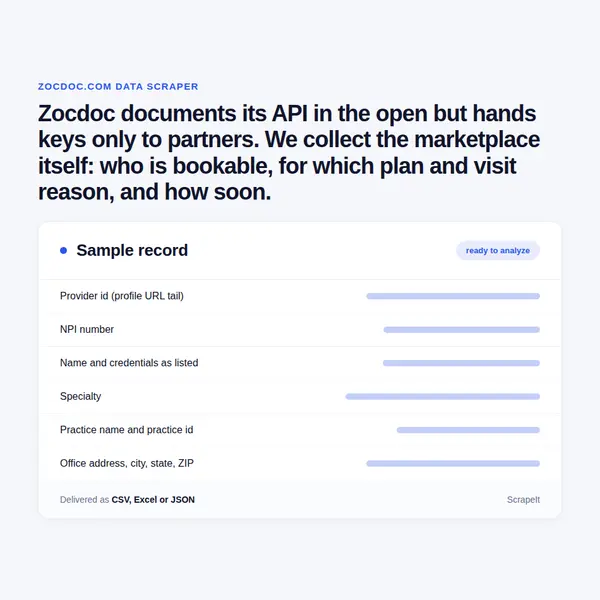
What a Zocdoc scraper extracts from each provider profile
Zocdoc public API and developer program: what partners get and what stays closed

Zocdoc public API and developer program: what partners get and what stays closed

The Zocdoc public API is real, and its documentation is open to read at api-docs.zocdoc.com. The Zocdoc developer API authenticates with OAuth 2.0 client credentials against a sandbox and a production host. It searches providers by NPI, and provider locations by ZIP code, specialty or visit reason and insurance plan within a radius of up to 50 miles; returns availability for up to 50 provider locations per call in windows of up to 31 days; lists specialties, visit reasons and insurance plans typed as HMO, PPO, EPO or POS and grouped into programs such as commercial, ACA marketplace, Medicare Advantage and Medicaid managed care; and handles booking, webhooks and a schedulable entities feed sent by SFTP as often as hourly.

Access is the catch. Keys follow a partnership agreed with Zocdoc, under a developer licensing agreement; each partner works against a bookable roster curated for it, not the whole marketplace; the insurance-mapping endpoints are reserved for select partners; review endpoints return counts and averages, never text. No price list is published. In syndicated condition search the API itself returns only providers with active budget, which is the payment model showing through.

Paid reach works the same way on the site. Sponsored Results lets a practice bid for placement on top of its booking fee, and the Patient Reach Network pushes one calendar to Google, Apple Maps, a California health plan's directory and Veterans Affairs care coordinators.

Zocdoc data starts with a marketplace, not a census of US doctors

Zocdoc is a United States marketplace for booking medical, dental, vision and mental health visits. A patient states three things - an insurance plan, a visit reason and a location - and gets back clinicians who are in network, open to new patients and bookable online at a stated time. Booking is free for the patient. The practice pays no subscription and no joining fee, only a one-time charge each time a new patient books through the Zocdoc app or website, priced by specialty and location; existing patients, and bookings through the practice's own website button or Google profile, cost it nothing. Every limit of Zocdoc data follows from that model.

The bookable catalog is self-selected: a practice appears when a new patient is worth the fee to it. Clinicians who stay out can still appear on NPI-keyed stub pages, marked noindex, which say they do not take part in online booking and point to similar providers who do. Listings show only providers open to new patients. Read Zocdoc as a map of bookable supply, and join it to the federal NPI registry when you need a census.

The public directory has a regular grammar. A bookable profile is /doctor/ plus name, credential and a numeric id; a practice is /practice/ plus slug and id; listings cross a specialty with a place and a carrier, as in /primary-care-doctors/denver-228319pm/medicare-356m, with /2 and /3 for further pages. Places run from cities to neighborhoods, ZIP codes and campuses, and visit reasons have pages of their own, such as /procedure/annual-physical-76. robots.txt closes /search, /booking/ and any address carrying insurance-match, start-time or appointment-date parameters, so the crawl runs through this directory.

Get a Quote
dev_w
25

Developers

customers
500+

Customers worldwide

pages
1 500 000 000+

Pages extracted

stime
15000+

Hours saved for our clients

Plans

Airplane

€199 / one-time

setup fee - included

Data limits100,000
Frequencyone-time
Run timeup to 5 days
Data storing7 days

Helicopter

€169 / mo

setup fee €499

Data limits250,000
Frequencymonthly
Run timeup to 5 days
Data storing14 days

Glasses

€229 / mo

setup fee €499

Data limits1,000,000
Frequencyweekly
Run timeup to 5 days
Data storing30 days

DNA

€549 / mo

setup fee €799

Data limits3,000,000
Frequency3 times daily
Run timesame day
Data storing90 days

Doctor appointment availability data: why the patient's plan changes the slots

On Zocdoc an open slot is not a property of the doctor alone. It is computed for a visit reason, which sets the appointment length, and for a new or an existing patient, and then it is gated by insurance. Filter a listing by plan and the cards switch from Accepts to In-network for that carrier; a practice can take in-network bookings only, refuse self-pay and require a member ID; age settings can block new patients outside a pediatric or adult range. Two patients looking at one calendar can see different bookable supply.

That is why we scrape Zocdoc per plan rather than per doctor. A health plan or regulator testing network adequacy needs days to the next new-patient appointment for Medicaid members beside commercial members, specialty by specialty and ZIP by ZIP. A provider group tracks how fast rival calendars fill and which visit reasons they open. Vendors building Zocdoc alternatives for providers use the roster as a market map: who lists, in which specialties and neighborhoods, with video or without. Telehealth researchers follow the video visit flag over time.

Availability also needs a clock. Next available dates, new-patient flags and daily slot counts move with every booking and cancellation, and each listing prints when its availability was last updated, so every row should carry the plan, visit reason, place and capture time it was resolved against.

Our Blog

Reads Our Latest News & Blog

Learn how to use web scraping to solve data problems for your organization

How Artificial Intelligence Is Used In Web Scraping

How Artificial Intelligence Is Used In Web Scraping

Leveraging advances in technology, the AI-powered web scraper has skyrocketed in demand and is helping to expand capabilities by automating tedious daily tasks and speeding up data collection from thousands of websites several times over.

What is Web Scraping and What is it Used For?

What is Web Scraping and What is it Used For?

Web scraping is a method of obtaining web data by extracting it from pages of web resources with the help of a program, that is, in automatic mode. It is used to syntactically convert web pages into more usable forms.

Web Scraping for Machine Learning

Web Scraping for Machine Learning

If you specialize in machine learning, you need to feed large amounts of data to the algorithms. Web scraping is the easiest and the most efficient method of collecting the data from all over the Internet.

scrapeit logo

The team behind your Zocdoc provider feed

ScrapeIt runs web scraping as a managed service: we design the crawler, run it to your schedule, monitor it and repair it when Zocdoc changes a template, and you receive files or an endpoint. We are not affiliated with Zocdoc.

We never collect patient data, appointments or reviews with their authors, nor the personal identity fields some therapists add. A clinician's Zocdoc listing is published information about an offer of care; we treat it as data on the supply of medical services and do not build dossiers on people.

FAQ

Is there a Zocdoc public API, and is the Zocdoc API free?

There is a real one. The Zocdoc API documentation is public at api-docs.zocdoc.com and covers provider search, availability, booking and reference data, with a sandbox to test against. Keys are not self-serve: you apply as a developer partner, and credentials come under a licensing agreement for a roster Zocdoc provisions to you. No Zocdoc API pricing is published and no free tier is described, so the terms are whatever the partnership sets. If you need the open marketplace rather than a provisioned roster, that is what we collect.

Which Zocdoc data fields do you extract for each provider?

Provider key, name and credentials as listed, specialty, NPI, practice name, every office location with state and ZIP, the video visit flag, languages, education, accepted carriers and plans, visit reasons, the new-patient flag, the next available date and open appointments per day, the three rating averages with the review count, badges, and the listing context the row came from - specialty, place, plan and page. Practice pages add the two-week availability grid and the practice rating. Ratings arrive as averages and counts, the same shape Zocdoc's own API uses.

Can you pull Zocdoc availability by ZIP code, specialty and insurance plan, and how often?

Yes, and that is the natural unit: the directory crosses a specialty or visit reason with a place and a carrier, and places go down to neighborhoods and ZIP codes. We hold your grid fixed so a series stays comparable, and run it daily for access and wait-time tracking, weekly for roster and insurance changes, and monthly for a full market map. Each row carries our capture time next to the site's own availability-updated stamp. Delivery is CSV, JSON, XLSX, a database load or an endpoint we host.

How much is a Zocdoc appointment, and is there price data to collect?

Booking on Zocdoc is free for patients; the visit is paid to the practice, and what it costs depends on the plan and the provider. Some services, such as 24/7 on-demand virtual care, carry an upfront visit fee. Zocdoc marks providers in-network or out-of-network and, for some carriers and specialties, shows an expected copay worked out from the patient's own coverage - that is personal, so we leave it alone. Public Zocdoc price data is narrower: the self-pay session fees and out-of-pocket prices mental health providers may publish on their profiles. The booking fee is paid by the practice, which may not pass it on to patients.

Is scraping Zocdoc legal?

Zocdoc's acceptable use policy prohibits robots, spiders and web scraping of the platform, and specifically names building a searchable database of healthcare provider content; its terms of use limit the service to lawful, non-commercial use. We say that plainly rather than bury it. The scope of any Zocdoc project is agreed with the client's counsel before collection starts, we decline briefs that cannot be justified, and we never log in or touch booking flows.

How does it Work?

Step 1 - Make a Request

You share your needs, expectations, and desired timeframe. We’ll suggest the best solution based on your request and budget.

Step 2 - Configuring Custom Web Crawlers

Our specialists configure the crawlers and extract a sample dataset for your review before proceeding with the full-scale extraction.

Step 3 - Collect and Deliver

Once you approve the sample, we launch the project and start full data collection. We gather, filter, and structure the data for easy use, delivering it on time in your preferred format.

Step 4 - Maintain and Support

Our team manages ongoing processes, monitors website changes, and supports all data extraction cycles. We can also help integrate data into your systems or create dashboards to simplify analysis.

Request a Quote

Tell us more about you and your project information.
Which sites, which fields, how often. A couple of lines is enough.

We reply within 1 business day. No obligation.

scrapiet

Scrapeit Sp. z o.o.
10/208 Legionowa str., 15-099, Bialystok, Poland
NIP: 5423457175
REGON: 523384582