CDC Data Collection for Surveillance and Guidance

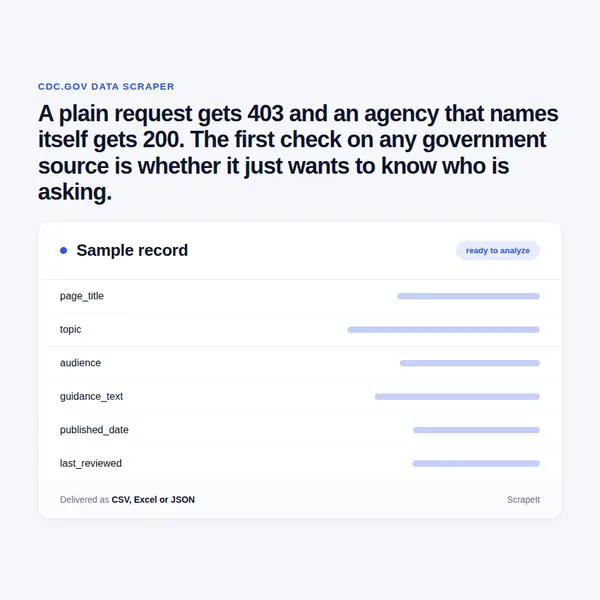
A plain request gets 403 and an agency that names itself gets 200. The first check on any government source is whether it just wants to know who is asking.

CDC Scraper
Solutions

Managed public health data, run end to end by us

ScrapeIt runs the collection as a managed service. You name the topics, indicators or geographies; we use the open data portal where it covers the need, collect and version guidance where it does not, flag suppression and definition breaks, and hand back CSV, JSON, Excel or a push into your warehouse.

We identify our agent the way the site asks and pace politely. That is how the source is meant to be used, not a workaround.

This is public health information published by a federal agency and contains no patient data. It is population guidance rather than individual clinical advice, and if your product touches patient care it needs clinical governance of its own. Your counsel should see the use case before the project starts.

CDC fields in every export

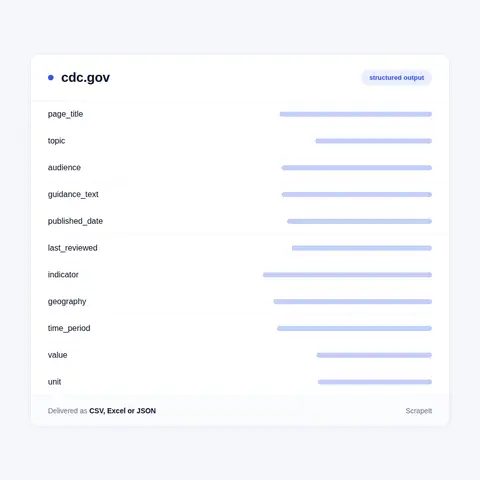
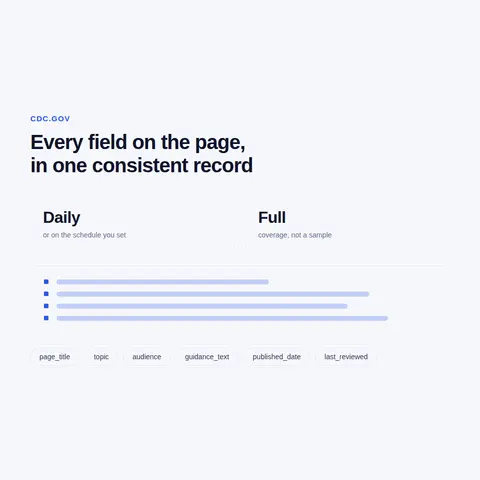
Guidance records carry the page title, topic, audience where stated, the guidance text with its section structure, publication and last-reviewed dates where published, and the address.

The last-reviewed date is treated as a first class field. Public health guidance changes, sometimes quickly, and a recommendation without the date it was last reviewed is a statement with no shelf life attached - which for anything downstream of clinical use is the difference between current advice and historical advice.

Surveillance records carry the indicator, geography, time period, value, unit and any confidence interval or suppression flag as published. Suppression matters: small-count data is frequently withheld for disclosure control, and a pipeline that reads a suppressed cell as zero manufactures a finding.

Provenance is recorded per row - open data portal or page collection - because a mixed pipeline should always be able to say which route a number came by.

Every row carries the collection timestamp.

CDC fields in every export
Guidance change history, suppression and licensing

Guidance change history, suppression and licensing

Guidance change history is the distinctive product. Which recommendations changed, when, and how the wording moved is a question asked by public health researchers, health systems and anyone who had to act on advice that later shifted. It exists only from the point collection began, and we say that plainly rather than implying an archive.

Suppression handling is the quiet quality issue in surveillance work. Suppressed cells carry meaning - the count was below a disclosure threshold - and they must stay distinguishable from zeros and from missing data. Three different states, three different flags.

Definition change tracking matters over multi-year series. Indicator definitions and geography codes are revised, and flagging the break is what stops a methodology change being read as an epidemiological one.

On licensing this source is comparatively simple: US federal government works are generally not subject to copyright. We still check for incorporated third party material rather than assuming, and we say generally rather than always.

Guidance, surveillance and an open data portal

The Centers for Disease Control and Prevention is the US federal public health agency. It publishes clinical and public guidance, disease surveillance data, vaccination coverage, mortality statistics and outbreak information.

Access has a wrinkle worth knowing before anyone writes the source off. A request with a generic browser user agent is refused; the same address with a user agent that identifies the requester is served. We tested it directly and the difference is exactly that. This is the same pattern as other US federal sources and it is a request for identification rather than a barrier.

The second thing to know is that the agency runs an open data portal, and it is substantial. A great deal of what people arrive wanting to scrape is already published there as structured datasets with their own interfaces, and checking that first is part of scoping rather than a nicety.

What the portal does not carry is the guidance content: recommendations, clinical advice and the narrative parts of the site that change as public health advice changes. That is where collection earns its place.

Get a Quote
dev_w
25

Developers

customers
500+

Customers worldwide

pages
1 500 000 000+

Pages extracted

stime
15000+

Hours saved for our clients

Plans

Airplane

€199 / one-time

setup fee - included

Data limits100,000
Frequencyone-time
Run timeup to 5 days
Data storing7 days

Helicopter

€169 / mo

setup fee €499

Data limits250,000
Frequencymonthly
Run timeup to 5 days
Data storing14 days

Glasses

€229 / mo

setup fee €499

Data limits1,000,000
Frequencyweekly
Run timeup to 5 days
Data storing30 days

DNA

€549 / mo

setup fee €799

Data limits3,000,000
Frequency3 times daily
Run timesame day
Data storing90 days

Why guidance needs versions and data needs the portal

Briefs here split cleanly in two, and the halves deserve opposite answers.

Statistical and surveillance requests usually belong on the open data portal. It is published, structured and maintained, and building a crawler to reproduce it is work nobody should pay for. We check it first and say so in the quote.

Guidance is different. It exists as web content, it changes as advice changes, and the historical versions are not published anywhere convenient. A client tracking how a recommendation evolved needs somebody to have been collecting it, and once collection starts every change becomes a record. That is the piece with real value and it is unrecoverable retrospectively.

The third consideration is suppression and comparability in the surveillance data. Counts are suppressed below thresholds, definitions change between reporting years, and geography boundaries are revised. A dataset that ignores those produces trend lines with methodology breaks presented as real movement.

The fourth is that this is a federal agency's public output. It is generally free of copyright restriction, which makes reuse comparatively simple, and it is public health guidance rather than clinical advice for an individual - a distinction we state rather than leave implied.

Our Blog

Reads Our Latest News & Blog

Learn how to use web scraping to solve data problems for your organization

How Artificial Intelligence Is Used In Web Scraping

How Artificial Intelligence Is Used In Web Scraping

Leveraging advances in technology, the AI-powered web scraper has skyrocketed in demand and is helping to expand capabilities by automating tedious daily tasks and speeding up data collection from thousands of websites several times over.

What is Web Scraping and What is it Used For?

What is Web Scraping and What is it Used For?

Web scraping is a method of obtaining web data by extracting it from pages of web resources with the help of a program, that is, in automatic mode. It is used to syntactically convert web pages into more usable forms.

Web Scraping for Machine Learning

Web Scraping for Machine Learning

If you specialize in machine learning, you need to feed large amounts of data to the algorithms. Web scraping is the easiest and the most efficient method of collecting the data from all over the Internet.

scrapeit logo

Who builds and keeps your public health feed

ScrapeIt is a managed extraction company, not a tool you have to learn. Our team builds the pipeline, watches it as page structures and indicator definitions change, and repairs it before a guidance history develops a gap that cannot be filled.

You see a sample first, in your format, over the topics you actually track, with suppression flags and review dates populated so you can judge the handling on real indicators.

FAQ

Why does a normal request get refused?

Because the site wants the requester identified. A generic browser user agent gets 403; a user agent naming who is asking gets 200 on the same address. We tested exactly that. It is the same pattern as other US federal sources and is a request, not a barrier.

Should I use the open data portal instead?

For statistical and surveillance requests, usually yes, and we check first. It is published, structured and maintained. Collection earns its place on the guidance content, which is not in the portal and which changes over time.

Can you show how guidance changed over time?

From the point collection starts, yes, as a change record. Historical versions are not published anywhere convenient, so the history accumulates forward rather than being recoverable - which is exactly why starting matters more than waiting.

How do you handle suppressed counts?

As their own state, distinct from zero and from missing. Small counts are withheld for disclosure control, and a pipeline that reads a suppressed cell as zero manufactures a finding that looks like data.

Can I reuse this content?

Generally yes - US federal government works are typically not subject to copyright. We check for incorporated third party material rather than assuming, and we say generally rather than always because that exception is real.

How does it Work?

Step 1 - Make a Request

You share your needs, expectations, and desired timeframe. We’ll suggest the best solution based on your request and budget.

Step 2 - Configuring Custom Web Crawlers

Our specialists configure the crawlers and extract a sample dataset for your review before proceeding with the full-scale extraction.

Step 3 - Collect and Deliver

Once you approve the sample, we launch the project and start full data collection. We gather, filter, and structure the data for easy use, delivering it on time in your preferred format.

Step 4 - Maintain and Support

Our team manages ongoing processes, monitors website changes, and supports all data extraction cycles. We can also help integrate data into your systems or create dashboards to simplify analysis.

Request a Quote

Tell us more about you and your project information.
Which sites, which fields, how often. A couple of lines is enough.

We reply within 1 business day. No obligation.

scrapiet

Scrapeit Sp. z o.o.
10/208 Legionowa str., 15-099, Bialystok, Poland
NIP: 5423457175
REGON: 523384582