The Ladders Scraper for Executive Jobs and Salary Data

A managed Ladders scraper for the top end of the US and Canada job market: titles, employers, cities, seniority bands and pay, delivered as CSV, JSON, XLSX or an API on your schedule.

The Ladders Scraper
Solutions

How a Managed Ladders Scraper Runs Here

The Ladders scraping pipeline runs here as a managed service. You describe the slice you want - industries, states, employer list, seniority band, pay floor - and we build the crawler, run it and keep it working when the layout moves. The site sits behind a serious protection layer, and dealing with that is part of the job, not an extra: anti-bot handling, proxy rotation and CAPTCHA solving, with pacing that keeps the crawl polite. You do not build or maintain that layer, and nothing behind a login is touched.

Delivery is CSV, JSON, XLSX, a hosted API, or a push straight to S3, Google Sheets, a database or your BI tool. Schedules run hourly, daily, weekly or on demand, deduplicated on the posting id, with changed records flagged and closed adverts kept in your archive after the source drops them. Pricing follows volume and frequency, and the first sample is free so you can inspect the fields before committing.

Fields in a Ladders Job Data Extract

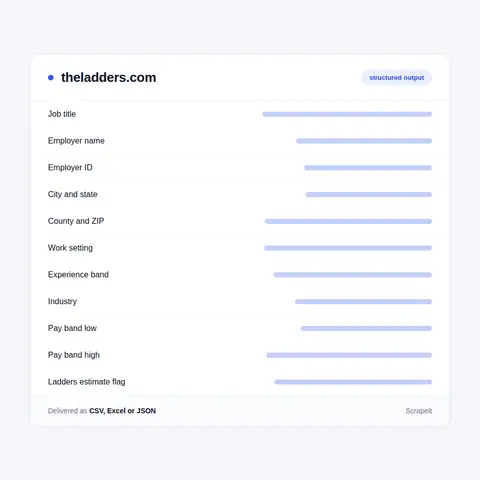
Every advert is keyed on the numeric id closing its address: in /job/senior-engineer-deutschebank-cary-nc_88731668 the digits after the underscore are the record, and the words in front are decoration. Join on the id. We extract Ladders jobs the way your warehouse wants them, and a standard Ladders data feed carries:

  • Posting id, URL and title as published, plus the per-site slug an advert keeps when one role opens in several cities.
  • Employer name and id with directory slug and logo, and a flag for adverts run without a named hirer, where the card prints Company Name instead.
  • Location as city, state, county and ZIP with latitude and longitude, plus the work setting: In-Person, Hybrid or Remote. Fully remote adverts read US-Anywhere.
  • Seniority as the experience band on the card - Less than 5, 5 - 7, 8 - 10 or 11 - 15 years - beside the months of experience the schema declares.
  • Industry as label and internal id: Finance and Insurance, Information Technology, Enterprise Technology, Healthcare, Business Services.
  • Pay as lower and upper band in US dollars a year, with bonus and other-compensation fields and a confidential-pay marker.
  • Estimate flag - a boolean saying whether that band is a Ladders estimate or a figure the employer gave. The most useful field here.
  • Dates - posted timestamp, the repost history behind the Reposted label, the cut-off date, and our first-seen and last-seen stamps.
  • Apply route - whether external apply is allowed and where it points, normally the employer's own ATS: Workday, iCIMS, Greenhouse, Lever or ADP.
  • Description in three shapes - the card summary, the full advert as HTML and plain text, and the generated Job Overview by Ladders split into Qualifications, Responsibilities and Benefits.
  • Employer profile - headcount, founding year, market capitalization, exchange ticker and a five-year trend, beside an employment type that reads full-time on nearly everything.

We collect postings and company profiles. Recruiter names and contacts, and the candidate profiles and resumes behind the employer product, are excluded by default.

Fields in a Ladders Job Data Extract
What a Ladders Salary Figure Means, and How Far the Catalogue Can Be Crawled

What a Ladders Salary Figure Means, and How Far the Catalogue Can Be Crawled

The threshold is positioning, not a hard filter. The site is branded on $100K+ work, but the bands printed on cards tell a softer story. Across the technology, finance, healthcare, sales and remote hubs, bands opening below $100K are common and a real share sit wholly below it - a Boston healthcare seat, for instance, banded from roughly $68K to about $98K. Treat it as a heavy skew toward the upper segment, not a guaranteed floor, and apply your own cut-off if you need one.

The asterisk and the flag are different things. Every figure carries an asterisk pointing at the Ladders Estimates note, and job page metadata calls it an estimated salary even where the employer printed an exact range in the advert. The record underneath carries a boolean saying whether the band was modelled. Keep the flag, drop the asterisk: mixing estimated and stated pay quietly ruins a benchmark.

How the estimate is built. Ladders describes it as an analysis of pay grades across geographies, companies, roles and work details, drawn from more than five million jobs reviewed each year, and says the figure a member sees follows the compensation filter in the search. The salary hub, with an annual average and 25th and 75th percentiles per title, rests on three years of job and member data.

Coverage plan. A role hub pages out at four hundred pages of twenty-five results; keyword search stops near eighty. Coverage comes from slicing - industry by state, employer by employer, title by title - seeded from the job, company and salary sitemaps that robots.txt names.

What The Ladders Publishes, and Why That Is the Point

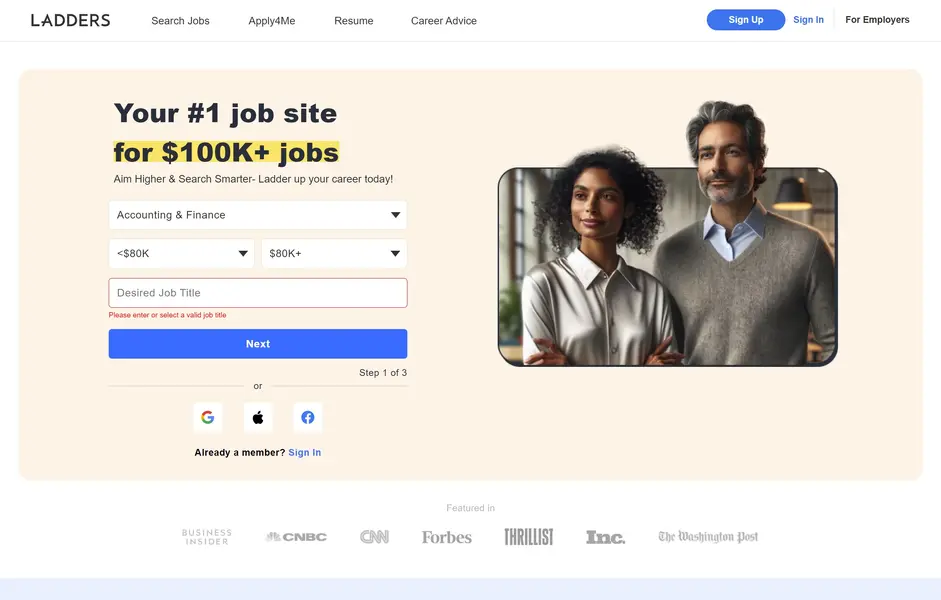
Ladders, at theladders.com, is a US and Canada job board built on an editorial rule rather than on volume: it lists work at the top of the pay scale, not the whole labor market. Every hub repeats the promise - $100K+ jobs, high-paying roles, executive openings - and the guest wall puts the catalogue at about 170,000 curated jobs from roughly 96,000 companies. That rule is why buyers scrape Ladders rather than a horizontal board: the selection is pre-narrowed to senior, salaried, mostly full-time seats. It is also the honest limit of the source. A dataset built here describes the upper segment of hiring, not hiring in general.

The catalogue is cut three ways and each cut has its own address. Role hubs sit under /jobs, from /jobs/technology-jobs and /jobs/finance-jobs through accounting, engineering, healthcare, legal, media, project and program management, sales, human resources, investments, marketing and operations. Geography runs to all fifty states plus the District of Columbia, a top-cities list from New York and Chicago to Plano and St. Paul, and a remote hub where fully distributed adverts carry the location US-Anywhere. Employers get a directory at /company, with pages such as /company/accenture-jobs/jobs grouped into twenty-one industries from aerospace and defense to hospitals and medical centers.

Note where the paywall falls. Premium is sold on one, three, six and twelve month plans, and Apply4Me, resume rewriting and the ATS scanner are seeker services, not data. The job page itself is open: title, employer, city, county, ZIP, work setting, industry, experience band, posted date, pay band and the full advert render without an account. We do not sign in, so member-only features and the recruiter product stay out of scope.

Get a Quote

dev_w
25

Developers

customers
500+

Customers worldwide

pages
1 500 000 000+

Pages extracted

stime
15000+

Hours saved for our clients

Plans

Airplane

€199 / one-time

setup fee - included

Data limits100,000
Frequencyone-time
Run timeup to 5 days
Data storing7 days

Helicopter

€169 / mo

setup fee €499

Data limits250,000
Frequencymonthly
Run timeup to 5 days
Data storing14 days

Glasses

€229 / mo

setup fee €499

Data limits1,000,000
Frequencyweekly
Run timeup to 5 days
Data storing30 days

DNA

€549 / mo

setup fee €799

Data limits3,000,000
Frequency3 times daily
Run timesame day
Data storing90 days

Who Buys Executive Jobs Data and What They Do With It

Executive pay benchmarking. Reward teams and compensation consultancies read advertised bands by title, seniority band and metro, then set a director seat in New York against the same seat in Dallas or Atlanta. Because the board is already filtered to the senior end, the sample needs far less cleaning than a general feed before it can support a benchmark.

Headcount and expansion signals. Counting live adverts per employer, per industry and per state each week shows where a company is building at leadership level. A run of vice president and director seats reads very differently from a run of individual-contributor ones, and the shift shows up here weeks before it reaches a press release.

Search and staffing intelligence. Executive search firms and RPO providers use vacancy tracking to see which competitors hold which mandates, which employers advertise repeatedly for the same seat, and which roles are being reposted rather than filled.

HR-tech go-to-market. The apply link on a record names the employer's applicant tracking system. Rolled up across the catalogue, that turns into an installed-base map: who runs Workday, who runs iCIMS, who moved to Greenhouse, and who is worth a sales call.

Market research and analysts. Equity and private-market researchers, trade press and index builders use the series to put numbers behind hiring trends in the six-figure segment, where demand for senior talent is heating up and where it has gone quiet.

Our Blog

Reads Our Latest News & Blog

Learn how to use web scraping to solve data problems for your organization

How Artificial Intelligence Is Used In Web Scraping

How Artificial Intelligence Is Used In Web Scraping

Leveraging advances in technology, the AI-powered web scraper has skyrocketed in demand and is helping to expand capabilities by automating tedious daily tasks and speeding up data collection from thousands of websites several times over.

What is Web Scraping and What is it Used For?

What is Web Scraping and What is it Used For?

Web scraping is a method of obtaining web data by extracting it from pages of web resources with the help of a program, that is, in automatic mode. It is used to syntactically convert web pages into more usable forms.

Web Scraping for Machine Learning

Web Scraping for Machine Learning

If you specialize in machine learning, you need to feed large amounts of data to the algorithms. Web scraping is the easiest and the most efficient method of collecting the data from all over the Internet.

scrapeit logo

Why Teams Bring This to ScrapeIt

ScrapeIt is a managed web scraping agency. We are not a tool you have to learn, and not a proxy subscription with a support queue bolted on. We take the brief, write the extraction, run the infrastructure and hand back clean, validated data in the format and on the cadence you asked for, with a named engineer when something needs changing.

Tell us the scope and the volume and you get a sample file and a quote, usually inside a working day.

FAQ

Does Ladders have a public API for job data?

No. There is no developer program, no documented endpoint and no key you can request as a data buyer, and the internal JSON paths the site uses for its own front end are disallowed in robots.txt. The employer side at recruit.theladders.com is a paid subscription for posting adverts and searching candidates, not a data feed. That gap is what this service fills: we run the extraction and hand you the Ladders API you wanted, as a hosted endpoint of your own or as CSV, JSON and XLSX files on a schedule.

Is every job on Ladders really $100K or more?

Not by the numbers printed on the cards. The board is positioned on six figure jobs and its help text says so, but pay bands opening below $100K turn up across every major hub, and some adverts sit under the line from top to bottom. The right way to read the source is as a heavy skew toward senior, well-paid work rather than a hard floor. We return the raw lower and upper band on every record so you can apply your own threshold and report exactly how much of your slice clears it.

Is the salary on a Ladders posting the employer's figure or an estimate?

Both appear, and the record tells you which. Ladders stamps an asterisk on every figure and links it to its estimates note, and job page metadata calls the number an estimated salary even when the employer states an exact range in the advert body. Underneath that presentation each posting carries a flag marking whether the band was modelled by Ladders. We keep the flag, the lower and upper bounds, any bonus or other-compensation text, and the confidential-pay marker, so your analysts can separate stated pay from estimated pay before benchmarking.

What can you extract without logging in, and do you touch member data?

Job pages are open to a visitor: title, employer, city, county, ZIP, coordinates, work setting, industry, experience band, posted date, pay band, apply link and the full advert all render without an account, along with the generated overview that splits an advert into qualifications, responsibilities and benefits. We do not create accounts and we do not sign in, so nothing that is Premium-only is collected. Candidate profiles, resumes and recruiter contact details are outside the scope by default.

How do you cover the whole catalogue, and how often can it refresh?

By slicing rather than by walking one list. A role hub stops at four hundred pages of twenty-five results and keyword search stops earlier, so we combine industry, state, city, employer and posted-date slices, seeded from the job, company, category and salary sitemaps, and deduplicate on the numeric posting id. Refreshes run hourly, daily or weekly, whichever the decision needs. Because adverts expire, we stamp first-seen and last-seen on every row and keep closed postings in your history so hiring trends survive after the source removes them.

How does it Work?

Step 1 - Make a Request

You share your needs, expectations, and desired timeframe. We’ll suggest the best solution based on your request and budget.

Step 2 - Configuring Custom Web Crawlers

Our specialists configure the crawlers and extract a sample dataset for your review before proceeding with the full-scale extraction.

Step 3 - Collect and Deliver

Once you approve the sample, we launch the project and start full data collection. We gather, filter, and structure the data for easy use, delivering it on time in your preferred format.

Step 4 - Maintain and Support

Our team manages ongoing processes, monitors website changes, and supports all data extraction cycles. We can also help integrate data into your systems or create dashboards to simplify analysis.

Request a Quote

Tell us more about you and your project information.
Which sites, which fields, how often. A couple of lines is enough.

We reply within 1 business day. No obligation.

scrapiet

Scrapeit Sp. z o.o.
10/208 Legionowa str., 15-099, Bialystok, Poland
NIP: 5423457175
REGON: 523384582