Upwork Scraper for Job Posts, Budgets and Client History

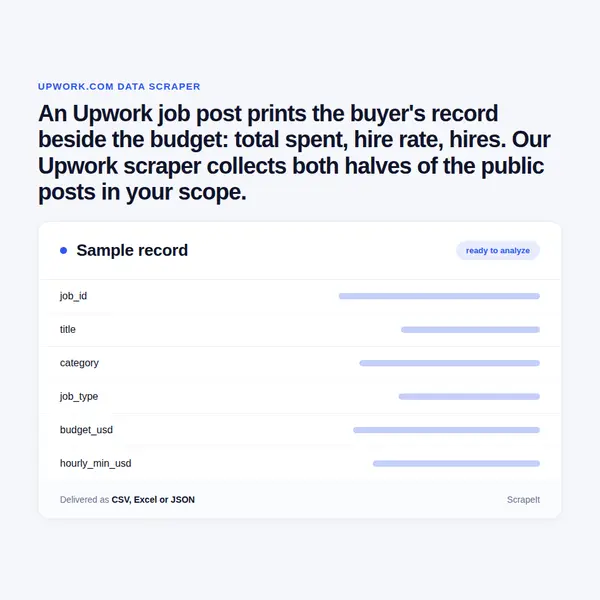
An Upwork job post prints the buyer's record beside the budget: total spent, hire rate, hires. Our Upwork scraper collects both halves of the public posts in your scope.

Plans from €169/month · Free project assessment · Reply within 1 business day

Upwork Scraper
Solutions

How Our Upwork Job Scraper Service Works

Tell us which part of the freelance market you watch - a list of skills, categories such as Web Development or Digital Marketing, a client country, a budget floor - and how often you need it. We write the crawler, operate it and keep it working when Upwork changes its pages. You receive rows, not a tool to run yourself.

Upwork places a browser challenge in front of its job pages, so rendering, pacing, proxy rotation and CAPTCHA handling are included. We read only what an anonymous visitor is shown: no account, no Connects, no proposals sent. The first step is a free assessment of your scope, and a sample of real posts can be ordered before the first full run.

What the Upwork Data Scraper Reads on a Job Post

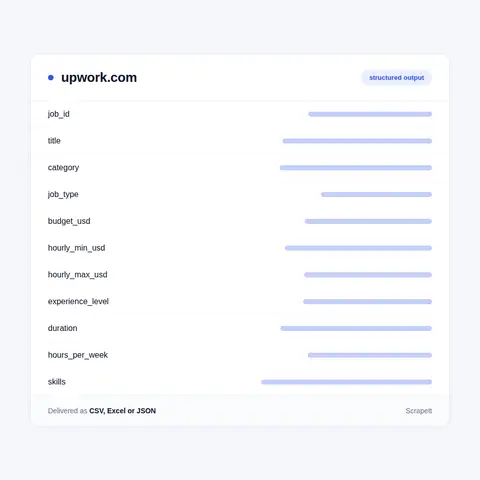
Every public post has an address under /freelance-jobs/apply/ that ends in a tilde and the job id. The id, not the title slug in front of it, is the key of the row. From the post we return:

  • Identity - job id, URL, title, the category the post is filed under (Web Development, Virtual Assistance, Mobile Development and so on) and the posted date.
  • Price - the job type, Hourly or Fixed-price; the budget of a fixed-price post; the hourly rate range of an hourly post with its low and high end. Amounts are in USD.
  • Scope - hours per week (Less than 30 hrs/week, More than 30 hrs/week or Not Sure), duration in the platform's own bands from Less than 1 month to More than 6 months, project type (One-time project or Ongoing project) and the Contract to Hire flag.
  • Requirements - experience level (Entry, Intermediate or Expert), the skills listed under Skills and Expertise, and whether it is a Remote Job.
  • Description - the full text the client wrote.
  • Activity on this job - Proposals as a range such as Less than 5 or 5 to 10, Last viewed by client, Hires, Interviewing, Invites sent and Unanswered invites.
  • About the client - country, city, Member since date, jobs posted, hire rate, open jobs, total spent, hires and how many are active, average hourly rate paid, hours of work, industry and company size where the client gave them, plus the rating and the number of reviews.

The client block is what separates Upwork from an ordinary job board. The buyer stays unnamed, yet the purchasing record is printed next to the budget. It matters because a budget is whatever the client typed: a fixed price of a few dollars beside an Expert requirement reads more like a placeholder than a market rate. With the block delivered as columns, such a post can be read against a client history of many hires and a high average rate - or against none at all.

What the Upwork Data Scraper Reads on a Job Post
Skill Pages, Activity Counters and an Upwork Jobs Dataset

Skill Pages, Activity Counters and an Upwork Jobs Dataset

Posts are discovered through the public browse pages. Each skill has a page under /freelance-jobs/ with the open listings for it, and many skills have city variants - the same skill near New York or Los Angeles. A card repeats the core of the post: Hourly or Fixed-price, the posted or renewed time, the budget or the hours needed, duration, experience level and an excerpt behind a See more link. We crawl the skill pages you choose, remove duplicates by job id - one post can sit under several skills - and open each post for the full record.

The second dimension is time. Activity on this job is a live block: the Proposals range climbs, Interviewing and Invites sent move, Hires goes from nothing to one, and Last viewed by client says whether the buyer is still there. Repeated runs store each observed state with a timestamp, so an Upwork jobs dataset shows how fast a post drew proposals and whether it ended in a hire. Skill pages show current openings, so a post that is filled or withdrawn drops off them; the last state we recorded stays in your history.

Two blocks under a post - Other open jobs by this Client and Explore similar jobs on Upwork - give the crawl further addresses, and the first ties several posts to one unnamed buyer.

About Upwork and Its Public Job Pages

Upwork calls itself a work marketplace: clients post jobs, freelancers and agencies answer with proposals, and contracts and payments run through the platform. The company grew out of the merger of Elance and oDesk, took the Upwork name afterwards, and trades on Nasdaq as UPWK.

For a data buyer the line that matters runs between public and private. Job posts are public unless the client chooses otherwise, and so are the browse pages that group them by skill and by place. A job the client limits to Upwork members or to invited freelancers never reaches the open pages. Proposals, messages and the identity of whoever was hired belong to signed-in members, and freelancer profiles are the personal pages of individual people.

What makes the public post useful is its vocabulary. Budgets come in two kinds, hourly and fixed-price. Duration and weekly hours are picked from fixed bands, experience level has three values, and competition is shown as a proposals range instead of an exact count. Because clients pick these values from fixed lists, posts from different categories and different months can be compared as they stand, and money is quoted in US dollars whatever the client's country.

Get a Quote

dev_w
25

Developers

customers
500+

Customers worldwide

pages
1 500 000 000+

Pages extracted

stime
15000+

Hours saved for our clients

Plans

Upwork Scraping Plans and Pricing

Airplane

€199 / one-time

setup fee - included

Data limits100,000
Frequencyone-time
Run timeup to 5 days
Data storing7 days

Helicopter

€169 / mo

setup fee €499

Data limits250,000
Frequencymonthly
Run timeup to 5 days
Data storing14 days

Glasses

€229 / mo

setup fee €499

Data limits1,000,000
Frequencyweekly
Run timeup to 5 days
Data storing30 days

DNA

€549 / mo

setup fee €799

Data limits3,000,000
Frequency3 times daily
Run timesame day
Data storing90 days

Delivery: CSV, JSON or XLSX files, our API or a JSON feed. MCP server on request.

Full plan details →

Why Scrape Upwork Jobs

A job post on Upwork is a priced request from a buyer with a visible track record, which makes the feed a live survey of what freelance work costs and who pays for it.

  • Rate benchmarks. Hourly ranges and budgets by skill, experience level and client country show what the market offers an Expert against an Intermediate - input for agencies, staffing firms and anyone setting contractor rates.
  • Demand by skill. New posts per skill per week show which tools and specialisations are rising, long before a salary survey catches them. Training providers and software vendors read it as a leading indicator.
  • Buyer quality. Total spent, hire rate and average hourly rate paid split the feed into proven buyers and first-timers, so a segment can be sized by serious demand only.
  • Competition and speed. The proposals range and the time between posting and the first hire measure how crowded a category is.
  • Product research. Descriptions name the platforms clients struggle with, which tells a software company where integrations and services are in demand.

The post does not name the client, so this is market intelligence, not a contact list.

Our Blog

Reads Our Latest News & Blog

Learn how to use web scraping to solve data problems for your organization

How Artificial Intelligence Is Used In Web Scraping

How Artificial Intelligence Is Used In Web Scraping

Leveraging advances in technology, the AI-powered web scraper has skyrocketed in demand and is helping to expand capabilities by automating tedious daily tasks and speeding up data collection from thousands of websites several times over.

What is Web Scraping and What is it Used For?

What is Web Scraping and What is it Used For?

Web scraping is a method of obtaining web data by extracting it from pages of web resources with the help of a program, that is, in automatic mode. It is used to syntactically convert web pages into more usable forms.

Web Scraping for Machine Learning

Web Scraping for Machine Learning

If you specialize in machine learning, you need to feed large amounts of data to the algorithms. Web scraping is the easiest and the most efficient method of collecting the data from all over the Internet.

scrapeit logo

About ScrapeIt

ScrapeIt builds and runs crawlers as a managed service and hands over the result as a dataset with field documentation. Job boards are a steady part of that work, and Upwork is the one where a post carries a price and a buyer's record instead of a salary and an employer name. We collect job posts and public market data only: nothing from behind the sign-in, and no lists or dossiers of freelancers. Runs are one-off or on the schedule you set - daily, weekly or on demand.

FAQ

Do you offer an Upwork API for job post data?

Yes. The ScrapeIt Upwork API returns job id, title, category, job type, budget or hourly range, experience level, skills, the proposals range and the client block as JSON from an endpoint we host, refreshed on the schedule you set. Those rows can also arrive as CSV or Excel files, as a JSON feed or as a load into your database.

Is it legal to scrape Upwork?

Yes. Public job posts with their budgets, skills, activity counters and the unnamed client record are open to any visitor without an account. We collect only publicly available data - everything a visitor can see on Upwork - and we collect it legally. We never log in, and freelancer profiles are left out by default.

Are Upwork prices in USD on every job post?

Yes. Fixed-price budgets, hourly rate ranges, total spent and the average hourly rate a client has paid are all quoted in US dollars, wherever the client is based. We store amounts as numbers with a currency column and keep the low and the high end of an hourly range in separate fields.

Does Upwork scraping include freelancer profiles?

No. The service covers job posts and the market data printed on them; freelancer profiles are personal data, and we do not sell lists or dossiers of freelancers. The client block on a post is a different matter: it carries no name, only location, spending and hiring figures, so it stays in the dataset.

How often should Upwork job posts be collected?

Daily is the sensible minimum. A post is short-lived: the Proposals range fills up, Interviewing and Hires change, and once the job is filled or withdrawn it drops off the skill pages. A daily run catches the post while it is open and stores the activity counters with a timestamp at every pass.

How does it Work?

Step 1 - Make a Request

You share your needs, expectations, and desired timeframe. We’ll suggest the best solution based on your request and budget.

Step 2 - Configuring Custom Web Crawlers

Our specialists configure the crawlers and extract a sample dataset for your review before proceeding with the full-scale extraction.

Step 3 - Collect and Deliver

Once you approve the sample, we launch the project and start full data collection. We gather, filter, and structure the data for easy use, delivering it on time in your preferred format.

Step 4 - Maintain and Support

Our team manages ongoing processes, monitors website changes, and supports all data extraction cycles. We can also help integrate data into your systems or create dashboards to simplify analysis.

Request a Quote

Tell us more about you and your project information.
Which sites, which fields, how often. A couple of lines is enough.

We reply within 1 business day. No obligation.

Upwork data from €169/month. Free project assessment, reply within 1 business day.

scrapiet

Scrapeit Sp. z o.o.
10/208 Legionowa str., 15-099, Bialystok, Poland
NIP: 5423457175
REGON: 523384582