Toptal Scraper - Extract Public Toptal Data at Scale

Toptal is a screened network: no public gig board, no published freelancer rates. We collect what the site does publish, clean it and deliver it on your schedule.

Toptal Scraper
Solutions

How delivery works

Data arrives in whatever your team already uses: CSV, JSON, XLSX, a direct database load, or an API endpoint we host. Schedules run hourly, daily, weekly or monthly, and a single snapshot is fine when that is all the question needs.

Every run is validated before it reaches you - schema checks, a row count comparison against the previous run, deduplication on canonical URL, and an alert when a field starts coming back empty. Toptal reworks its templates like any large site does; when that happens we repair the extractor and the repair is included, not raised as a change request.

Scope is fixed up front: which page types, which verticals, which fields, which geographies, and how often. You get a sample before the full run, so nothing is a surprise at invoice time.

Toptal data we can extract

A Toptal collection is defined page type by page type. Each public template carries a different slice.

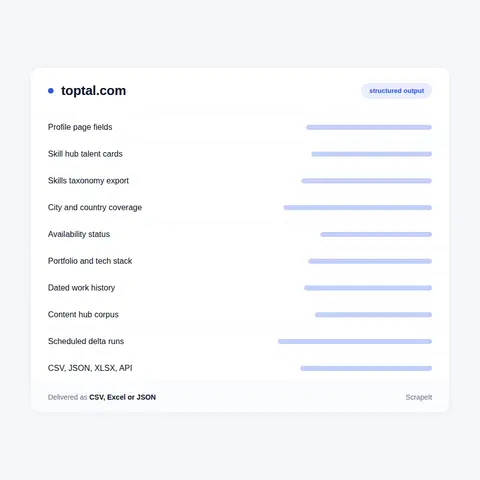
  • Public profile pages - the largest public set on the site, one readable slug per person under the resume path. A page carries a role title, a verified-expert vertical label, a city and country, a member-since date, an availability line, a bio, a skills tag list, portfolio entries with their tech stacks, per-skill years of experience, a preferred environment note, dated work history with employers and technologies, and education and certifications. No hourly rate appears on any of them.
  • Skill hub pages - one page per skill per vertical, with positioning copy, a related-skills block, talent cards, client testimonials carrying job title and company, and an average client rating with a review count for that skill.
  • The published skills taxonomy - the per-vertical skill lists themselves, which are the cleanest read available on how this talent marketplace segments engineering, design, finance, marketing, product, project management, sales, coaching and operations.
  • Skill by city pages - the geographic cut of the same talent pool, built as skill plus country plus city, useful for reading where a network says it has contractor supply for remote engineering and design work.
  • Content hubs - blog articles, case studies, insights pieces, interview question sets, job description templates, community pages and the services section, with titles, categories, bylines where shown, body copy and internal links.
  • Structural fields - canonical URL, slug, breadcrumb path, page title, meta description and any embedded structured data, so rows stay joinable between runs and nothing silently duplicates.

Because slugs are readable and stable, the same page is trackable across runs. We record state as well as content: which skill hubs appear and disappear, how the taxonomy grows, how geographic coverage shifts, how availability lines change. For most buyers the deltas beat a single snapshot.

Toptal data we can extract
What Toptal scraping can and cannot deliver

What Toptal scraping can and cannot deliver

Anti-bot work is part of the service. Toptal sits behind a commercial edge network, and a request that does not present itself as a real browser is refused outright. Sustained scraping needs proxy rotation, browser-like sessions, CAPTCHA solving where it appears, pacing that does not hammer the origin, and adaptive crawling when a template changes. We run that layer and keep it running. Your team does not maintain it and there is no separate proxy bill. We promise no perfection - protections change and a run can degrade - so we monitor, re-run and tell you when a field stops resolving. We do not sign in, and we collect nothing that sits behind an account.

Personal data, stated plainly. A public Toptal talent page describes a named individual. We do not build person-level records and we do not produce ranked talent lists for recruitment. Names, photographs and any contact route are excluded by default. What we deliver is aggregated or structural: counts by skill, city and vertical, taxonomy exports, page inventories and content corpora. Many of the people described are in the EU, so the GDPR applies to any person-level use of this material; that is a question for your own counsel, and our default is exclusion rather than a checkbox. If a lawful, documented purpose genuinely requires person-level fields, it has to be agreed in writing before we build anything.

What Toptal actually publishes without an account

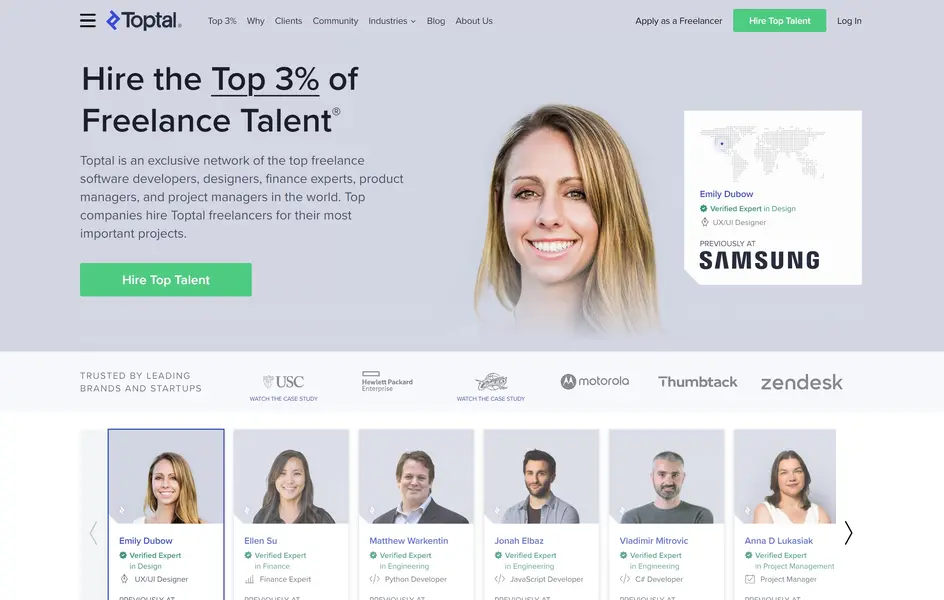
Toptal is a screened freelance talent network covering software engineering, design, finance and management consulting, product and project management, marketing, sales and operations. It is not an open talent marketplace. Clients do not post a brief and collect bids, and freelancers do not compete on price in public. Toptal screens applicants, then its own matchers put a shortlist in front of a client, so the commercial layer - who was matched with whom, at what hourly rate, on what terms - sits entirely behind an account.

That closed model decides what a Toptal scraper can and cannot collect, and it is worth being blunt about it before anything else. There is no public board of open client projects to browse. The sections that read like a job board are recruiting landing pages aimed at freelancers who want to join, organised by skill, and the developer jobs directory is an index of those category pages rather than a list of live engagements. Toptal also publishes its own corporate vacancies in a small careers section; those are roles at the company itself, not client work.

What Toptal does publish, and publishes generously, is a large public talent library plus a deep set of content hubs. Public profile pages, skill hubs across every vertical, city and country pages, hiring guides, interview question sets, job description templates, case studies, an insights section and a long-running blog are all readable without signing in. That is the material a scrape of Toptal can legitimately return, and it is enough to answer real questions about contractor supply and the skills taxonomy of a talent marketplace.

Get a Quote
dev_w
25

Developers

customers
500+

Customers worldwide

pages
1 500 000 000+

Pages extracted

stime
15000+

Hours saved for our clients

Plans

Airplane

€199 / one-time

setup fee - included

Data limits100,000
Frequencyone-time
Run timeup to 5 days
Data storing7 days

Helicopter

€169 / mo

setup fee €499

Data limits250,000
Frequencymonthly
Run timeup to 5 days
Data storing14 days

Glasses

€229 / mo

setup fee €499

Data limits1,000,000
Frequencyweekly
Run timeup to 5 days
Data storing30 days

DNA

€549 / mo

setup fee €799

Data limits3,000,000
Frequency3 times daily
Run timesame day
Data storing90 days

Why buyers scrape Toptal

Requests for Toptal data cluster around a few concrete jobs.

Talent supply mapping. Skill hubs and location pages describe where a screened network claims contractor supply and in which disciplines. Aggregated by skill and country, that is a usable read on a remote engineering and design talent pool that is otherwise invisible.

Skills taxonomy work. Toptal maintains a long published skill list per vertical. Recruiters, HR tech teams and marketplace operators use a taxonomy like this to normalise their own tags, find categories they do not cover, and watch which technologies get promoted to a page of their own.

Recruitment market intelligence. Which skills a talent marketplace invests pages in, how quickly that set changes and which verticals it pushes are signals about where it sees demand. That is competitor hiring research at the category level, not the person level.

Content and SEO benchmarking. Hiring guides, interview question sets, job description templates and case studies form a large, well-structured corpus. Teams building competing content use it to size a gap before commissioning anything.

One caution, stated here rather than buried: if the project is hourly rate benchmarking, this source will not carry it. Toptal publishes no rate against any named freelancer, and we will point at sources that do carry price signals instead.

Our Blog

Reads Our Latest News & Blog

Learn how to use web scraping to solve data problems for your organization

How Artificial Intelligence Is Used In Web Scraping

How Artificial Intelligence Is Used In Web Scraping

Leveraging advances in technology, the AI-powered web scraper has skyrocketed in demand and is helping to expand capabilities by automating tedious daily tasks and speeding up data collection from thousands of websites several times over.

What is Web Scraping and What is it Used For?

What is Web Scraping and What is it Used For?

Web scraping is a method of obtaining web data by extracting it from pages of web resources with the help of a program, that is, in automatic mode. It is used to syntactically convert web pages into more usable forms.

Web Scraping for Machine Learning

Web Scraping for Machine Learning

If you specialize in machine learning, you need to feed large amounts of data to the algorithms. Web scraping is the easiest and the most efficient method of collecting the data from all over the Internet.

scrapeit logo

About ScrapeIt

ScrapeIt is a managed web scraping agency. We build the crawlers, run them on our own infrastructure and hand over clean, validated data on your schedule. There is nothing for your team to deploy, no proxy estate to manage and no scraper to babysit.

We scope honestly. When a source does not publish what a buyer is hoping for, we say so before any money changes hands, and we point at a source that does.

FAQ

Does Toptal have a public API I can pull data from?

No. Toptal publishes no public data API for buyers. The obvious guess at an API entry point simply redirects to a marketing page about hiring API developers, and the site robots file disallows its internal API paths. Whatever a client or a freelancer uses inside the platform requires an account. Public collection therefore has to come from rendered pages, which is exactly what our Toptal scraper does - and we do not sign in to reach anything else.

Can you scrape Toptal rates or freelancer prices?

No, because they are not published. Toptal does not show an hourly rate against a named freelancer anywhere on its public site, and there are no public bids or project budgets because the network does not run open bidding. Any pricing language on the site is general marketing copy, not a rate card per person. If hourly rate benchmarking is the actual goal, tell us and we will scope sources that do carry observable price signals rather than sell you a Toptal rates dataset that does not exist.

What can you extract from Toptal without logging in?

Public talent pages under the resume path, skill hub pages across every vertical, city and country pages, and the content hubs - blog, case studies, insights, interview questions, job description templates, community and services. Profile pages carry role, location, member-since date, skills, bio, portfolio entries, years of experience per skill, dated work history and certifications. Skill hubs carry positioning copy, related skills, talent cards and an average client rating with a review count. Counts across these sections move as the site publishes, so we re-read the sitemaps on every run instead of working from a fixed list.

Do you collect freelancer names and personal details, and is this legal?

Names, photographs and contact routes are excluded by default, and we do not build person-level records or ranked talent lists for recruitment. Our output is aggregated or structural. Many of the individuals described on these pages are in the EU, so the GDPR governs person-level use; that is a matter for your own legal counsel, and we set the default to exclusion. We collect only pages that anyone can open without an account, we never sign in, and we have no partnership or affiliation with Toptal. Responsibility for how the delivered data is used remains with you.

How do you handle Toptal bot protection, and how do I receive the data?

Proxy rotation, browser-like sessions, CAPTCHA solving where it appears, request pacing and adaptive crawling are all included, and your team maintains none of it. We make no perfection claim: edge protections change, and when a run degrades we monitor it, re-run it and tell you. Delivery is CSV, JSON, XLSX, a database load or a hosted API, on an hourly, daily, weekly or monthly schedule, with schema validation and row count checks on every run.

How does it Work?

Step 1 - Make a Request

You share your needs, expectations, and desired timeframe. We’ll suggest the best solution based on your request and budget.

Step 2 - Configuring Custom Web Crawlers

Our specialists configure the crawlers and extract a sample dataset for your review before proceeding with the full-scale extraction.

Step 3 - Collect and Deliver

Once you approve the sample, we launch the project and start full data collection. We gather, filter, and structure the data for easy use, delivering it on time in your preferred format.

Step 4 - Maintain and Support

Our team manages ongoing processes, monitors website changes, and supports all data extraction cycles. We can also help integrate data into your systems or create dashboards to simplify analysis.

Request a Quote

Tell us more about you and your project information.
Which sites, which fields, how often. A couple of lines is enough.

We reply within 1 business day. No obligation.

scrapiet

Scrapeit Sp. z o.o.
10/208 Legionowa str., 15-099, Bialystok, Poland
NIP: 5423457175
REGON: 523384582