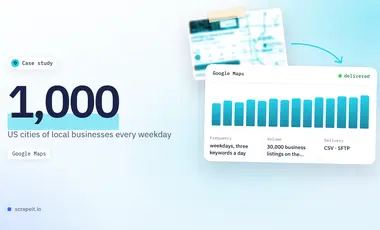
Google Maps Data: Local Businesses from 1,000 US Cities Every Weekday
A weekday feed of local businesses from Google Maps for a local-marketing company: 1,000 US cities, three keywords a day, files by 10:00 UTC.
Justdial splits every Indian city into localities and every trade into its own category page. Our Justdial scraper turns those pages into one business table.
Plans from €169 a month · Free project assessment · Reply within 1 business day
CSV · Excel · JSON · XML · FTP · SFTP · Amazon S3 · Google Cloud
API, JSON feed or CSV, XLSX and JSON files
ScheduleOne-time, monthly, weekly, daily or 3 times a day
Justdial pages, filters, fields and a schedule
Built, monitored and repaired by our team
API, JSON feed or CSV, XLSX and JSON files
You tell us which cities, localities and categories matter - dentists across Mumbai, plumbers in Pune, every restaurant in Bandra West - and we run the crawl for you. How to scrape data from Justdial without counting a business twice is the part we solve: a category page carries an nct- code, a business page ends in its own document id, and one clinic can sit on many category pages at once, so we keep one row per document id and record every category that listed it. Pacing, proxy rotation, CAPTCHA handling and page rendering are included. Runs are one-off or on the schedule you set, and field documentation ships with every delivery. A free project assessment comes first, and you can order a sample from the cities you name.
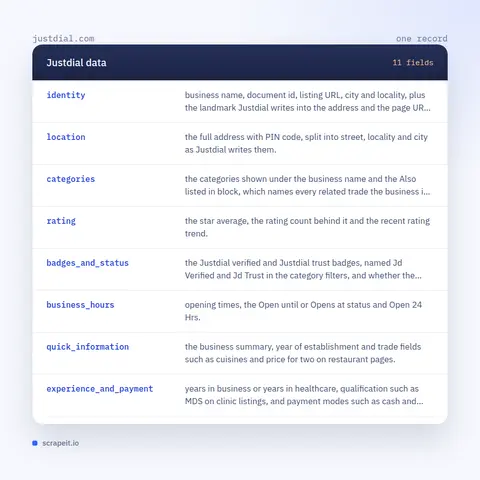
A Justdial business page is built from a fixed set of blocks, and the scraper reads each one into its own columns. The document id at the end of the page address is the key: it stays the same when a business moves up or down a category page, so runs line up row by row.
Fields differ by trade. A dental clinic page carries qualifications and treatments, a restaurant page carries price for two and cuisines such as North Indian or Multicuisine, so the dataset keeps a shared core of columns and adds trade columns only where Justdial fills them.
Most projects start from category pages rather than single businesses. Justdial builds them for a whole city (Dentists in Mumbai) and for a locality inside it (Dentists in Andheri West), and narrower categories split a trade by price band or specialty, such as Moderate Restaurants or Orthodontist Doctors. Category pages can be filtered by Jd Verified, Jd Trust, Top Rated or Open Now, and the order of each list goes into a position column.
Reviewer names and profile photos are personal data under GDPR, so we leave them out by default and deliver the review text with its score and date.
Justdial is India's local search directory, founded in 1996 by V. S. S. Mani and headquartered in Mumbai; Reliance Retail took a controlling stake in 2021. It began as a phone enquiry service and now runs as a website and apps, with local listings for cities across India.
The site is organised by city first. Every address opens with a city segment - /Mumbai/, /Pune/ - followed by a category or a business. Categories are fine-grained: Dentists, Dental Surgeons and Orthodontist Doctors are separate pages, and so are Plumbers and Waterproofing Contractors. A business can appear in many of them at once, and the Also listed in block on its page shows where.
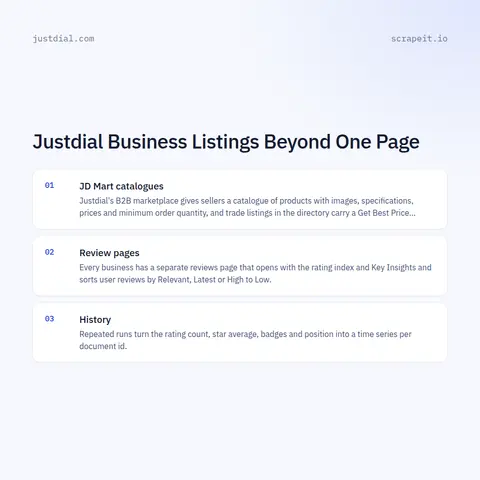
Any business can add a free listing and claim it, so a page shows either Claimed or Claim this business. The star rating is Justdial's rating index, built from ratings across the web, and sits beside the Jd Verified and Jd Trust badges. Next to the local directory, JD Mart runs a B2B marketplace where sellers publish product catalogues with prices and minimum order quantities.
Delivery: CSV, JSON or XLSX files, our API or a JSON feed. MCP server on request.
Full plan detailsJustdial lists businesses down to the locality, so its data answers questions about local Indian markets that national sources leave open.
All of these rest on the same document id, so a list built for one purpose can be refreshed for another without matching businesses again.
Learn how to use web scraping to solve data problems for your organization
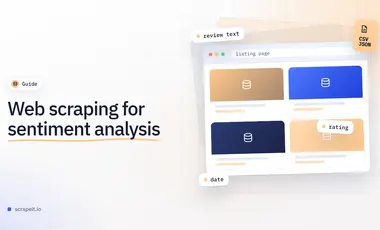
Where opinion text lives on the public web, what a review record contains on each kind of site, which fields a model needs besides the text, and what quietly breaks a sentiment dataset - with examples from our own projects.
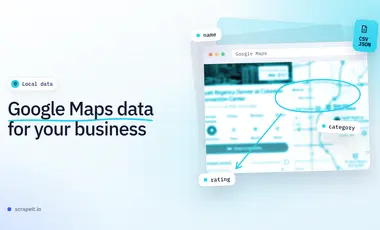
Using web scraping to extract Google Maps data will help you quickly and efficiently find businesses in any industry, city, state, or region. And the extracted contact information, such as phone or email address, social networks, or links to web pages, will help to contact them.
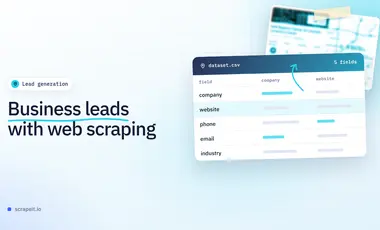
Lead scraping is a reliable way to get the right customer contacts to market your product, saves organizations time, and helps you better understand the audience you want to attract. Contacts include emails, phone numbers, or social media profiles.

ScrapeIt is a managed web scraping company: we build, run and repair the crawlers and deliver the dataset. For Justdial that means coverage plans worked out city by city, document-id deduplication across overlapping category pages and trade-specific columns described in the field documentation. Files arrive as CSV, Excel or JSON, through our API, by SFTP or as a load into your database. Plans start from EUR 169 a month, or EUR 199 for a one-time extract.
Still unsure? Write to info@scrapeit.io
Yes. The ScrapeIt Justdial API returns business name, document id, address with locality, categories, rating, rating count and verification badges as JSON from an endpoint we host, refreshed on the schedule you set. The same records also come as CSV or XLSX files, a JSON feed or a load into your database.
Yes. Business names, addresses, categories, hours, ratings and badges are shown on every listing without signing in. We collect only publicly available data - everything a visitor can see on Justdial - and we collect it legally. Reviewer names stay out of the dataset by default, and personal data is handled under GDPR.
Yes, and it is built to your scope rather than taken off a shelf. We crawl the category pages of each city and locality you name and merge businesses that appear under several categories on their document id. For a state we work through its cities one by one and keep a city column so the file can be split again.
Monthly is enough for addresses, hours and categories, which rarely change. Rating counts, badges and the rank order on category pages move faster, so reputation and placement projects usually run weekly. Each run keeps the document id, so the changes line up as a history per business.
Yes. JD Mart catalogue pages give products with images, specifications, prices and minimum order quantity, and we export them as a product table linked to the seller's business record. The directory file and the JD Mart file can come in one delivery, joined on the seller's document id.
You share your needs, expectations, and desired timeframe. We'll suggest the best solution based on your request and budget.
Our specialists configure the crawlers and extract a sample dataset for your review before proceeding with the full-scale extraction.
Once you approve the sample, we launch the project and start full data collection. We gather, filter, and structure the data for easy use, delivering it on time in your preferred format.
Our team manages ongoing processes, monitors website changes, and supports all data extraction cycles. We can also help integrate data into your systems or create dashboards to simplify analysis.
Tell us which sites, which fields and how often. A couple of lines is enough to start.
Justdial data from €169/month. Free project assessment, reply within 1 business day.