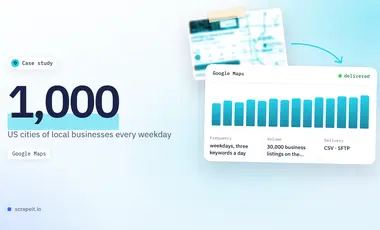
Google Maps Data: Local Businesses from 1,000 US Cities Every Weekday
A weekday feed of local businesses from Google Maps for a local-marketing company: 1,000 US cities, three keywords a day, files by 10:00 UTC.
Crunchbase shows part of every company profile to anonymous visitors and masks the rest. Our Crunchbase scraper collects the open part: industries, status, rounds, investors.
Plans from €169 a month · Free project assessment · Reply within 1 business day
CSV · Excel · JSON · XML · FTP · SFTP · Amazon S3 · Google Cloud
API, JSON feed or CSV, XLSX and JSON files
ScheduleOne-time, monthly, weekly, daily or 3 times a day
Crunchbase pages, filters, fields and a schedule
Built, monitored and repaired by our team
API, JSON feed or CSV, XLSX and JSON files
You name the scope and we deliver the table. A scope can be a list of company names or domains to match against Crunchbase permalinks, a set of hubs - an industry, a region, a founding year - or the funding rounds of companies you already follow. We build the crawler, run it once or on your schedule, and repair it when the profile layout changes.
Crunchbase puts a session check in front of its profiles, so pacing, proxy rotation, rendering and CAPTCHA handling are part of the service. We never log in and never go behind the paywall: a value the site masks for anonymous visitors arrives as an empty, flagged cell, and the field documentation says which columns that can affect.
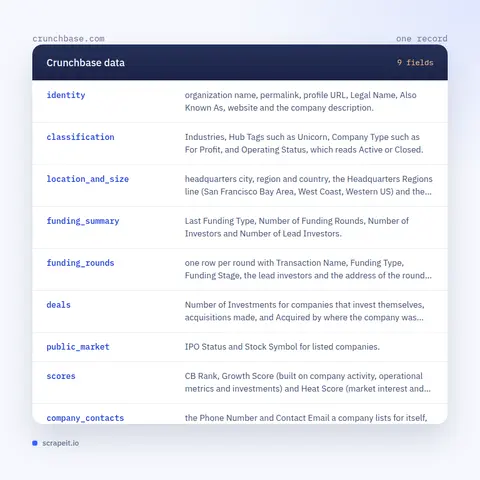
A company lives at /organization/ plus a permalink - a slug of its name, with a short suffix where two companies share one. The permalink is the key of every row. From the open part of the profile we return:
Not every cell is readable. For visitors who are not signed in Crunchbase masks part of the financial detail - typically the Money Raised of a round, the Total Funding Amount and a round's Announced Date, and on some profiles the Founded Date as well. We deliver what the page shows: a masked value becomes an empty cell with a flag, so an analyst can tell a figure that was never disclosed from one that was not visible. Founders, team members and investors who are private individuals are people, not company fields, and are left out by default.
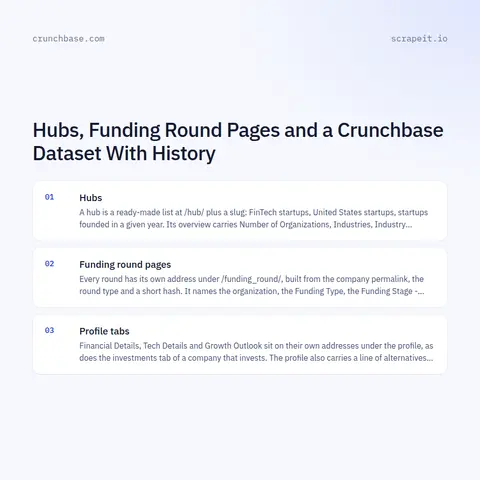
Company profiles are one of three public page types worth collecting.
A Crunchbase dataset earns its keep on the second run. Repeated passes record when Operating Status flips to Closed, when Last Funding Type moves from Seed to Series A, when a new round joins the list and how the scores drift from quarter to quarter - a history the site shows only as today's state.
Crunchbase is a company database: organizations, the investors behind them and the deals that connect the two. It began as the startup database of the technology news site TechCrunch, later became an independent company based in San Francisco, and now presents itself as a platform for business intelligence on private and public companies, used by sales teams, investors and analysts.
Three things about its structure matter to a data buyer. First, everything is an entity with its own address - organizations, funding rounds, acquisitions, hubs - and an investor is an organization too, so a venture firm has the same kind of profile as the startups it backs. Second, the vocabulary is closed. Funding Type runs from Pre-Seed and Seed through the lettered series to Venture - Series Unknown, Private Equity, Debt Financing and Secondary Market, and Funding Stage groups those into a handful of stages. Closed lists mean the columns filter without cleaning.
Third, the site has two layers. The public layer shows the skeleton of each profile and most of its descriptive fields; the rest is kept for signed-in accounts. This page, like our service, deals with the first layer only.
Delivery: CSV, JSON or XLSX files, our API or a JSON feed. MCP server on request.
Full plan detailsCrunchbase is where a company's category, stage and backers are written down in one place and in one vocabulary. Teams collect it for work that needs many companies at once:
Learn how to use web scraping to solve data problems for your organization

Where opinion text lives on the public web, what a review record contains on each kind of site, which fields a model needs besides the text, and what quietly breaks a sentiment dataset - with examples from our own projects.
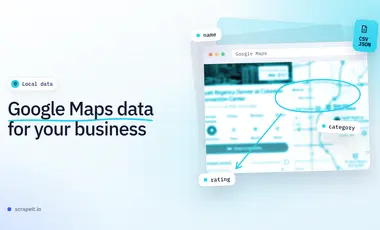
Using web scraping to extract Google Maps data will help you quickly and efficiently find businesses in any industry, city, state, or region. And the extracted contact information, such as phone or email address, social networks, or links to web pages, will help to contact them.
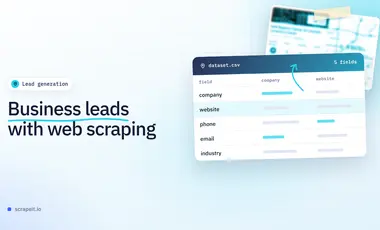
Lead scraping is a reliable way to get the right customer contacts to market your product, saves organizations time, and helps you better understand the audience you want to attract. Contacts include emails, phone numbers, or social media profiles.

ScrapeIt is a web scraping agency that works as a managed service: you describe the company data you need, and we build, run and repair the crawlers that deliver it. Company directories like Crunchbase are their own kind of job - entity pages that link to each other, closed vocabularies, and a public layer that ends where the sign-in begins. We work inside that public layer, document every field, and handle personal data under GDPR. We assess a project for free, and a sample of real profiles can be ordered ahead of the full run. Plans start from EUR 169 a month, or EUR 199 for a one-time extract.
Still unsure? Write to info@scrapeit.io
Yes. The ScrapeIt Crunchbase API returns the permalink, Legal Name, Industries, Operating Status, Last Funding Type and the list of funding rounds as JSON from an endpoint we host, refreshed on the schedule you set. The same data also comes as CSV or XLSX files, a JSON feed or straight into your database.
Yes. Company names, descriptions, industries, headquarters, operating status and funding round types are shown on Crunchbase to anyone who opens a profile. We collect only publicly available data - everything a visitor can see on Crunchbase - and we collect it legally. Profiles of founders and other people are personal data and stay out of the dataset by default.
No. We never log in and never go behind the paywall, so values that Crunchbase masks for anonymous visitors - money raised, total funding, some dates - are delivered as empty cells with a flag. What is shown openly on company profiles, funding round pages and hubs is what the dataset contains.
Yes. A Crunchbase data export arrives as CSV, Excel (XLSX), JSON or JSONLines, with one table for companies and one for funding rounds, joined on the permalink. Files go to e-mail, SFTP, Amazon S3, Google Drive or your own database, as a one-off or on a schedule.
It depends on the field. Growth Score and Heat Score are published with their change over the past quarter, so a monthly pass is enough for them, while new funding rounds and a switch of Operating Status to Closed deserve a weekly check on the companies you follow. Every run is stamped with its date, and that stamp is what turns snapshots into history.
You share your needs, expectations, and desired timeframe. We'll suggest the best solution based on your request and budget.
Our specialists configure the crawlers and extract a sample dataset for your review before proceeding with the full-scale extraction.
Once you approve the sample, we launch the project and start full data collection. We gather, filter, and structure the data for easy use, delivering it on time in your preferred format.
Our team manages ongoing processes, monitors website changes, and supports all data extraction cycles. We can also help integrate data into your systems or create dashboards to simplify analysis.
Tell us which sites, which fields and how often. A couple of lines is enough to start.
Crunchbase data from €169/month. Free project assessment, reply within 1 business day.