Google Maps Data: Local Businesses from 1,000 US Cities Every Weekday
A weekday feed of local businesses from Google Maps for a local-marketing company: 1,000 US cities, three keywords a day, files by 10:00 UTC.
Learn More
Y Combinator adds startups to its directory as each batch launches and updates their status as they grow, sell or close. Our Y Combinator scraper records each change between runs.
Plans from €169/month · Free project assessment · Reply within 1 business day
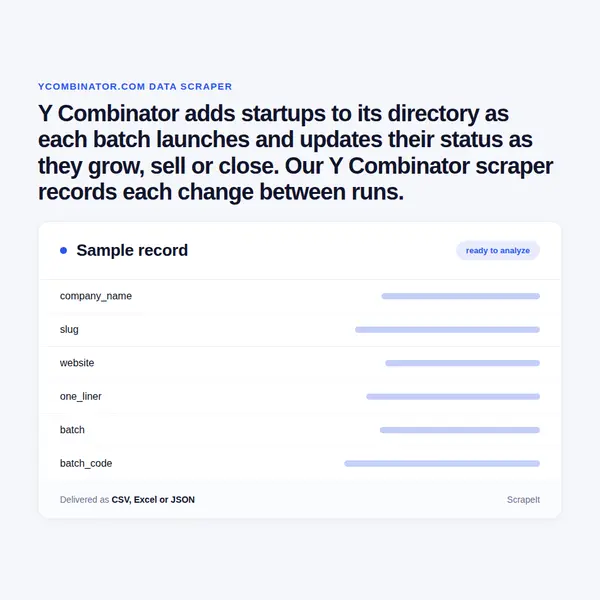
Tell us the slice: every company in the directory, a set of batches, an industry, a region, or only companies with the Is Hiring flag. We build the crawler for the directory and the company pages behind it, run it once or on a schedule, and fix it when YC changes the layout. The directory renders in the browser and loads more companies as you scroll, so rendering and pacing are built in, along with proxy rotation and CAPTCHA handling.
Data arrives as CSV, Excel or JSON, through our API or a JSON feed, or lands in Dropbox, Amazon S3 or your database. An MCP server is available on request. Field documentation ships with the first file.
Every company in the YC startup directory has a page at ycombinator.com/companies/ plus a slug - /companies/airbnb, /companies/postscript - and that slug keeps a row stable between runs. Our Y Combinator scraper reads the directory card and the company page behind it:
Founder names, photos, bios and personal profile links also appear on company pages. They are personal data, so we leave them out by default and deliver company-level fields only.
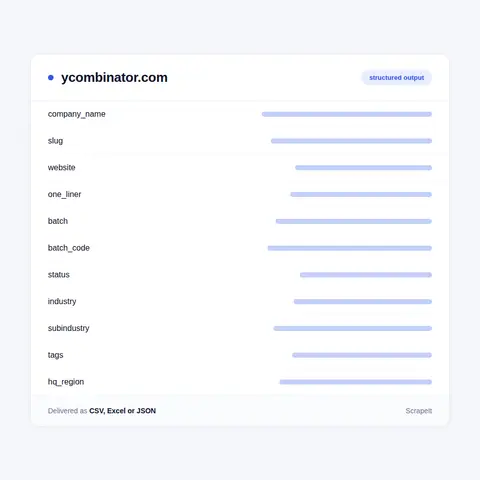
Company pages are the starting point. Three other public layers of the site add what a profile alone cannot.
Y Combinator is a startup accelerator, and its startup directory at ycombinator.com/companies is the public record of the companies it has funded since 2005. YC curates it itself: only YC companies appear, and batches and statuses are YC's own labels. That makes it narrower than a general company database and exact about one thing - the YC cohort.
The directory page is a filterable list. Sort by Default or Launch Date; filter by Top Companies, Is Hiring or Nonprofit; by Batch, from the earliest seasons to the latest; by Industry, such as B2B, Fintech, Consumer, Healthcare, Industrials, Education or Real Estate and Construction; by HQ Region, from America / Canada and Europe to South Asia, Latin America and Remote; and by Company Size on a range from 1 to 1,000+. Each card shows name, city, one-liner, batch, industry and subindustry.
Company pages carry the detail, with Company, Jobs and News tabs and a sidebar of Founded, Batch, Team Size, Status, Location and Primary Partner, the YC partner assigned to the company. The directory sends job seekers to Work at a Startup, and Launch YC hosts the companies' launch posts.
Get a Quote
Developers

Customers worldwide

Pages extracted

Hours saved for our clients
€199 / one-time
setup fee - included
€169 / mo
setup fee €499
€229 / mo
setup fee €499
€349 / mo
setup fee €499
€549 / mo
setup fee €799
Delivery: CSV, JSON or XLSX files, our API or a JSON feed. MCP server on request.
Full plan details →Y Combinator data is a ready-made list of startups that went through one selective programme, labelled by cohort, sector and outcome. The uses follow from those labels.
A weekday feed of local businesses from Google Maps for a local-marketing company: 1,000 US cities, three keywords a day, files by 10:00 UTC.
Learn MoreLearn how to use web scraping to solve data problems for your organization

Where opinion text lives on the public web, what a review record contains on each kind of site, which fields a model needs besides the text, and what quietly breaks a sentiment dataset - with examples from our own projects.
Using web scraping to extract Google Maps data will help you quickly and efficiently find businesses in any industry, city, state, or region. And the extracted contact information, such as phone or email address, social networks, or links to web pages, will help to contact them.

Lead scraping is a reliable way to get the right customer contacts to market your product, saves organizations time, and helps you better understand the audience you want to attract. Contacts include emails, phone numbers, or social media profiles.
ScrapeIt is a managed scraping company: we build and run the crawlers, you get the data. For a curated directory like YC's that means a stable key per company, statuses compared run over run, jobs linked to the company that posts them, and personal data kept out unless a project needs it under GDPR. Ask for a free project assessment or a sample. Plans start from EUR 169 a month, or EUR 199 for a one-time extract.
Yes. The ScrapeIt Y Combinator API returns company name, batch, status, industry, HQ Region and open jobs with salary range as JSON from an endpoint we host, refreshed on the schedule you set. The same records also come as CSV or XLSX files, through a JSON feed, or loaded into your database.
Yes. The startup directory, company pages, job listings and Launch YC posts are open to every visitor. We collect only publicly available data - everything a visitor can see on Y Combinator - and we collect it legally. Founder details stay out by default.
Yes. New companies appear as each batch launches, and YC now runs four batches a year, so we schedule a refresh around launch weeks or simply monthly. Each run re-reads status, Team Size and the Jobs count, so acquisitions, closures and hiring changes show up as dated changes rather than silent overwrites.
The four that YC assigns: Active, Acquired, Public and Inactive. We deliver the current value with the date it was read and, on scheduled runs, the date it changed, so you can count exits per batch or filter out companies that have shut down.
Not by default. Company pages list active founders with names, titles, photos and bios, but those are personal data, so the dataset leads with company fields. If a project needs a founder count or founder roles per company, we agree the scope first and handle it under GDPR; we do not build dossiers on people.
Step 1 - Make a Request
You share your needs, expectations, and desired timeframe. We’ll suggest the best solution based on your request and budget.
Step 2 - Configuring Custom Web Crawlers
Our specialists configure the crawlers and extract a sample dataset for your review before proceeding with the full-scale extraction.
Step 3 - Collect and Deliver
Once you approve the sample, we launch the project and start full data collection. We gather, filter, and structure the data for easy use, delivering it on time in your preferred format.
Step 4 - Maintain and Support
Our team manages ongoing processes, monitors website changes, and supports all data extraction cycles. We can also help integrate data into your systems or create dashboards to simplify analysis.
Y Combinator data from €169/month. Free project assessment, reply within 1 business day.

Scrapeit Sp. z o.o.
10/208 Legionowa str., 15-099, Bialystok, Poland
KRS: 0000996672
NIP: 5423457175
REGON: 523384582