What a Sherdog fight record holds, bout by bout
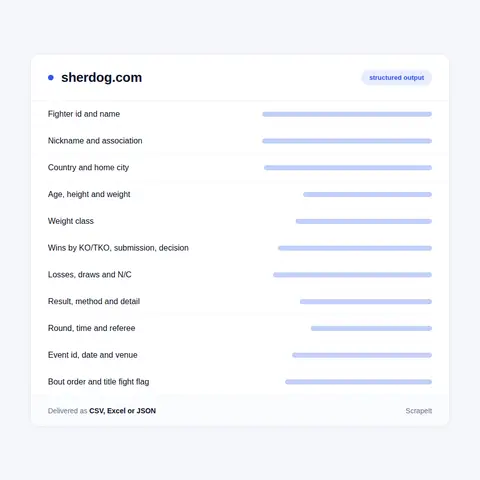
A fighter page opens with the profile: name and nickname, country and home city, age with date of birth, height in feet and centimeters, weight in pounds and kilograms, association (the team or gym, sometimes two joined by a slash), weight class and, for some fighters, a fighting style. Sherdog MMA records then split wins and losses by method - KO/TKO, submissions, decisions and others such as disqualifications - with a count and a share for each, followed by draws and no contests.
The fight history table carries the Sherdog fight results themselves. Each row holds:
- Result - win, loss, draw or NC.
- Opponent - name and fighter id.
- Event - name, event id and date.
- Method - a class plus a detail in parentheses, such as Submission (Face Crank), TKO (Submission to Punches) or Decision (Split); we split the two into separate fields.
- Referee - name and referee id, often blank on regional bouts.
- Round and time - when the fight ended.
- Play-by-play - a link to the round-by-round report on major cards.
Professional and amateur bouts sit in separate tables, so an amateur record never leaks into the pro win-loss-draw line. A profile can also show the next scheduled bout with venue and date, plus related news.
A Sherdog fight card adds what the profile leaves out: bout order (the main event carries the highest match number), MAIN EVENT and TITLE FIGHT flags, the weight class of each bout, catchweights included (160lb Catchweight), and venue, city and country, with scheduled bouts marked yet to come. One trap: the record printed beside each fighter on a card is the current record, not the one on fight night - UFC 319 from 2025 shows Khamzat Chimaev at 15-1-0, a line that already counts his 2026 loss - so a point-in-time record has to be rebuilt from the fight history.