Al Jazeera Scraper for English and Arabic Coverage

The English and Arabic newsrooms are not translations of one another. Collecting only the English one and calling it Al Jazeera coverage is a measurement error, not a shortcut.

Al Jazeera Scraper
Solutions

Managed Al Jazeera scraping, run end to end by us

ScrapeIt runs the Al Jazeera collector as a managed service across both the English and Arabic services. You name the sections and subjects; we build the crawl, run it on your cadence and hand back CSV, JSON, Excel or a push into your warehouse, with entities normalised across scripts and the source text preserved in its original form.

Cadence is per source. The news index and active live pages justify frequent passes; section archives run slower. Requests are paced deliberately rather than bursted.

We collect what both services render publicly. There is no meter here, so the dataset is unusually complete, but the journalism is still copyrighted and the terms restrict reuse, so it is built for analysis rather than republication. Bring the use case to your own counsel before the project starts.

Al Jazeera fields in every export

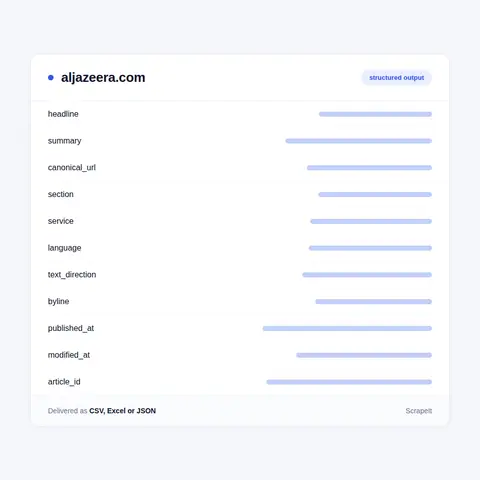
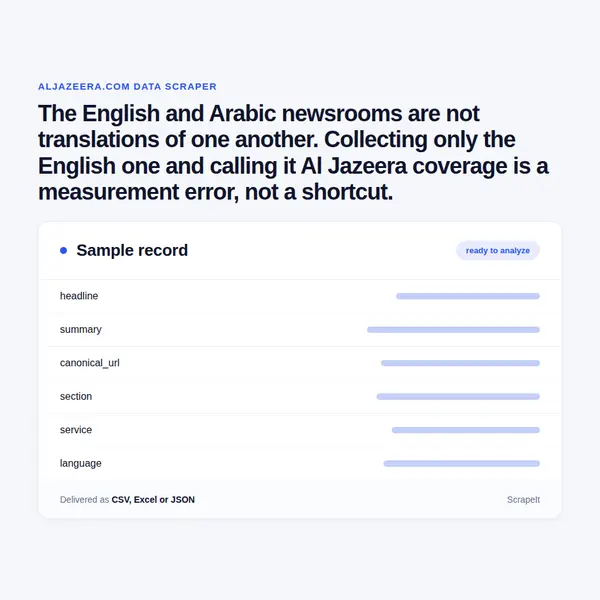
The article record covers canonical URL, headline, summary, section, service, language, text direction, byline, publication timestamp, last modified timestamp, item type and the article identifier used in the URL.

Service and language are separate fields for a reason. Service tells you which newsroom produced the item; language tells you the script the row is in. Keeping them apart makes it possible to ask whether a story was covered by the Arabic service at all, which is a different question from whether an Arabic version of a known story exists.

Entity matching across scripts is delivered rather than left to you. A named organisation, place or person is linked across the two services using a normalised identifier, so a company that appears under three transliterations arrives as one entity with the surface forms recorded. Doing this downstream, after the data has landed in two scripts, is far harder than doing it during collection.

Both timestamps are kept separately, front observations record which stories were promoted on which index and when, and the usual context fields follow: topic tags where published, lead image URL and caption, word count, outbound links, and the collection timestamp on every row.

Text is stored in the original script with direction recorded, never transliterated in place. Transliteration and translation, where wanted, are separate labelled fields.

Al Jazeera fields in every export
Cross language comparison, live coverage and the archive

Cross language comparison, live coverage and the archive

Cross language comparison is the output most clients end up wanting. It asks, for a given event, whether each service covered it, when, how prominently and at what length. That requires the entity normalisation described above plus story matching across scripts, and it is delivered as a joined table rather than two datasets you have to reconcile yourself.

Live coverage is collected as entries under a parent record, with entry text, timestamp and author where credited. On fast moving regional stories this is where most of the reporting actually appears, and collapsing it into a single article loses nearly all of it.

Historical backfill is practical because article URLs are stable and section pagination reaches back, and because there is no meter the historical rows are as complete as the current ones. Retrospectives run as a one time job separate from the ongoing feed.

Translation is a separate labelled field, never a replacement for the source text. For anything that might be quoted or challenged, the original has to remain available, and a translated headline sitting in the headline column is exactly how a dataset becomes unciteable.

Two newsrooms, two domains, two editorial lines

Al Jazeera operates separate English and Arabic services on separate domains, and they are not mirrors. Story selection, emphasis and framing differ, and a great many items exist in one and not the other. Anyone treating the English site as the whole output is measuring a subset and reporting it as the total.

Both are free to read, with no meter, which makes this one of the more collectable large outlets and one of the widest sources for coverage across the Middle East, North Africa and much of the global south. For risk, political and commodity monitoring that reach is the reason to collect it at all.

Structurally the English site is arranged into conventional sections with a news index, and the Arabic service has its own equivalent structure. A general RSS feed is served and works. Article pages carry structured markup with the headline, publisher and dates. A news sitemap is not served at the conventional path, so discovery leans on the news index, the section fronts and the feed together.

The practical work on this source is text handling rather than access. Arabic is right to left, it has its own numeral forms, and the same organisation or person is routinely spelled several ways in transliteration. Getting that right is what separates a usable bilingual dataset from a pile of mismatched rows.

Get a Quote
dev_w
25

Developers

customers
500+

Customers worldwide

pages
1 500 000 000+

Pages extracted

stime
15000+

Hours saved for our clients

Plans

Airplane

€199 / one-time

setup fee - included

Data limits100,000
Frequencyone-time
Run timeup to 5 days
Data storing7 days

Helicopter

€169 / mo

setup fee €499

Data limits250,000
Frequencymonthly
Run timeup to 5 days
Data storing14 days

Glasses

€229 / mo

setup fee €499

Data limits1,000,000
Frequencyweekly
Run timeup to 5 days
Data storing30 days

DNA

€549 / mo

setup fee €799

Data limits3,000,000
Frequency3 times daily
Run timesame day
Data storing90 days

Why the Arabic service is the half most datasets are missing

The mistake is easy to make and hard to see. An English language pipeline collects the English service, the numbers look reasonable, and nothing indicates that a second newsroom with different editorial priorities published a good deal more on the same subject.

For companies with exposure across the Middle East and North Africa the difference is material. Regulatory stories, labour disputes and political coverage frequently run more fully in Arabic, and the framing can differ in ways that matter to a communications team. Collecting both services and being able to compare them is the whole point of using this source rather than a wire.

Arabic text needs handling as Arabic. It is right to left, it uses its own numeral forms, and diacritics may or may not be present in the same word across two articles. On top of that, transliteration of names into Latin script is not standardised, so one organisation can appear under several spellings in the English service alone. We normalise entities across both scripts during collection and keep the surface forms, which is the only way the two halves join reliably.

The second reason is reach beyond the region. Al Jazeera covers a great deal of the global south that Western outlets treat lightly, so for anything with operations or supply chains there it is often the fullest available source, and it is free to read.

The third is that there is no meter to work around, which keeps the dataset unusually complete compared with the European papers of record.

Our Blog

Reads Our Latest News & Blog

Learn how to use web scraping to solve data problems for your organization

How Artificial Intelligence Is Used In Web Scraping

How Artificial Intelligence Is Used In Web Scraping

Leveraging advances in technology, the AI-powered web scraper has skyrocketed in demand and is helping to expand capabilities by automating tedious daily tasks and speeding up data collection from thousands of websites several times over.

What is Web Scraping and What is it Used For?

What is Web Scraping and What is it Used For?

Web scraping is a method of obtaining web data by extracting it from pages of web resources with the help of a program, that is, in automatic mode. It is used to syntactically convert web pages into more usable forms.

Web Scraping for Machine Learning

Web Scraping for Machine Learning

If you specialize in machine learning, you need to feed large amounts of data to the algorithms. Web scraping is the easiest and the most efficient method of collecting the data from all over the Internet.

scrapeit logo

Who builds and keeps your Al Jazeera feed

ScrapeIt is a managed extraction company, not a tool you have to learn. Our team builds the pipeline, watches it as both services change, and repairs it before your dashboard goes quiet.

You see a sample first, in your format, across both services, with the cross language entity matching already applied so you can judge it on real rows rather than on a promise.

FAQ

Is the Arabic service just a translation of the English one?

No, and that assumption is the most common error on this source. They are separate newsrooms with different story selection and emphasis, and many items exist in one service only. We collect both, tag every row with its service and language, and treat a story appearing in one and not the other as a finding rather than a gap in the data.

How do you match the same company across Arabic and English?

With entity normalisation applied during collection rather than afterwards. Transliteration is not standardised, so one organisation can appear under several Latin spellings and its Arabic form as well. We link them to a single identifier and keep every surface form encountered, which is what makes the two halves join reliably.

Do you transliterate or translate the Arabic text?

Not in place. The source text is stored in its original script with the text direction recorded. Transliteration and translation are delivered as separate labelled fields when a client wants them, because anything that might later be quoted or challenged has to be verifiable against the original.

Is there a paywall or a news sitemap?

No meter, which makes the dataset unusually complete compared with the European papers of record. There is no news sitemap at the conventional path, so discovery uses the news index, the section fronts and the general feed together. That costs a few more requests and yields prominence data as a by product.

Is scraping Al Jazeera legal, and can I republish?

Republication is not what this dataset is for. The journalism is copyrighted and the terms restrict reuse, even though there is no paywall to work around. We collect only public pages, honour the crawl rules the site publishes and pace requests, and we build for analysis: monitoring, comparison, measurement. Have your own counsel approve the use case before the project starts.

How does it Work?

Step 1 - Make a Request

You share your needs, expectations, and desired timeframe. We’ll suggest the best solution based on your request and budget.

Step 2 - Configuring Custom Web Crawlers

Our specialists configure the crawlers and extract a sample dataset for your review before proceeding with the full-scale extraction.

Step 3 - Collect and Deliver

Once you approve the sample, we launch the project and start full data collection. We gather, filter, and structure the data for easy use, delivering it on time in your preferred format.

Step 4 - Maintain and Support

Our team manages ongoing processes, monitors website changes, and supports all data extraction cycles. We can also help integrate data into your systems or create dashboards to simplify analysis.

Request a Quote

Tell us more about you and your project information.
Which sites, which fields, how often. A couple of lines is enough.

We reply within 1 business day. No obligation.

scrapiet

Scrapeit Sp. z o.o.
10/208 Legionowa str., 15-099, Bialystok, Poland
NIP: 5423457175
REGON: 523384582