BBC News Scraper for Headlines, Sections and Timestamps

The BBC publishes without a paywall in dozens of languages, which makes it the widest single source in media monitoring and the easiest one to collect badly.

BBC News Scraper
Solutions

Managed BBC News scraping, run end to end by us

ScrapeIt runs the BBC collector as a managed service. You name the sections, topics and languages you care about; we build the crawl, run it on your cadence and hand back CSV, JSON, Excel or a push into your warehouse. Deduplication against the other outlets in your feed is part of the job, not a separate project.

Cadence is set per source rather than uniformly. During an active story the English news fronts justify collection every few minutes; the long tail of topic pages runs hourly or daily. Paying to re-read a quiet regional front every sixty seconds buys nothing.

We take what the BBC renders publicly and no more. There is no paywall to work around here, but the BBC terms of use restrict copying and commercial reuse of its content, so the dataset is built for analysis rather than republication: metadata, structured fields and the publicly visible text, delivered to you and not onward. Bring the use case to your own counsel before the project starts, and we scope the work to what counsel signs off.

BBC News fields in every export

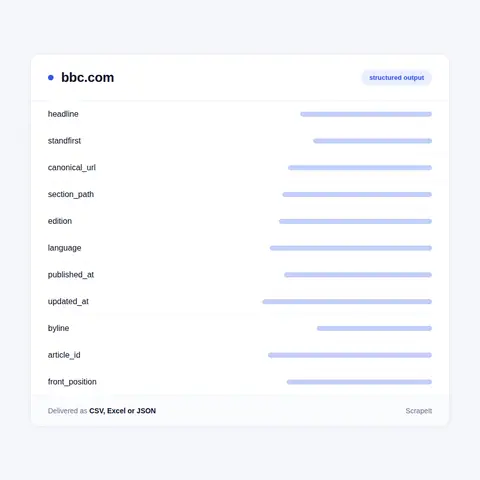
The article record is the spine: canonical URL, headline, the summary line where one is published, section path, publisher edition, language and the article identifier the BBC uses in its own URLs. That identifier is what lets you follow one story across a rewrite rather than treating each version as a new item.

Timestamps come in a pair and both matter. Published is when the story first appeared, updated is when it was last touched. A story with six hours between them is not the same event as a story with six seconds, and any measure of how fast the BBC moved on something needs both. We keep them separately and never overwrite one with the other.

Attribution is thinner on the BBC than on a newspaper: many stories carry a desk rather than a named reporter, and correspondents are often credited in the body instead of a byline field. We record what is published, mark the rest as unattributed and do not guess.

The rest is context. Section and topic tags, the position a story held on its section front and when that position was observed, the lead image URL and its caption, word count of the publicly rendered body, outbound links, and whether the page is an article, a live page or a video item. Live pages also carry the entry count and the timestamp of the last entry, because a live page that stopped updating three hours ago is a different thing from one that is still running.

Every row carries the collection timestamp. On a site that rewrites in place, a field without a time attached is not a fact about anything.

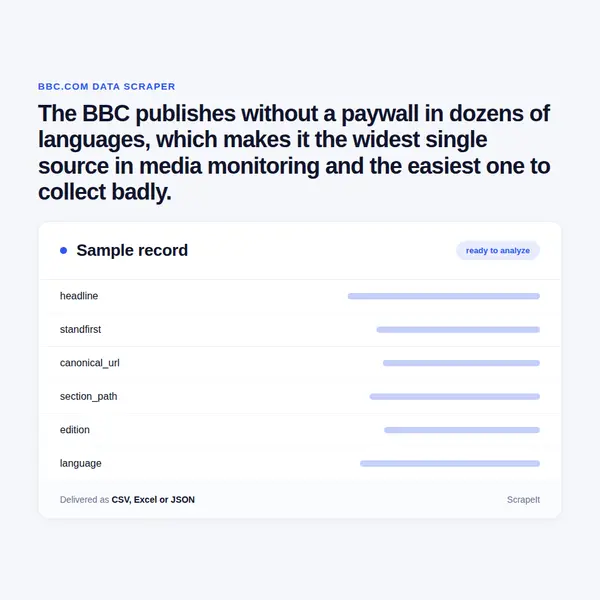
BBC News fields in every export
Language services, live pages and the archive

Language services, live pages and the archive

The language services are the part most monitoring setups skip, and they are usually the cheapest thing to add once the pipeline exists. Each service has its own front and its own topic pages, so the same collection logic applies; what changes is the text handling. We keep the original script, record the language on every row and, where a client needs it, run translation as a separate labelled field rather than overwriting the source.

Live pages need their own treatment. A live page is a stream of timestamped entries under one URL that can run for a day or longer, and collecting it as a single article throws away everything interesting inside it. We collect the entries: text, timestamp, author where credited, and any embedded quote or link. The parent page keeps its own record with the entry count and the time of the latest entry.

Historical backfill depends on what is still reachable. Topic pages paginate a long way back and the BBC keeps old articles online at stable URLs, so a retrospective run over a subject or a company is usually practical. It is a separate one time job from the ongoing feed, and it is normally the cheaper half of the project.

Video and audio items are indexed like articles but have no body text, so they are marked by type rather than dropped. For a share of voice measure, a six minute television package on the news front matters more than most of the text around it.

How BBC News arranges sections, regions and languages

The BBC is not one site. The international edition lives on bbc.com and the domestic one on bbc.co.uk, and the same story can appear on both with different URLs, different section paths and occasionally a different headline. Any collector that treats them as one source double counts, and one that picks a single domain misses half the output.

Underneath that sit three kinds of page. Section fronts such as the world, business and technology indexes carry an ordered list of what the desk is promoting right now. Topic pages gather everything tagged to a subject, a company or a person, and they reach much further back than the fronts do. Live pages run for hours and rewrite themselves continuously, which makes them a genuinely different object from an article.

Then there are the language services. Alongside English the BBC publishes in dozens of languages, each with its own front, its own editorial priorities and its own URL shape. For a brand tracked outside the anglophone world that is the difference between seeing the coverage and guessing at it. Collecting them means handling several scripts and right to left text without mangling either.

Machine readable entry points exist. The news sitemap index at bbc.com lists what has been published recently, and article pages carry structured markup with the headline, the publisher and the timestamps. Neither is a substitute for reading the section fronts, because neither tells you what the BBC chose to put at the top.

Get a Quote
dev_w
25

Developers

customers
500+

Customers worldwide

pages
1 500 000 000+

Pages extracted

stime
15000+

Hours saved for our clients

Plans

Airplane

€199 / one-time

setup fee - included

Data limits100,000
Frequencyone-time
Run timeup to 5 days
Data storing7 days

Helicopter

€169 / mo

setup fee €499

Data limits250,000
Frequencymonthly
Run timeup to 5 days
Data storing14 days

Glasses

€229 / mo

setup fee €499

Data limits1,000,000
Frequencyweekly
Run timeup to 5 days
Data storing30 days

DNA

€549 / mo

setup fee €799

Data limits3,000,000
Frequency3 times daily
Run timesame day
Data storing90 days

Why BBC coverage is measured by section, not by count

The usual brief is a count: how many times did we appear on the BBC last quarter. It is the wrong number, and the BBC is the clearest place to see why. A mention in a technology explainer that sat fourth on the technology front for two hours is not equivalent to a line in a regional roundup that nobody linked. Both are one row in a count.

So we collect the position as well as the item. Section fronts are read on a schedule, and each observation records which stories were on the front, in what order and at what time. That turns coverage from a tally into something with weight behind it: promoted for how long, on which front, alongside what else.

The second reason is the rewrite. BBC stories are edited in place, sometimes substantially, and the URL does not change. A headline that said one thing at nine in the morning can say something noticeably different by noon, with no note anywhere on the page. Keeping the headline at each observation, alongside both timestamps, is the only way to see that happen. For reputation work and for anything with a legal edge, that history is the whole point.

The third is reach. Because there is no paywall, the BBC is where a story becomes visible to everyone at once, including in markets where the local press has not picked it up yet. Watching the language services alongside the English fronts is often the earliest signal that something is travelling.

Our Blog

Reads Our Latest News & Blog

Learn how to use web scraping to solve data problems for your organization

How Artificial Intelligence Is Used In Web Scraping

How Artificial Intelligence Is Used In Web Scraping

Leveraging advances in technology, the AI-powered web scraper has skyrocketed in demand and is helping to expand capabilities by automating tedious daily tasks and speeding up data collection from thousands of websites several times over.

What is Web Scraping and What is it Used For?

What is Web Scraping and What is it Used For?

Web scraping is a method of obtaining web data by extracting it from pages of web resources with the help of a program, that is, in automatic mode. It is used to syntactically convert web pages into more usable forms.

Web Scraping for Machine Learning

Web Scraping for Machine Learning

If you specialize in machine learning, you need to feed large amounts of data to the algorithms. Web scraping is the easiest and the most efficient method of collecting the data from all over the Internet.

scrapeit logo

Who builds and keeps your BBC News feed

ScrapeIt is a managed extraction company, not a tool you have to learn. Our team builds the pipeline, watches it as the site changes, and repairs it before your dashboard goes quiet.

You see a sample first, in your format, on the sections and languages you actually track. Approve it and the full run follows on the cadence you choose, from a daily digest to minute level collection while a story is moving.

FAQ

Does the BBC have an API or feeds I could use instead?

There are RSS feeds per section and a news sitemap, and both are useful inputs. Neither is sufficient on its own. Feeds carry a slice of the output, usually the top of a handful of sections and only for a short window, and neither a feed nor a sitemap tells you the order stories held on a front or that a headline was rewritten an hour later. We read feeds and sitemaps first because they are cheap, then collect the fronts and topic pages for everything they leave out.

Can you collect bbc.com and bbc.co.uk without double counting?

Yes, and it is one of the first things we set up. The same story often runs on both editions under different URLs. We resolve the canonical version, group the copies under one story identifier and mark which edition each row came from. You can then count stories once, or count editions separately, without recollecting anything.

Which languages can you cover?

Any of the language services the BBC publishes. The collection logic is the same across them; the work is in text handling, since several use non Latin scripts and some are right to left. We keep the original text, tag every row with its language and service, and add translation only as a separate field when a client asks for it.

How often can the feed refresh, and in what formats?

From a daily digest up to minute level on a narrow set of fronts. Cadence is set per source: the main news fronts fast, topic pages and language services slower. Delivery is CSV, Excel, JSON, JSONLines or XML over FTP, SFTP, Amazon S3, Google Cloud Storage, Dropbox, Google Drive or email, or written straight into your database.

Is it legal to scrape the BBC, and can I republish what you collect?

We are direct about this. BBC content is copyrighted and the BBC terms of use restrict copying and commercial reuse, so the dataset we build is for analysis and not for republication. We work only on public pages, never behind a login, we collect no personal data about commenters, and we honour the crawl rules the site publishes. Media monitoring on published metadata and publicly rendered text is common practice, but the use case is yours: have your own counsel approve it before the project starts, and we scope the work to what counsel signs off.

How does it Work?

Step 1 - Make a Request

You share your needs, expectations, and desired timeframe. We’ll suggest the best solution based on your request and budget.

Step 2 - Configuring Custom Web Crawlers

Our specialists configure the crawlers and extract a sample dataset for your review before proceeding with the full-scale extraction.

Step 3 - Collect and Deliver

Once you approve the sample, we launch the project and start full data collection. We gather, filter, and structure the data for easy use, delivering it on time in your preferred format.

Step 4 - Maintain and Support

Our team manages ongoing processes, monitors website changes, and supports all data extraction cycles. We can also help integrate data into your systems or create dashboards to simplify analysis.

Request a Quote

Tell us more about you and your project information.
Which sites, which fields, how often. A couple of lines is enough.

We reply within 1 business day. No obligation.

scrapiet

Scrapeit Sp. z o.o.
10/208 Legionowa str., 15-099, Bialystok, Poland
NIP: 5423457175
REGON: 523384582