Feedly Scraper for Sources, Follower Counts and Topic Rankings

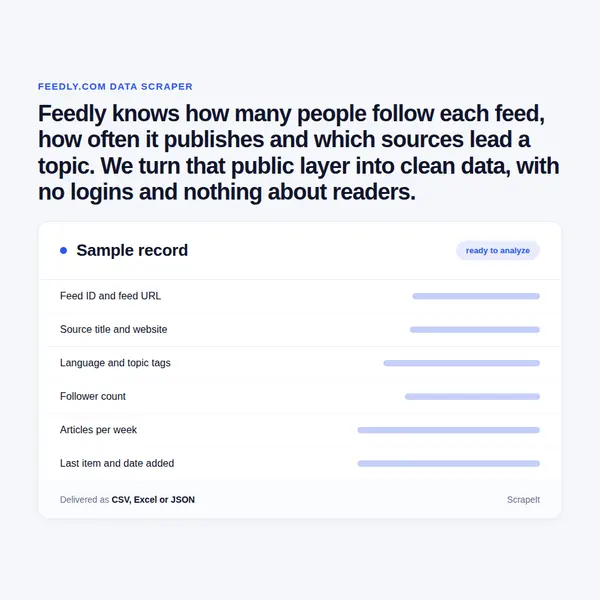
Feedly knows how many people follow each feed, how often it publishes and which sources lead a topic. We turn that public layer into clean data, with no logins and nothing about readers.

Feedly Scraper
Solutions

Extract Feedly Data as a Managed, Scheduled Feed

ScrapeIt runs Feedly scraping end to end. You name topics, languages, publishers, feed URLs or CVE vendors; we build the collector around the public pages and open endpoints, schedule it by velocity so busy feeds are read more often than quiet ones, and deliver CSV, JSON, Excel or a push to your database or bucket. Source lists can also arrive as OPML, ready to load into any reader. Anti-bot handling, proxy rotation and CAPTCHA solving are part of the service, and request rates are set against the per-user limits Feedly's developer terms suggest. Records are deduplicated on feed id and entry id, and article text, where you need it, comes from the publisher's canonical URL, not from Feedly.

Feedly Data per Source, per Topic and per Article

Rows keep Feedly's own field names, so Feedly data joins cleanly to whatever else you hold on a publisher.

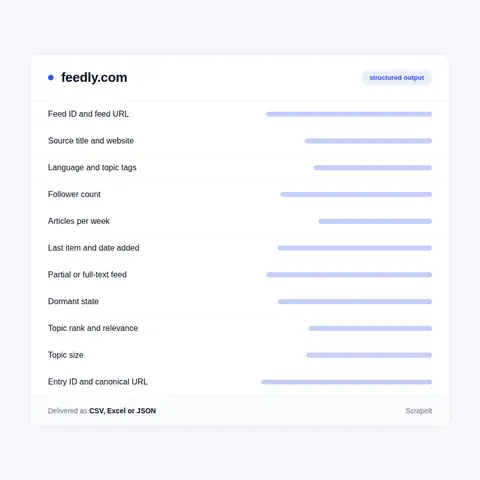
  • Source record. Feed id and feed URL, title, website, description, language, topic tags, exact follower count (pages round it to 11K, the metadata keeps every digit), velocity in articles per week, time of the last item, date added to the index, a partial flag that separates snippet feeds from full-text ones, the dormant state, and icon and cover image URLs.
  • Topic ranking. Topic id, label and language, topic size in sources, related topics with their own sizes, and up to 100 ranked sources with position, followers, velocity and relevance score. The order is not a follower sort: Feedly weighs relevance to the topic, so the leader of a topic can trail a lower-ranked source on followers.
  • Feedly articles. Recent items of any public feed with Feedly's immutable entry id, title, author credit as the feed gives it, published and crawled times in epoch milliseconds, canonical URL, the publisher's own keywords, summary snippet, lead image and a content fingerprint. A most-engaging view adds an engagement score per item.
  • CVE records. CVE id, CWE, CVSS score and vector, EPSS probability, severity, Feedly KEV and CISA KEV flags, affected vendor and product, proof-of-concept links and a dated timeline of exploitation reports, scanner detections and the first article to mention the flaw.
  • AI model library. Model name, definition, what it includes and excludes, the plans that carry it and the commonTopics id it writes into article JSON.

Every row is stamped with its collection time, which is what turns follower counts into a growth series.

Feedly Data per Source, per Topic and per Article
Feedly API, Crawl Rules and What Stays Behind Sign-In

Feedly API, Crawl Rules and What Stays Behind Sign-In

The Feedly API is a documented REST API at api.feedly.com, built for customers working with their own streams. Feedly API access sits on the top plans: Enterprise in the reader, Advanced in Market Intelligence, and Advanced in Threat Intelligence, which adds Intel Agents, a Threat Graph STIX API and an MCP server. A Feedly API token is generated by a team admin, and the Feedly API limit is currently 100,000 requests a month per token. The Feedly API documentation covers AI Feeds, folders, boards, search, webhooks and the CVE, threat actor, malware and company Insights Cards. Its article JSON adds Feedly enrichment - named entities, commonTopics, AI summary sentences, duplicates and clusters - that public streams do not carry.

The crawl rules are unusually explicit. Its robots.txt closes /i/entry/, the article view inside Feedly, and most of /v3/, yet leaves feed search, feed metadata, public streams, topic recommendations, /cve/ and /ai/ open to crawlers. That is the boundary our collection keeps to.

Anything tied to an account stays out: personal feeds, Feedly AI Feeds, boards, Read Later, notes, newsletters and Ask AI answers all sit behind sign-in, and we do not log in. Who follows a source is never shown either, only how many.

How the Feedly RSS Aggregator Organizes Sources and Topics

The Feedly RSS reader and its AI monitoring products, Feedly Market Intelligence and Feedly Threat Intelligence, are run by feedly, Inc. A Feedly scraper works on the public layer of that system: the sources people follow, the topics they are filed under and the counters Feedly keeps for each. The reading side - personal feeds, folders, Feedly boards, Read Later, notes and highlights - belongs to signed-in accounts and stays out of scope.

The unit of record is the feed. Each Feedly RSS feed is identified by its URL with a prefix, as in feed/https://www.theverge.com/rss/index.xml, and a large publisher often owns several: a main feed, section feeds, podcasts, sometimes a subscriber-only full feed. Each has its own title, website, language, topic tags, follower count, articles per week (Feedly calls this velocity), the date it entered Feedly's index and a dormant state once it stops publishing.

Above the feeds sits the Feedly top blogs directory, Discover Top Blogs: topic pages at /i/top/{topic}-blogs, each with a ranked source list, a topic size and related topics. The sitemap lists roughly 4,000 of them. Discovery is localized by language: the English view groups sources by industry, while the French and German views put Liberation, FAZ.NET or Handelsblatt under local hashtags. The paid products show a public face too, in Feedly CVE pages and an AI model library.

Get a Quote
dev_w
25

Developers

customers
500+

Customers worldwide

pages
1 500 000 000+

Pages extracted

stime
15000+

Hours saved for our clients

Plans

Airplane

€199 / one-time

setup fee - included

Data limits100,000
Frequencyone-time
Run timeup to 5 days
Data storing7 days

Helicopter

€169 / mo

setup fee €499

Data limits250,000
Frequencymonthly
Run timeup to 5 days
Data storing14 days

Glasses

€229 / mo

setup fee €499

Data limits1,000,000
Frequencyweekly
Run timeup to 5 days
Data storing30 days

DNA

€549 / mo

setup fee €799

Data limits3,000,000
Frequency3 times daily
Run timesame day
Data storing90 days

Why Scrape Feedly: Audience and Cadence for Every Source

Ranking sources by real readership. Blogs and trade sites rarely publish audience figures, and traffic estimates are guesses. Feedly followers count people who chose to follow a feed, which makes them a practical weight for media lists, outreach targets and source scoring in a monitoring stack. Section feeds are counted apart: in September 2026 the main feed of The Verge had about 1.45 million followers and its AI section about 11,000, a split no site-level metric shows.

Seeding your own crawler. A topic pull returns feed URLs with language, velocity and dormant state, so a news app, research tool or retrieval pipeline starts from live sources and knows how often to poll each one.

Tracking growth. Repeated snapshots of the same sources show which blogs in a niche are gaining followers and which have gone quiet, for competitor content programs and for publishers benchmarking their own feeds.

Vulnerability research. The public CVE layer adds severity, exploitation status and a dated timeline per CVE, which security teams join to their own asset and advisory data.

Our Blog

Reads Our Latest News & Blog

Learn how to use web scraping to solve data problems for your organization

How Artificial Intelligence Is Used In Web Scraping

How Artificial Intelligence Is Used In Web Scraping

Leveraging advances in technology, the AI-powered web scraper has skyrocketed in demand and is helping to expand capabilities by automating tedious daily tasks and speeding up data collection from thousands of websites several times over.

What is Web Scraping and What is it Used For?

What is Web Scraping and What is it Used For?

Web scraping is a method of obtaining web data by extracting it from pages of web resources with the help of a program, that is, in automatic mode. It is used to syntactically convert web pages into more usable forms.

Web Scraping for Machine Learning

Web Scraping for Machine Learning

If you specialize in machine learning, you need to feed large amounts of data to the algorithms. Web scraping is the easiest and the most efficient method of collecting the data from all over the Internet.

scrapeit logo

Who Runs Your Feedly Dataset at ScrapeIt

ScrapeIt is a managed web scraping agency. Our engineers set up your Feedly dataset, review a sample with you before the first full run and keep the collector working when Feedly changes its pages or rebuilds its topic index. You get one contact, a fixed delivery schedule and a price that follows sources, topics and refresh rate rather than seats. When an official Feedly plan fits the job better, we say so.

FAQ

Does Feedly have an API, and what does Feedly API pricing include?

Yes, a REST API at api.feedly.com, but there is no Feedly API free tier. Feedly issues its self-service tokens, the Feedly API key in practice, to Enterprise clients only, and the free, Pro and Pro+ plans do not list API access; Market Intelligence adds API access at Advanced, currently listed at $2,400 a month billed annually, and Threat Intelligence Advanced is priced on request. It returns your team's AI Feeds, folders, boards, search results and insight cards, 100 articles per page, so there is no pay-as-you-go Feedly news API sold on its own. Its developer terms also bar mass export without permission.

How much does Feedly cost, and is Feedly free?

Yes, the lowest Feedly price is zero: the free plan follows up to 100 feeds in 3 folders. Paid Feedly pricing plans add capacity - Pro 1,000 feeds with search and notes, Pro+ 2,500 with AI Feeds, newsletters, Google News feeds and the Feedly RSS Builder. The Feedly Pro price on the US App Store is $7.99 a month and Pro+ $15.99 (September 2026); on the web the Feedly subscription price is shown per month, billed annually, in local currency. The Feedly Enterprise price is quoted by sales, the Feedly Market Intelligence price is currently $1,600 a month billed annually for Standard, and the Feedly Threat Intelligence price is on request.

How do you scrape Feedly without logging in?

We read what Feedly shows signed-out and what its robots.txt leaves open: topic pages in Discover Top Blogs, source pages, the feed search and feed metadata behind them, public streams of recent items, CVE pages and the AI library. No accounts, no tokens lifted from Feedly's apps and nothing under /i/entry/. Coverage is built topic by topic and language by language, then widened through related topics and each publisher's section feeds. Where you need full article text, we fetch it from the publisher, because a feed item in Feedly often carries only a snippet.

How often can Feedly data be refreshed, and in what formats?

Follower counts move slowly, so weekly or monthly snapshots are enough for growth charts. Recent items are polled by velocity, several times a day for a feed posting over a hundred items a week and weekly for a quiet blog, and CVE records daily. Every row carries its collection time. Delivery is CSV, JSON, Excel or a database push, and source lists can come as OPML. That differs from the Feedly export at /i/opml, which moves a user's own subscriptions and leaves out boards, Read Later, AI Feeds and Reddit feeds.

Is it legal to scrape Feedly, and what do you leave out?

Feedly's terms of use forbid copying its own properties or using them to build a competing service, a restriction they say does not extend to third-party content, and they bar overloading its servers. Its developer terms bar mass export from Feedly Cloud without explicit permission, so volume is agreed with your counsel and, for large pulls, with Feedly. We stay on public, signed-out pages and allowed paths, take CVE scores and dates rather than Feedly's written summaries, and collect nothing about Feedly users. Articles belong to their publishers: use the data for measurement, not republication.

How does it Work?

Step 1 - Make a Request

You share your needs, expectations, and desired timeframe. We’ll suggest the best solution based on your request and budget.

Step 2 - Configuring Custom Web Crawlers

Our specialists configure the crawlers and extract a sample dataset for your review before proceeding with the full-scale extraction.

Step 3 - Collect and Deliver

Once you approve the sample, we launch the project and start full data collection. We gather, filter, and structure the data for easy use, delivering it on time in your preferred format.

Step 4 - Maintain and Support

Our team manages ongoing processes, monitors website changes, and supports all data extraction cycles. We can also help integrate data into your systems or create dashboards to simplify analysis.

Request a Quote

Tell us more about you and your project information.
Which sites, which fields, how often. A couple of lines is enough.

We reply within 1 business day. No obligation.

scrapiet

Scrapeit Sp. z o.o.
10/208 Legionowa str., 15-099, Bialystok, Poland
NIP: 5423457175
REGON: 523384582