Wired Scraper for Reviews, Buying Guides, Headlines and the Magazine Archive

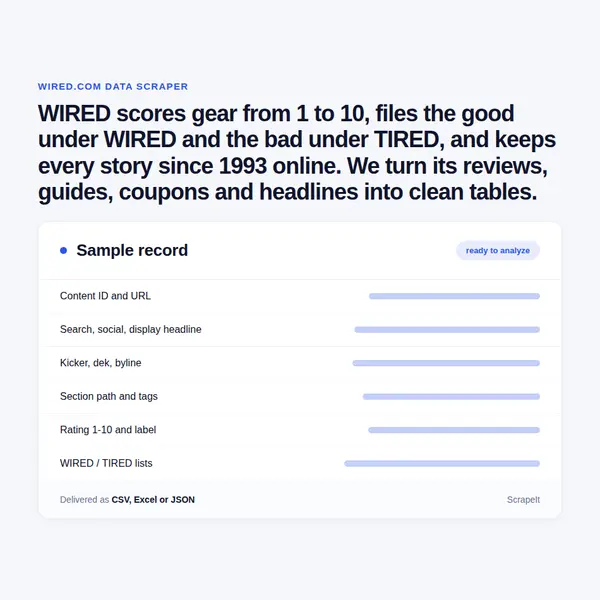
WIRED scores gear from 1 to 10, files the good under WIRED and the bad under TIRED, and keeps every story since 1993 online. We turn its reviews, guides, coupons and headlines into clean tables.

Plans from €169/month · Free project assessment · Reply within 1 business day

Wired Scraper
Solutions

How We Scrape Wired Data From Public Pages

ScrapeIt runs Wired data scraping as a managed service: we build the collector, run it on our own infrastructure and repair it when templates change. Anti-bot handling, proxy rotation and CAPTCHA solving are part of the service, and since the site throttles bursts, runs are paced. We extract Wired data from public pages only, logged out, and leave gated text alone. Guides and coupon pages change in place, so each run keeps a dated snapshot and every change becomes a row. Award dates, WIRED/TIRED lists and currencies are normalized, records are keyed on the content id, and a sample comes first. Delivery is CSV, JSON or XLSX, a push to S3, SFTP or your warehouse, or a Wired scraper API endpoint you call.

Wired Reviews Data: 1-10 Rating, WIRED/TIRED, Price and Seller

Wired reviews carry the fullest record on the site, and most of it sits in structured page data, so values come out as published rather than parsed from prose.

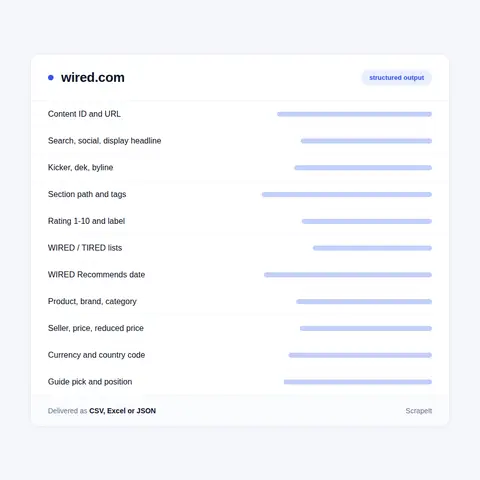
  • Review record. Content id, URL, the three headlines, dek, byline, publish and update times, Gear subsection and tags, so Wired mattress reviews or Wired ebike reviews can be pulled as sets of their own.
  • Rating. A whole number from 1 to 10 and the one-line label the site attaches to each score, from a complete failure at 1 to "Metaphysical perfection" at 10.
  • WIRED/TIRED. Pros under WIRED and cons under TIRED, the pairing behind the magazine's year-end Expired/Tired/WIRED list. The US site writes them as sentences and WIRED Italia as bullet lists; we deliver both as clean arrays.
  • WIRED Recommends. An editorial award with its own date. It is set apart from the score - it turns up on some 6 and 7 reviews and is missing from some 9s - and its date arrives in several formats, which we normalize.
  • Offers. Product name, brand and category, then each buy button: seller, price, reduced price during a deal, currency and country code. One review can list a US offer in dollars and a UK offer in pounds, so the Wired review price is kept per market.
  • Wired buying guides. Each pick's position, label such as The Best Kindle or Best for Students and Note-Takers, product, brand, prices and sellers, the Updated note and the FAQ block that often includes How I Test. The WIRED 101 adds the editors' 101 current favorites, grouped by themes like Bedtime and Kitchen, with price, discount and retailer.
  • Coupon pages. Brand, the discount the headline promises, such as 15% off or $150 off bundles, the month it names, the last update time and the product cards inside.

Bylines stay as printed. Author biographies and social profiles, reader comments and anything behind a login stay out of the data.

Wired Reviews Data: 1-10 Rating, WIRED/TIRED, Price and Seller
Wired Magazine Archive and the Regional Editions

Wired Magazine Archive and the Regional Editions

The archive. The Wired archive keeps Wired magazine articles and Wired news articles on the open site all the way back to /1993/01/, and magazine stories carry a print issue label such as Nov/Dec 2026 in the page data. The magazine now prints at least four times a year, and /magazine/ lists its stories page by page. Print replicas are separate: issues from 2021 on sit in a subscriber app at archive.wired.com, so page images stay out and the Wired article archive comes from wired.com itself.

Editions. WIRED UK's website has closed. wired.co.uk forwards to wired.com, where the UK archive was folded in under /story/ with a migration tag; old /article/ links no longer reach their stories, and the UK print edition carries on. WIRED Italia, WIRED Japan, WIRED Middle East and the Spanish-language es.wired.com run on the same Conde Nast platform, each with its own sitemaps; Italy uses the same review template priced in euros, with its picks hub under Wired Consiglia. Language is read from each page. The Czech and Slovak, Greek and Turkish editions run on platforms of their own; wired.de now forwards to GQ Germany and wired.tw to wired.com.

Wired Headlines, Sections and Content Types

Wired has covered technology, science, business and culture since its first print issue in March/April 1993. Conde Nast publishes it at wired.com on the platform it shares with Vogue and The New Yorker, which helps a Wired scraper: news, reviews and guides all expose the same structured page data. The menu splits the site into Security, Politics, The Big Story, Business, Science, Culture and Reviews, which is the Gear section, with the magazine, The Big Interview, podcasts and video one level down.

Content types differ by address and schema type. Wired articles and features live at /story/ as NewsArticle; single-product reviews at /review/ as Review, with a rating out of 10; buying guides at /gallery/ or /story/, the gallery ones with an ItemList of picks; live blogs at /live/, with timestamped updates. Wired coupons are Gear stories whose headline usually names the month. Wired branded content sits apart under /sponsored/story/, typed AdvertiserContentArticle and marked Advertisement Feature With plus the sponsor, so Wired sponsored content can be split from editorial or studied on its own.

Wired headlines come in layers. A page can carry one headline for search in its title tag and structured data, another for social sharing and a third on the page itself; the Kindle buying guide uses three different ones. Around them sit a kicker line, a dek, bylines, a section path such as Gear / Buying Guides, tags, and a 24-character content id that keys every record.

Get a Quote
dev_w
25

Developers

customers
500+

Customers worldwide

pages
1 500 000 000+

Pages extracted

stime
15000+

Hours saved for our clients

Plans

Wired Scraping Plans and Pricing

Airplane

€199 / one-time

setup fee - included

Data limits100,000
Frequencyone-time
Run timeup to 5 days
Data storing7 days

Helicopter

€169 / mo

setup fee €499

Data limits250,000
Frequencymonthly
Run timeup to 5 days
Data storing14 days

Glasses

€229 / mo

setup fee €499

Data limits1,000,000
Frequencyweekly
Run timeup to 5 days
Data storing30 days

DNA

€549 / mo

setup fee €799

Data limits3,000,000
Frequency3 times daily
Run timesame day
Data storing90 days

Wired Sitemaps Back to 1993 and the Fields Only Pages Carry

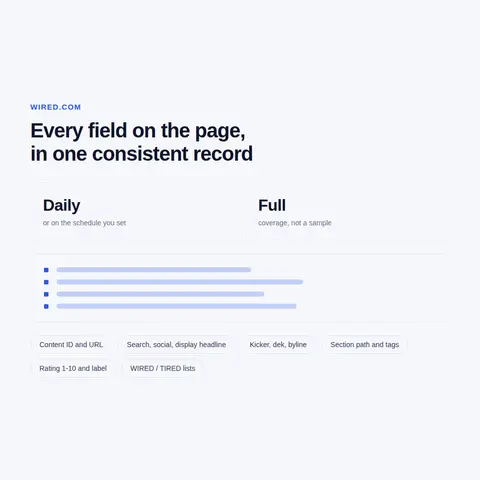
Everything a visitor sees on Wired can be collected: headline, link, content id, publish time, dek, section path, tags, kicker, author and lead image on every story, and on Gear pages the score, WIRED/TIRED notes, prices and sellers as well. Print stories sit in the same stream as everything else and carry their issue label.

The sitemaps are the complete list. The index names only the latest 60 monthly files, yet a file exists for every month back to January 1993 at /sitemap-YYYY-MM.xml. Files group URLs by last update rather than first publication, so a guide first posted in 2019 sits in the month it was last rewritten, and a monthly file that changes between two pulls is a list of what moved. Further sitemaps cover tag pages, contributors, curated bundles and branded content, the Google News sitemap holds the last two days, and an HTML site map runs by year and month.

Category pages paginate back for years, twenty stories at a time, but the fields buyers pay for - scores, WIRED/TIRED notes, prices, sellers, picks - exist only on the pages. Brand teams track how WIRED rates them and their rivals, commerce teams see which sellers win the buy buttons in each market, and media analysts compare the three headlines of a story.

Our Blog

Reads Our Latest News & Blog

Learn how to use web scraping to solve data problems for your organization

How Artificial Intelligence Is Used In Web Scraping

How Artificial Intelligence Is Used In Web Scraping

Leveraging advances in technology, the AI-powered web scraper has skyrocketed in demand and is helping to expand capabilities by automating tedious daily tasks and speeding up data collection from thousands of websites several times over.

What is Web Scraping and What is it Used For?

What is Web Scraping and What is it Used For?

Web scraping is a method of obtaining web data by extracting it from pages of web resources with the help of a program, that is, in automatic mode. It is used to syntactically convert web pages into more usable forms.

Web Scraping for Machine Learning

Web Scraping for Machine Learning

If you specialize in machine learning, you need to feed large amounts of data to the algorithms. Web scraping is the easiest and the most efficient method of collecting the data from all over the Internet.

scrapeit logo

ScrapeIt and Your Wired Dataset

ScrapeIt is a managed web scraping agency. For a Wired dataset we agree the scope with you in writing - Gear categories, buying guides, coupon pages, editions, archive years and refresh rate - and keep the pipeline running through template changes, so your series does not break when the site does. You receive finished tables, not a tool to operate. Pricing follows volume and refresh rate, and you review a sample built on your own categories before committing.

FAQ

Do you offer a Wired API for reviews and headlines?

Yes. The ScrapeIt Wired API returns review scores, WIRED/TIRED notes, offers with seller and price, headlines, bylines and dates as JSON from an endpoint we host, refreshed on the schedule you set. It doubles as a Wired news API, with headline, dek, section, tags and dates for every story. The same data also comes as CSV or XLSX files or straight into your database.

Can you scrape Wired reviews with the score, WIRED/TIRED notes and price?

Yes. Each review carries its 1-10 rating in structured data, plus the site's label for that score, the WIRED and TIRED lists, product name, brand and category, and one or more offers with seller, price, reduced price, currency and country code. When a review holds the WIRED Recommends award, its date comes along in one format. Buying guides add each pick's label, position and sellers, and WIRED Italia reviews follow the same template in euros, so one schema covers both.

What does the Wired paywall hide, and how much does a Wired subscription cost?

Gear - reviews, buying guides and coupon pages - stays open to every visitor. News and features are limited for non-subscribers, and a gated story is cut to its opening paragraph. We do not log in or work around the gate, so outside Gear the records carry metadata: headlines, dek, byline, section, tags, dates and print issue. In September 2026 the Wired subscription cost ran from an introductory $1 a week to regular annual rates of $99 for digital and $109.99 for print plus digital.

How far back does the Wired archive go, and are WIRED UK and other editions covered?

To January 1993: monthly sitemaps and dated addresses start there, and the HTML site map runs year by year. The backfill runs once, as its own job. WIRED UK is covered through wired.com, where its archive now lives. WIRED Italia, WIRED Japan, WIRED Middle East and the Spanish-language edition are separate sites on the same platform, collected as separate sources with a language field. After the backfill, most clients take news and reviews daily and guides weekly as snapshots.

Is it legal to scrape Wired?

Yes. We collect only publicly available data - everything a visitor can see on Wired - and we collect it legally. That means ratings, WIRED/TIRED notes, offers, headlines, dek, bylines, sections, tags and dates, plus the article text wherever a page shows it in full, as Gear reviews, buying guides and coupon pages do. We never log in or go behind the paywall, so a gated story comes as metadata.

How does it Work?

Step 1 - Make a Request

You share your needs, expectations, and desired timeframe. We’ll suggest the best solution based on your request and budget.

Step 2 - Configuring Custom Web Crawlers

Our specialists configure the crawlers and extract a sample dataset for your review before proceeding with the full-scale extraction.

Step 3 - Collect and Deliver

Once you approve the sample, we launch the project and start full data collection. We gather, filter, and structure the data for easy use, delivering it on time in your preferred format.

Step 4 - Maintain and Support

Our team manages ongoing processes, monitors website changes, and supports all data extraction cycles. We can also help integrate data into your systems or create dashboards to simplify analysis.

Request a Quote

Tell us more about you and your project information.
Which sites, which fields, how often. A couple of lines is enough.

We reply within 1 business day. No obligation.

scrapiet

Scrapeit Sp. z o.o.
10/208 Legionowa str., 15-099, Bialystok, Poland
NIP: 5423457175
REGON: 523384582