VentureBeat Scraper for Enterprise AI Mentions, Funding News and Topics

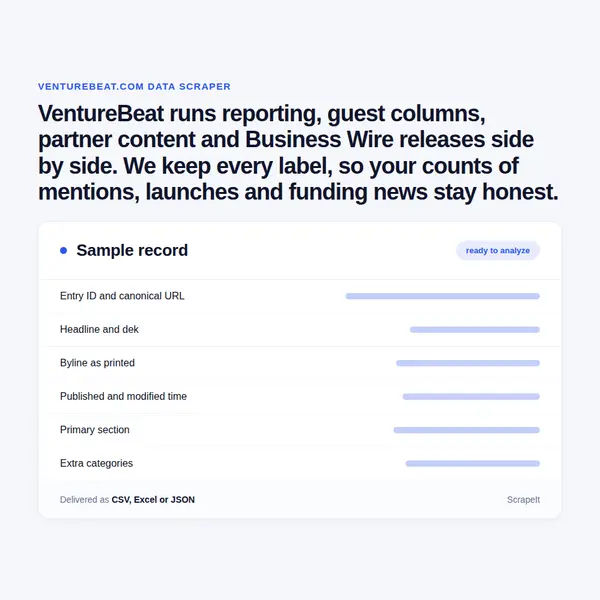
VentureBeat runs reporting, guest columns, partner content and Business Wire releases side by side. We keep every label, so your counts of mentions, launches and funding news stay honest.

Plans from €169/month · Free project assessment · Reply within 1 business day

VentureBeat Scraper
Solutions

How We Scrape VentureBeat: Discovery, Labels, Entities and Delivery

ScrapeIt runs VentureBeat data scraping as a managed service: we build the collector, run it on our own infrastructure and repair it when the site changes. The site sits behind a bot challenge that turns away scripted clients, so anti-bot handling, proxy rotation and CAPTCHA solving are part of the service. We extract VentureBeat data from public pages only, never from behind a login, and at a measured pace. Daily sitemaps and category pages find new stories, records are deduplicated on entry id and canonical URL, and each row keeps its section, categories, label and sponsor. Company and product names are matched to your watch list with the sentence they came from. A sample comes first. Delivery is CSV, JSON or XLSX, or a push to S3, SFTP or your warehouse.

Fields in Every Record and How VentureBeat Sponsored Content Is Marked

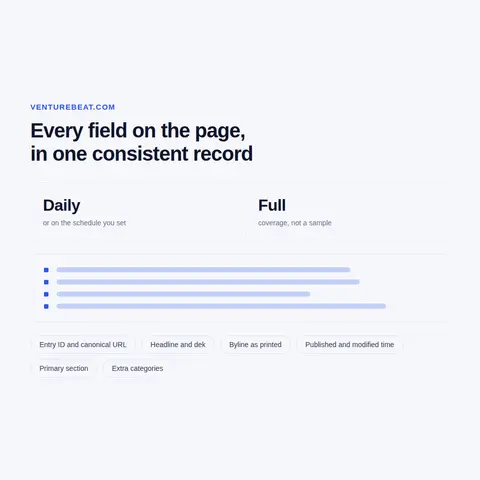
Story pages carry structured data and a page payload that hold more than a reader sees, so most fields come out exactly as the newsroom set them.

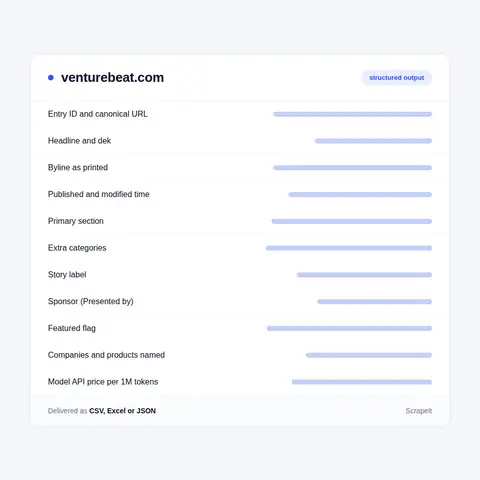
  • Record. CMS entry id, the 22-character key that identifies each story, canonical URL, slug, headline, dek, meta title and meta description.
  • Time. Published and modified timestamps in ISO form; the page itself prints the hour in Pacific time.
  • Byline as printed. A staff name, VB Staff, Business Wire on releases, or a name followed by a company on partner content.
  • Section and categories. The primary section plus extra categories that act as tags: DataDecisionMakers on guest columns, VB Transform on event coverage, Business on some reporting. Older posts keep the old taxonomy, such as AI, Big Data, Cloud, Dev and Enterprise.
  • Story label. Analysis, Exclusive, Opinion, Guest, Research, Sponsored, VB Spotlight or Press Release. Straight news carries no label, and a post type of article, sponsored or press backs it up.
  • Prominence. The featured and hero flags in the page data; hero stories also show a Featured kicker above the headline.
  • Body. Clean text, subheads, outbound links, the image credit, and the companies, products and models named in it.

VentureBeat sponsored content is marked in three places: a Partner Content kicker, a Presented by line naming the company, and a closing note that sponsored articles come from companies that pay for the post or have a business relationship with VentureBeat. One sponsored format, VB Spotlight, is typed as an ordinary article in the page data, and a VB Staff byline sits on research reports and partner pieces alike, so we take the sponsor from the Presented by line and store it as its own field. Author emails, social links and bios in the payload stay out of the dataset.

Fields in Every Record and How VentureBeat Sponsored Content Is Marked
VentureBeat Funding News, VB Transform and Pulse Research as Market Signals

VentureBeat Funding News, VB Transform and Pulse Research as Market Signals

Mentions and launches. Most reporting names vendors: model releases, agent platforms, data products, and the identity and agent-security tools the VentureBeat Security section follows. Model launches often come with the API price VentureBeat quotes per million input and output tokens, so a price series per model falls out of the coverage. Company mentions counted by week, section and label give share of voice, and keep what the newsroom chose to cover apart from what a vendor paid for or issued.

Funding and deals. VentureBeat funding news now runs in two streams: Business Wire releases that announce funding rounds, acquisitions and board seats in the company's own words, and editorial coverage of the larger deals. The archive adds years of round-by-round reporting from the venture era, enough for a VentureBeat startups list by year and category. Each row says which stream it came from.

Events and research. VB Transform coverage comes in two waves, speaker previews before the event and session write-ups after it, both tagged VB Transform, then session videos; VB Transform 2026 followed that pattern. Among other VentureBeat events, the Agentic Infrastructure Stack Summit page lists focus areas and the companies of its speakers, and the AI Impact Series posts titles, dates and cities. Special issues, themed collections published since 2020, group stories by topic. Pulse Research, the monthly VentureBeat research survey of enterprise readers, states a sample size and percentages we deliver as metric rows.

VentureBeat Data Today: Five Enterprise AI Sections and an Archive Back to 2006

VentureBeat has covered the technology business since 2006 and now focuses entirely on AI news and research for enterprise decision-makers, from data platforms to security. For a VentureBeat scraper the layout matters more than the slogan. Reporting sits in five sections - Orchestration, Infrastructure, Data, Security and Technology. Business carries a steady run of Business Wire releases, Resources holds the Pulse Research survey reports, and separate hubs list events, videos and special issues. That narrow focus makes VentureBeat enterprise AI coverage a practical base for tracking vendors, models and product launches.

Every story lives at /{section}/{slug}, and the slug is what the site resolves: the same story opens under other section prefixes too, and only the canonical link names the real one. Records are therefore keyed on the canonical URL and the CMS entry id, never on the address a crawler happened to arrive by. Posts from the early years moved to the same pattern and still open by slug, while their dated addresses, such as /2011/05/10/slug/, no longer resolve, and some early slugs do not open at all.

Games coverage is no longer part of this site: GamesBeat runs as its own publication, and old /games/ links redirect there. What remains is a single US English edition in which the section, the story label and the byline together tell you what kind of item you are reading.

Get a Quote
dev_w
25

Developers

customers
500+

Customers worldwide

pages
1 500 000 000+

Pages extracted

stime
15000+

Hours saved for our clients

Plans

VentureBeat Scraping Plans and Pricing

Airplane

€199 / one-time

setup fee - included

Data limits100,000
Frequencyone-time
Run timeup to 5 days
Data storing7 days

Helicopter

€169 / mo

setup fee €499

Data limits250,000
Frequencymonthly
Run timeup to 5 days
Data storing14 days

Glasses

€229 / mo

setup fee €499

Data limits1,000,000
Frequencyweekly
Run timeup to 5 days
Data storing30 days

DNA

€549 / mo

setup fee €799

Data limits3,000,000
Frequency3 times daily
Run timesame day
Data storing90 days

VentureBeat Story Pages and Sitemaps: Where Each Field Comes From

Everything a visitor sees on a VentureBeat story page can be collected: headline, dek, byline as printed, section and categories, story label, the Presented by sponsor line, the featured flag, published and modified times, full text with subheads and outbound links, and the lead image.

Collection covers the five sections - Orchestration, Infrastructure, Data, Security and Technology - plus DataDecisionMakers and Resources. Partner pieces are kept with their sponsor, and Business Wire releases are collected next to the reporting, with the stream each row came from recorded.

The VentureBeat sitemap index lists one sitemap per day back to January 2015. The daily lists are dependable for the last few years and patchy before that: plenty of older weekdays list nothing, although their stories still open. Category pages show about a dozen stories with no page two.

Sitemaps and the archive give the long list of stories. The fields monitoring depends on - story label, sponsor, featured flag, entities in the text - exist only on the pages.

Our Blog

Reads Our Latest News & Blog

Learn how to use web scraping to solve data problems for your organization

How Artificial Intelligence Is Used In Web Scraping

How Artificial Intelligence Is Used In Web Scraping

Leveraging advances in technology, the AI-powered web scraper has skyrocketed in demand and is helping to expand capabilities by automating tedious daily tasks and speeding up data collection from thousands of websites several times over.

What is Web Scraping and What is it Used For?

What is Web Scraping and What is it Used For?

Web scraping is a method of obtaining web data by extracting it from pages of web resources with the help of a program, that is, in automatic mode. It is used to syntactically convert web pages into more usable forms.

Web Scraping for Machine Learning

Web Scraping for Machine Learning

If you specialize in machine learning, you need to feed large amounts of data to the algorithms. Web scraping is the easiest and the most efficient method of collecting the data from all over the Internet.

scrapeit logo

ScrapeIt and Your VentureBeat Dataset

ScrapeIt is a managed web scraping agency. For a VentureBeat dataset we agree the scope in writing - sections, labels, a watch list of companies and products, how far back and how often - and keep the pipeline running through redesigns, so a market intelligence series does not break when the site does. You receive finished tables, not a tool to operate. Pricing follows volume and refresh rate, and you check a sample built on your own watch list before committing.

FAQ

Do you offer a VentureBeat API for stories, labels and sponsors?

Yes. The ScrapeIt VentureBeat API returns headline, byline, section, story label, sponsor and the companies and products named in the text as JSON from an endpoint we host, refreshed on the schedule you set. The same data also comes as CSV or XLSX files or straight into your database.

How far back does the VentureBeat archive go, and how often can it be refreshed?

To 2006. Stories from the first years still open at /{section}/{slug}, though some early slugs no longer resolve and the old dated addresses are gone. Daily sitemaps start in 2015 and have gaps in the older years, so a backfill also gathers old addresses from links inside stories and from historical URL lists, then maps them onto current slugs. After the backfill most clients take new stories daily or several times a day, and events, research and special issues weekly. Delivery is CSV, JSON Lines or XLSX, or a push to S3, SFTP or a database.

Is VentureBeat a reliable source, and how is sponsored content kept apart?

It is an established trade publication, but one site carries very different items: news, analysis, opinion, guest columns, Pulse Research, partner content and Business Wire releases. VentureBeat contributed articles run under the VentureBeat Data Decision Makers program, labeled DataDecisionMakers, and its guidelines reject vendor promotion; paid VentureBeat contributed content goes to Partner Content with a Presented by line instead. We keep the label and the sponsor on every row, so you decide what to weight, filter or drop.

Can you track funding rounds and company mentions in VentureBeat news?

Yes, from what each item says. For deals we capture company, amount, round, acquirer and target as written, with the source sentence attached; vague values stay empty. Each row records whether it came from a VentureBeat press release, which is the company's own Business Wire announcement, or from reporting. Company mentions and product launches are matched to your watch list and counted by week, section and label, which is how share of voice and topic trends are built.

Is it legal to scrape VentureBeat, and what goes into the dataset?

Yes. We collect only publicly available data - everything a visitor can see on VentureBeat - and we collect it legally, from story pages with no logins and no paywalls. Every public field is available, full article text included. Personal data is handled under GDPR: author emails, social links and bios that sit in the page data stay out, and bylines are kept as printed.

How does it Work?

Step 1 - Make a Request

You share your needs, expectations, and desired timeframe. We’ll suggest the best solution based on your request and budget.

Step 2 - Configuring Custom Web Crawlers

Our specialists configure the crawlers and extract a sample dataset for your review before proceeding with the full-scale extraction.

Step 3 - Collect and Deliver

Once you approve the sample, we launch the project and start full data collection. We gather, filter, and structure the data for easy use, delivering it on time in your preferred format.

Step 4 - Maintain and Support

Our team manages ongoing processes, monitors website changes, and supports all data extraction cycles. We can also help integrate data into your systems or create dashboards to simplify analysis.

Request a Quote

Tell us more about you and your project information.
Which sites, which fields, how often. A couple of lines is enough.

We reply within 1 business day. No obligation.

scrapiet

Scrapeit Sp. z o.o.
10/208 Legionowa str., 15-099, Bialystok, Poland
NIP: 5423457175
REGON: 523384582