Washington Post Data: Journalism Closed, Advertising Open

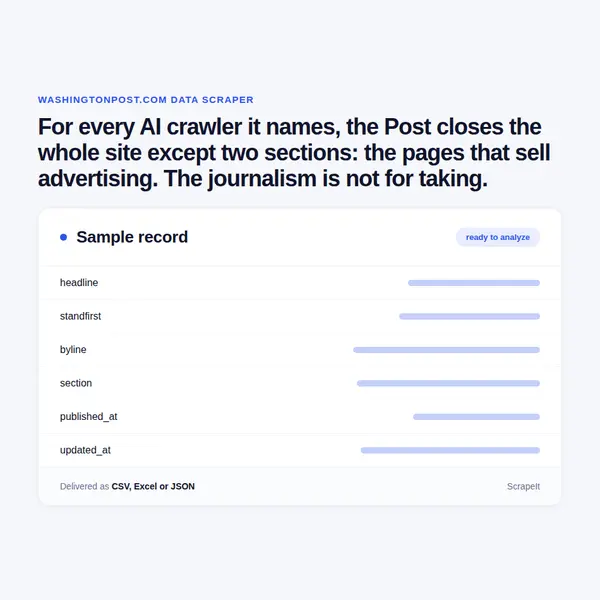
For every AI crawler it names, the Post closes the whole site except two sections: the pages that sell advertising. The journalism is not for taking.

The Washington Post Scraper
Solutions

Managed work within an agreement, run end to end by us

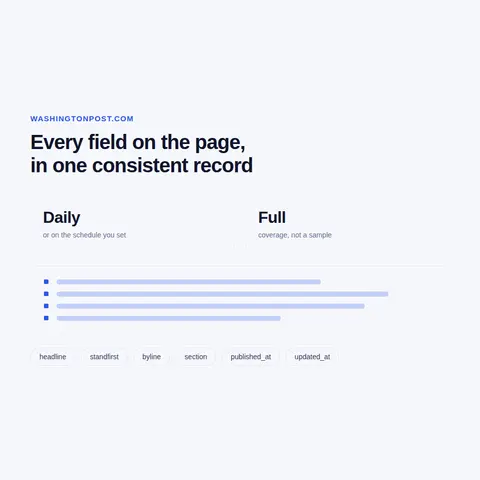
ScrapeIt runs the work as a managed service. If you hold a licence or syndication agreement, we build within its terms, record its reference and a use flag on every row, and hand back CSV, JSON, Excel or a push into your warehouse.

If you do not, we say so before quoting and scope what can be answered from citations and primary public sources.

We follow the line the paper draws in its own crawl rules: its journalism is not for AI use without its agreement. Your counsel should see the agreement and intended use before the project starts.

What a Post dataset can honestly carry

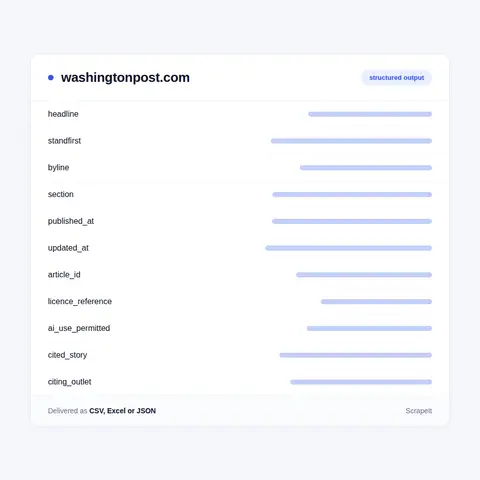
Where a client holds a licence or syndication agreement, article records carry the headline, standfirst, byline, section, publication and update timestamps and article identifier, within the agreement's scope and with its reference on every row.

A use flag is recorded on every licensed row. Given how explicitly the paper excludes AI crawlers from its journalism, data collected under an agreement for research should state plainly whether AI use is covered, so the boundary survives after delivery.

Citation records are built without the site: where other outlets cite or follow Post reporting, collected from sources that permit collection.

Every row carries the collection timestamp and its source type.

What a Post dataset can honestly carry
Citation analysis, licensed work and limits

Citation analysis, licensed work and limits

Citation and follow-up analysis is the strongest product without an agreement: which Post stories other outlets picked up, how quickly, and how the framing changed, collected from sources that permit collection.

Licensed or syndicated content work is ordinary structuring and delivery within the agreement, with the reference and a use flag on every row.

Policy coverage tracking, a common brief for this paper, can often be answered better from primary public sources - legislative and regulatory records - with the Post's role measured through citations.

Limits: no collection of the site without an agreement, no attempt to get past its silence or its rules, and no AI use of its journalism unless an agreement explicitly covers it.

A newspaper that draws its line in public

The Washington Post is one of the most prominent American newspapers, covering national politics, government and public affairs from the capital, published behind a subscription.

Its site did not respond to our requests. Its crawl rules, however, say a great deal. The file names AI crawlers one by one and gives each the same instruction: disallow the entire site, then allow exactly two sections - the creative services group and the advertising pages.

In other words, the paper is content for AI systems to read about buying advertising from it, and not content for them to read its journalism. It is one of the clearest statements of a publisher's position we have seen, written in the one file every crawler checks first.

That line is the one we follow. Editorial content is a licensing matter; the paper's influence can be measured from other sources.

Get a Quote
dev_w
25

Developers

customers
500+

Customers worldwide

pages
1 500 000 000+

Pages extracted

stime
15000+

Hours saved for our clients

Plans

Airplane

€199 / one-time

setup fee - included

Data limits100,000
Frequencyone-time
Run timeup to 5 days
Data storing7 days

Helicopter

€169 / mo

setup fee €499

Data limits250,000
Frequencymonthly
Run timeup to 5 days
Data storing14 days

Glasses

€229 / mo

setup fee €499

Data limits1,000,000
Frequencyweekly
Run timeup to 5 days
Data storing30 days

DNA

€549 / mo

setup fee €799

Data limits3,000,000
Frequency3 times daily
Run timesame day
Data storing90 days

Why the advertising exception tells you the policy

Crawl rules are usually read for what they forbid. The exceptions are often more informative, and here they are the whole story.

A publisher that simply wanted to reduce load would block crawlers everywhere. One that allows AI crawlers onto its advertising and creative services pages, and nowhere else, has made a distinction: commercial information about working with the paper is welcome to be read; the journalism is not available for that use. That is a considered editorial and commercial position, not an accident.

For a data project the consequence is straightforward. The journalism is reached through a licence or syndication agreement, and any use involving AI needs that agreement to say so explicitly. Nothing about the site's silence toward our requests suggests another route.

What remains open is influence: how other outlets cite and follow the Post's reporting. For communications, policy and media research teams, that is often the real question anyway - not what the Post wrote, but what it set in motion.
Our Blog

Reads Our Latest News & Blog

Learn how to use web scraping to solve data problems for your organization

How Artificial Intelligence Is Used In Web Scraping

How Artificial Intelligence Is Used In Web Scraping

Leveraging advances in technology, the AI-powered web scraper has skyrocketed in demand and is helping to expand capabilities by automating tedious daily tasks and speeding up data collection from thousands of websites several times over.

What is Web Scraping and What is it Used For?

What is Web Scraping and What is it Used For?

Web scraping is a method of obtaining web data by extracting it from pages of web resources with the help of a program, that is, in automatic mode. It is used to syntactically convert web pages into more usable forms.

Web Scraping for Machine Learning

Web Scraping for Machine Learning

If you specialize in machine learning, you need to feed large amounts of data to the algorithms. Web scraping is the easiest and the most efficient method of collecting the data from all over the Internet.

scrapeit logo

Who builds and keeps your coverage feed

ScrapeIt is a managed extraction company, not a tool you have to learn. Our team builds pipelines that respect the publisher's stated position, keeps agreements and use flags attached to the data, and repairs collection when formats change.

You see a sample first, in your format. Without an agreement in place, the sample is a citation analysis from other outlets, so you can judge the value before any licensing conversation.

FAQ

Can you scrape the Washington Post?

Not without an agreement. The site did not respond to our requests, and its crawl rules close the journalism to every AI crawler they name. With a licence or syndication agreement we build within its terms.

What is open to AI crawlers?

Only two sections: the creative services group and the advertising pages. For each AI crawler it names, the paper disallows the whole site and then allows exactly those. The commercial pages are open; the journalism is not.

Does a syndication agreement cover AI use?

Only if it says so explicitly. Given how clearly the paper excludes AI crawlers from its journalism, we record on every licensed row whether AI use is covered, so the boundary survives after delivery.

What can I get without an agreement?

Citation and follow-up analysis: which Post stories other outlets picked up and how quickly, from sources that permit collection. For policy topics, primary public records often answer the underlying question better anyway.

Why read the exceptions in the crawl rules?

Because they reveal the policy. Allowing AI crawlers onto advertising pages and nowhere else is a deliberate distinction between commercial information and journalism - more informative than the blocks themselves.

How does it Work?

Step 1 - Make a Request

You share your needs, expectations, and desired timeframe. We’ll suggest the best solution based on your request and budget.

Step 2 - Configuring Custom Web Crawlers

Our specialists configure the crawlers and extract a sample dataset for your review before proceeding with the full-scale extraction.

Step 3 - Collect and Deliver

Once you approve the sample, we launch the project and start full data collection. We gather, filter, and structure the data for easy use, delivering it on time in your preferred format.

Step 4 - Maintain and Support

Our team manages ongoing processes, monitors website changes, and supports all data extraction cycles. We can also help integrate data into your systems or create dashboards to simplify analysis.

Request a Quote

Tell us more about you and your project information.
Which sites, which fields, how often. A couple of lines is enough.

We reply within 1 business day. No obligation.

scrapiet

Scrapeit Sp. z o.o.
10/208 Legionowa str., 15-099, Bialystok, Poland
NIP: 5423457175
REGON: 523384582